
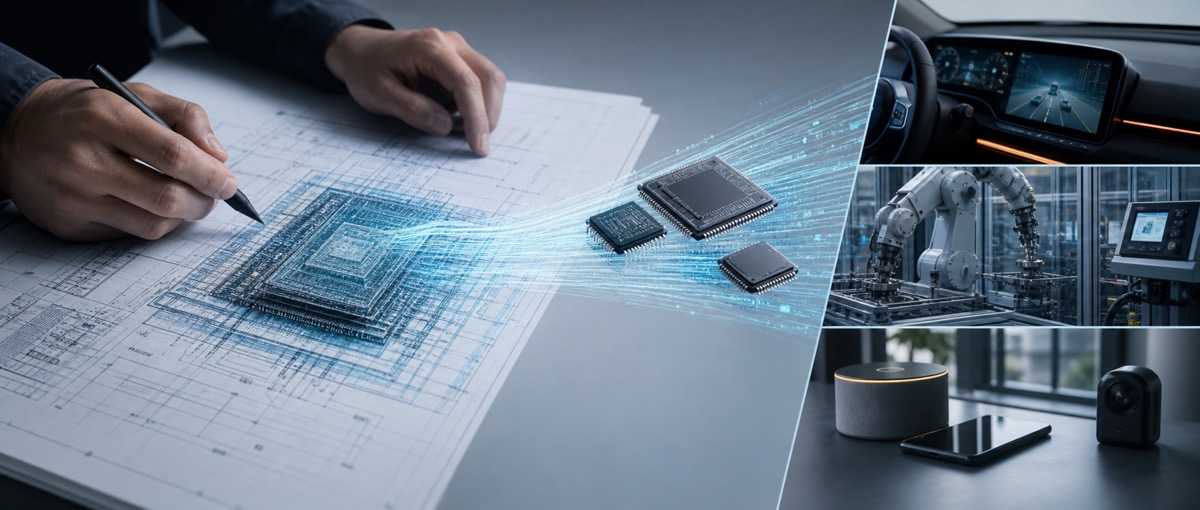
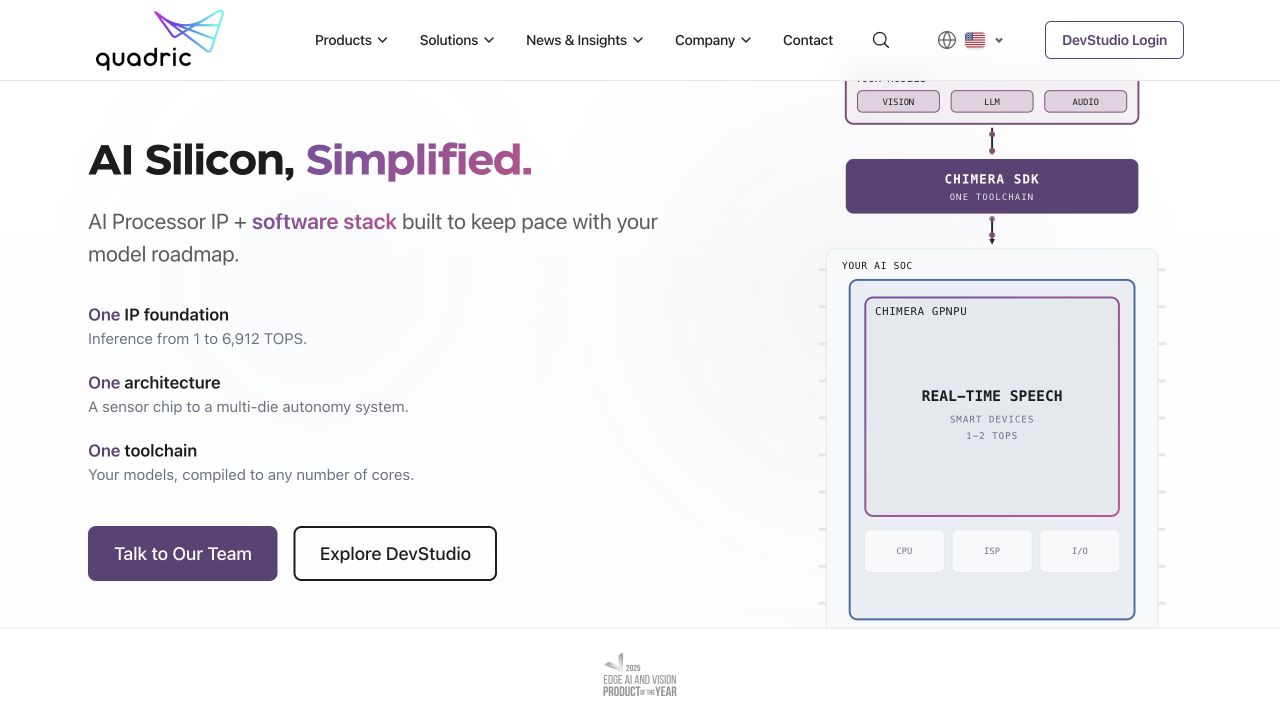
Image source: Quadric official site. The image shows the Chimera development flow from models and SDKs into a customer’s AI SoC.
In 2024, DENSO made a decision for a future automotive chip: it licensed AI processor IP from Quadric. The end product was not yet in mass production. The models it would need to run years later were not knowable. But the chip architecture decision had to start.
That is the difficult time gap for hardware companies. AI models can change in months. Chips for cars, industrial equipment, printers, or edge devices take years to design, verify, and produce, and then they keep operating for many more years. Choose the wrong architecture today, and the cost may appear only after the product reaches the field.
Quadric sells an AI processor blueprint that can be embedded into a customer’s SoC, plus compilers and development tools. The chipmaker saves the time of building an NPU from scratch and keeps more flexibility to support new models after hardware design is frozen.
The customer is buying optionality around an expensive decision.
That optionality has already produced revenue. Quadric’s CEO told TechCrunch that the company generated $15 million to $20 million in licensing revenue in 2025, up from about $4 million in 2024. Those figures are company-disclosed and not independently audited. Still, public license agreements with DENSO and Kyocera show that real chip programs have been willing to adopt the technology.
One contract is a bet on models years away
DENSO’s announcement reveals the core of the purchase. DENSO and Quadric would jointly develop NPU IP for automotive SoCs. DENSO needed an architecture that could handle future algorithm changes. Fixed-function hardware built only around today’s vision models would not cover the full life of the decision.
For automotive chips, the choice is especially heavy. Models can be updated. A chip inside a sold vehicle cannot be redesigned. Whether the processor is programmable, and whether the toolchain can keep supporting new operators, determines whether the chip remains useful years later.
Kyocera also confirmed in 2025 that it licensed Quadric’s Chimera GPNPU. Neither contract disclosed dollar value, but both give Quadric a stronger validation signal than funding alone: customers are willing to put external IP into long-cycle, high-cost core projects.
The blueprint charges before production
A traditional chip company may wait for tape-out, inventory, and product sales before seeing meaningful revenue. Quadric delivers design assets. It can collect license fees after signing without taking wafer manufacturing or inventory risk. The first revenue can arrive before any car or device containing the technology exists.
After the customer product reaches production, Quadric may also collect royalties on shipments. The design therefore has two layers of value. License fees charge for the customer’s R&D decision. Royalties share in later production volume.
This structure helps explain the revenue jump from about $4 million to $15 million to $20 million. Quadric turns a long hardware waiting period into a product that can be sold earlier.
The second layer remains unproven until customer products ship. Quadric expects the first products with its IP to appear in 2026. The royalty story will need real unit volume to become more than a promise.
Software determines how long the blueprint sells
Quadric’s Chimera SDK handles model import, compilation, profiling, and deployment. The public support story has moved beyond older convolutional networks toward models such as Qwen, DeepSeek, Whisper, and vision-language-action models. The model list will keep changing. The toolchain’s ability to let existing silicon catch those changes is what gives the license durable value.
Before the chip exists, the customer still has to estimate whether the architecture can hit performance and power targets. Quadric says its instruction-set simulator can estimate cycles, power, and bandwidth before physical silicon or a development board is available. These are company claims, but they address a real purchasing obstacle: buyers must evaluate a decision that will not be fully proven for years.
Once engineering teams build operators, performance baselines, and workflows around the SDK, switching processor IP becomes expensive. Quadric’s moat is not only the processor architecture. It is also the software path that engineers adopt before and after production.
The next test is the production line
Quadric has licensing revenue, but the first products using the IP still need to ship. That gap is both the business opportunity and the risk.
DENSO must decide before tape-out whether Chimera can support models that will matter years later. Quadric uses simulation to let engineers observe cycles, power, and bandwidth early, then uses the SDK to keep model and operator work inside its toolchain. When customers begin the next chip program, that engineering investment may pull Quadric forward.
But license agreements do not reveal unit economics. A design win is not the same as high-volume shipment. Customer delays can delay royalties. If new models require operators the architecture cannot support efficiently, the word “programmable” will be tested again.
The reported licensing revenue proves that customers have signed. It does not yet prove that the IP will collect royalties across many years of end products.
Quadric’s broader lesson is still sharp. In AI hardware, customers often pay before the future is visible. The best product may not be a finished chip. It may be the right to keep changing the software interpretation of a chip after the physical decision has already been made.