
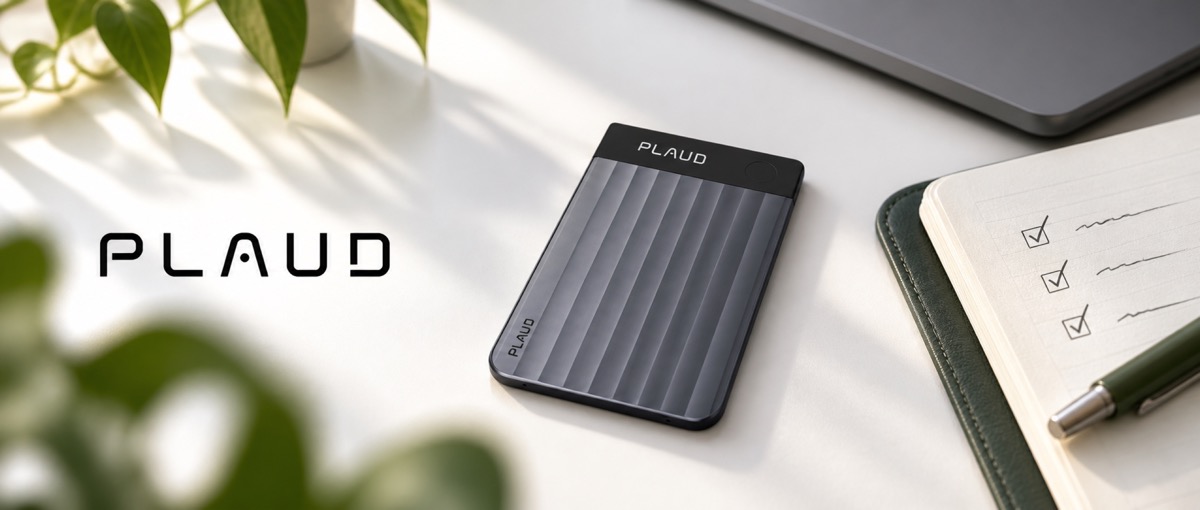
In July 2025, PLAUD founder Tianhong Xu sat down with a Forbes reporter in an Amsterdam cafe, asked for permission, and clipped a small recording device to his clothing. The conversation continued as usual. The device captured the audio, and the software later turned that audio into a transcript and summary. Forbes described that interview scene. What Xu was carrying was not an assistant that needed constant prompting. It was a tool designed to make the work of remembering disappear for a while.
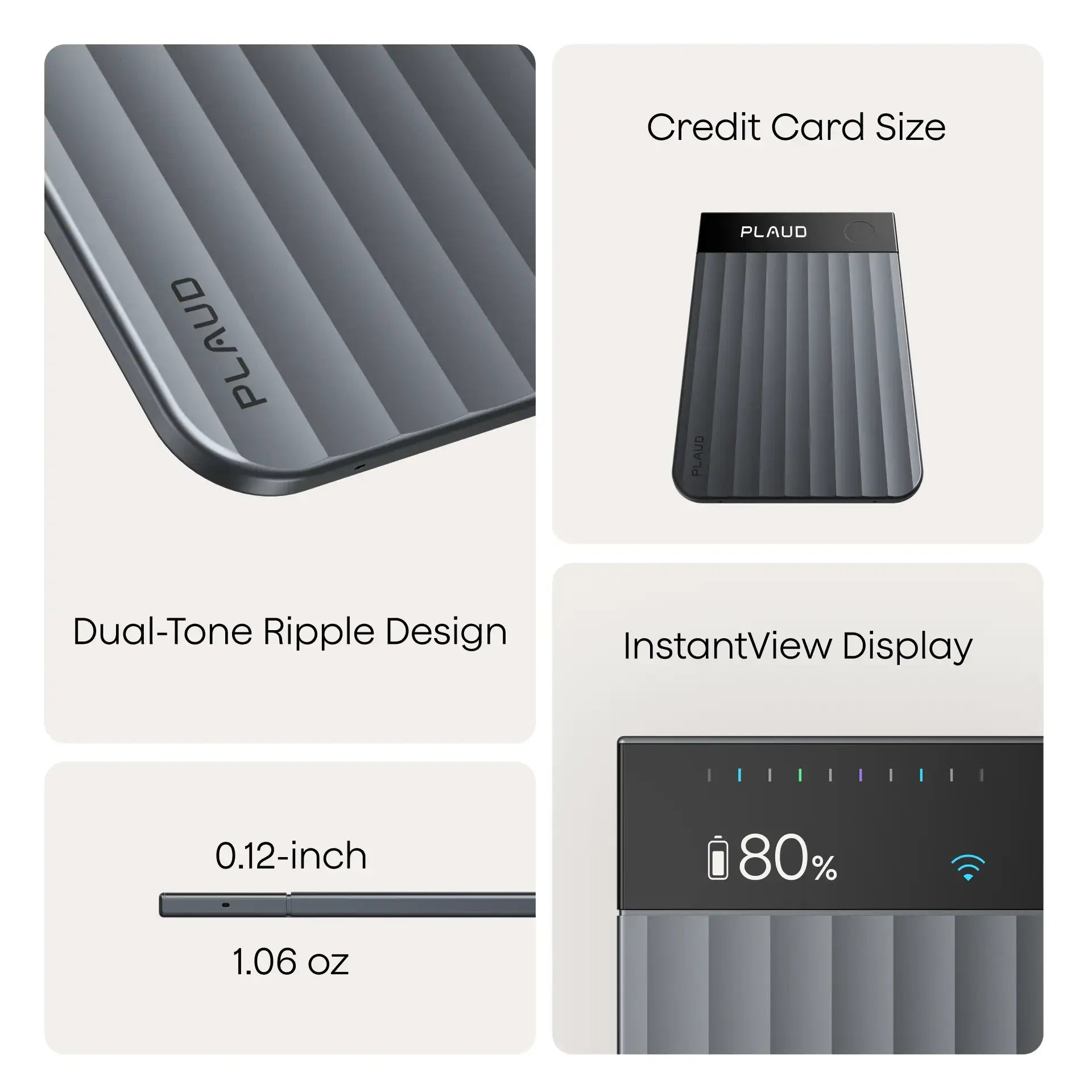
The obvious objection is simple: phones already record audio. Why would someone buy another piece of hardware, then pay again for software?
PLAUD has already turned that two-step question into a scaled business. In June 2026, the company said its software subscription business had passed $100 million in annual recurring revenue and that it had shipped more than 2 million AI notetakers. TechCrunch reported those company-disclosed figures; they should be treated as company figures rather than independently audited financials.
The useful way to understand the product is to start with a small feature PLAUD later added to the recorder: when something important happens, press a button.
Recording Everything Is Not The Same As Remembering What Matters
In August 2025, PLAUD announced Note Pro. The company did not only talk about sound quality and battery life. It added a way to mark key moments during recording: when users hear something that matters, they can press the device and leave a marker for the later AI summary. The launch material describes this as real-time human-AI alignment.
The action is small, but the problem is real. In the same meeting, a salesperson may care about when the customer is ready to buy, while an engineer may care about whether the requirement changed. The person who talks the most is not always the person who says the most important sentence. A throwaway comment can determine the next week of work.
If AI is asked to infer importance only from a full recording, it must also guess the listener’s goal. Pressing once gives the system a clearer signal: pay attention here.
The Tech Revolutionist’s January 2026 review treated the highlight feature as one of Note Pro’s useful improvements. The reviewer used the device in settings such as desktop group conversations and phone calls, and noted that markers gave long meetings review points instead of leaving the user with only a full transcript.
This is not a new AI capability added for its own sake. PLAUD moves part of the work that normally happens after a meeting, finding the important moments, into the moment when the user still knows why that sentence matters.
Audio Cannot Understand Every “This” In A Room
Audio has another natural gap: it cannot see the room.
When people discuss a design, someone may point at a chart and say, “this part needs to change.” When pricing comes up, someone may pull up a spreadsheet. A transcript can capture every word and still leave the reader with a pile of “this” and “that.”
PLAUD’s answer is to let users combine photos, text notes, and recording context. The product page shows the idea plainly: one moment is highlighted, another moment gets a photo, and another gets a written note. They sit along the conversation timeline rather than being scattered across a photo library and a notes app. PLAUD says these inputs are organized by the software.
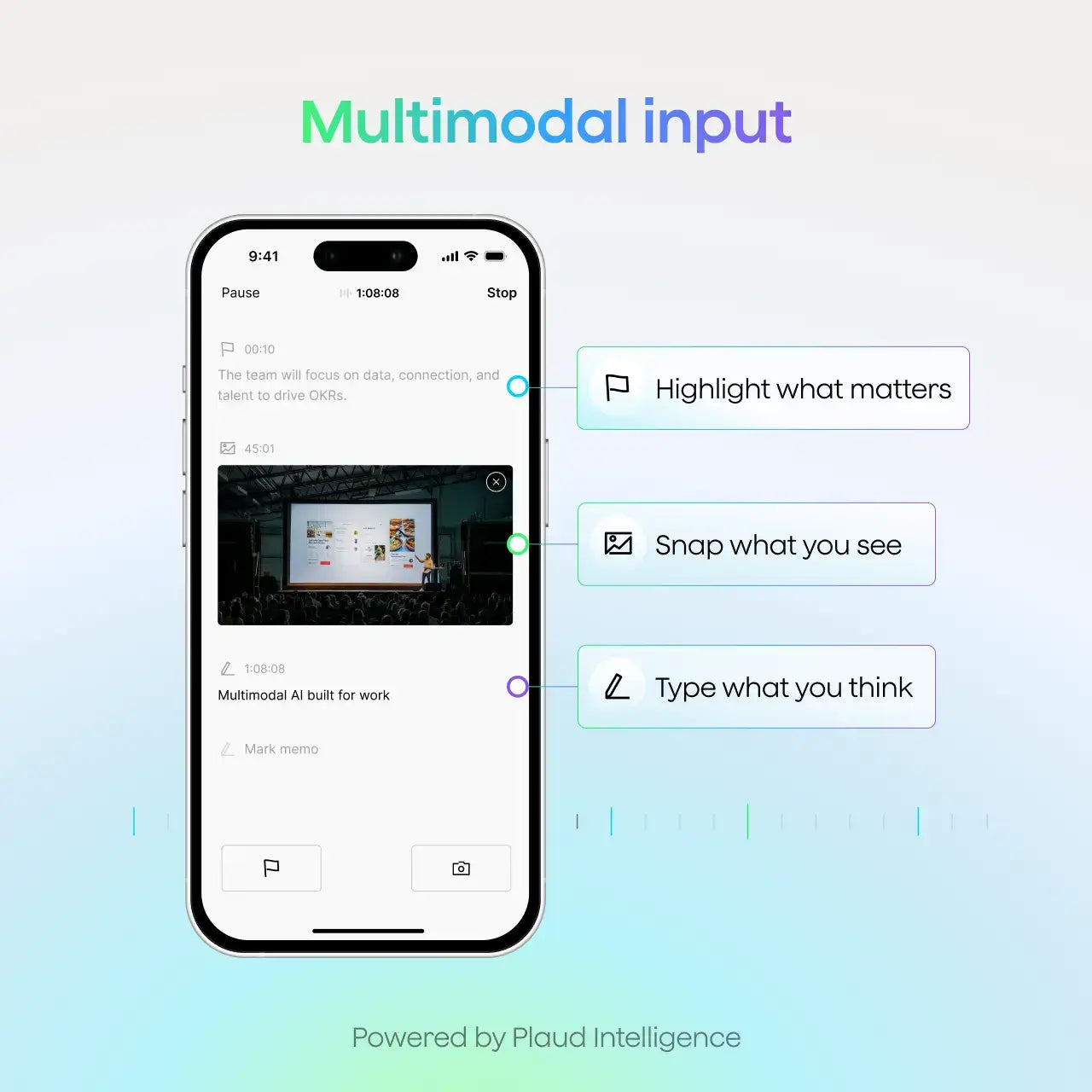
The product lesson is not just “support multiple input types.” The sharper point is that the user avoids one round of reconstruction. After the meeting, they do not have to remember which photo belonged to which part of the discussion.
Many AI tools treat material collection as a prerequisite. Users find files, upload them, add context, and then ask a question. PLAUD tries to move that preparation into the live conversation. The button keeps the important moment. The photo keeps the visual reference. The recorder keeps the original words.
That gives the hardware a reason to exist beyond phone recording. It makes capture easy to start. The connected software then handles the details that audio alone cannot explain.
A Summary Also Needs A Route Back To The Original Words
A neat summary is still not enough.
If a meeting note turns “aim to finish by Friday” into “will finish by Friday,” the writing is cleaner but the commitment has changed. Work records are vulnerable to exactly that kind of small shift, because the next email, plan, or deadline may rely on the note.
PLAUD’s Ask Plaud design gives answers that can be traced back to the original recording. In the company’s launch demonstration, a user asks about a version timeline and the answer includes source context; opening it shows the speaker, timestamp, and matching transcript segment. The launch material describes source-backed answers inside Ask Plaud.
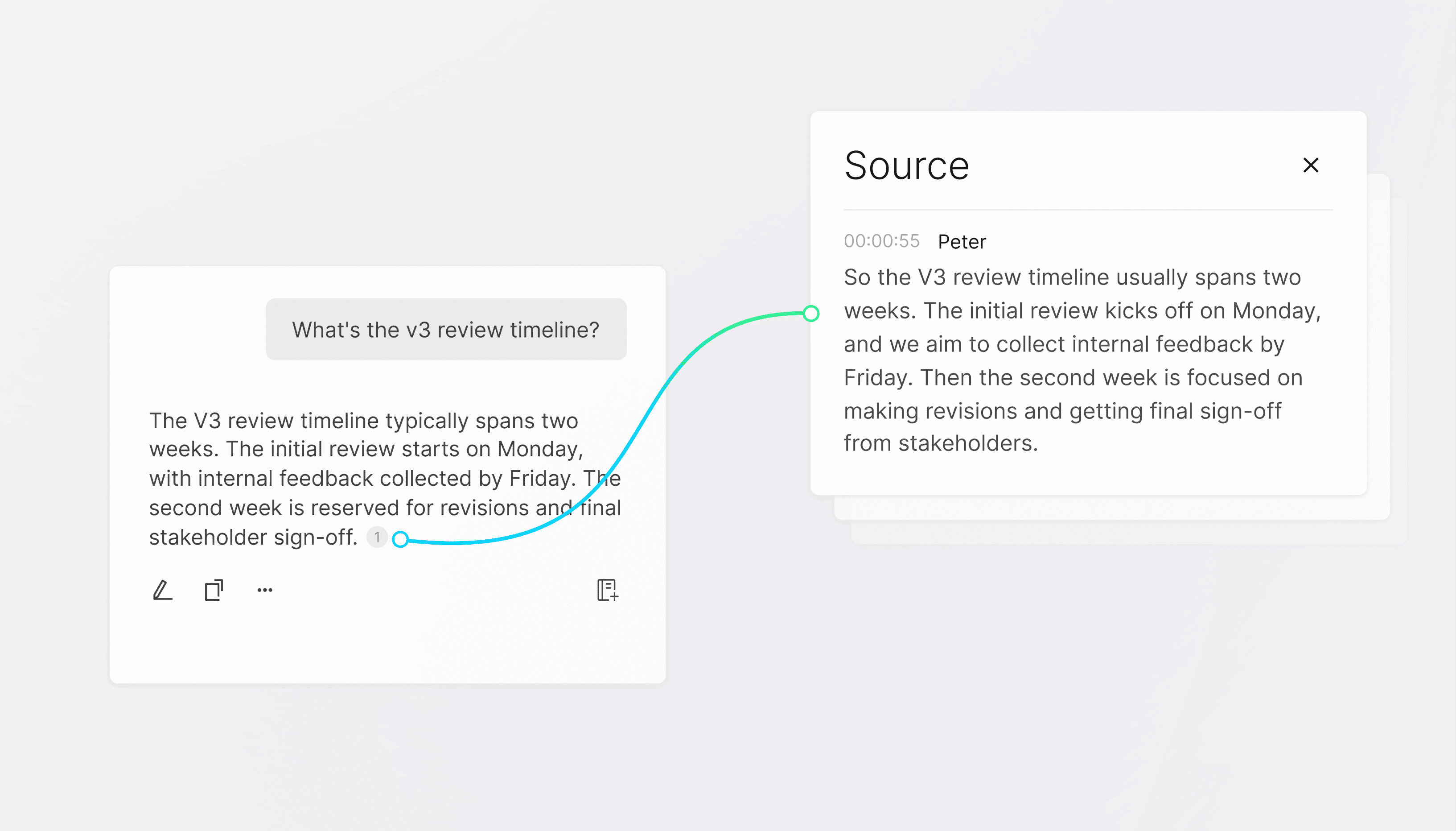
This does not make AI unable to err. It gives the user a path to check. For someone who is using the summary to assign work, confirm scope, or write a follow-up, “where did this sentence come from?” can matter more than whether the summary sounds polished.
By this point, the service PLAUD sells is more complete: record the conversation, mark the key moments while they happen, ask questions afterward, and return to the original words when the answer matters. The user is not just buying an audio file.
The Second Sale Is Priced By Conversation Workload
How does PLAUD charge for that service? It does not require every device buyer to subscribe immediately.
According to the current US pricing page, the free plan includes 300 transcription minutes per month. Pro includes 1,200 minutes and costs $99.99 per year. Unlimited costs $239.99 per year. Both paid plans also have monthly options, listed at $17.99 and $29.99.
Three hundred minutes is five hours. For an occasional interview, the free allowance may be enough. For someone with several long meetings a week, the workload is different. If one meeting lasts an hour, the free tier covers about five meetings. Pro covers about twenty. The paid boundary is easy for users to map against their calendar.
The hardware first reaches people who already have a recording need. The free allowance lets them experience the full path from capture to summary. Then heavier users pay for more processing capacity. That is easier to explain than selling every buyer an abstract AI membership before they have felt the workload.
One clause also matters: PLAUD says that when a paid plan is canceled, the account returns to the free tier and existing recordings and transcripts are not deleted. Users can keep their past records and decide later whether the next batch of work is worth paying for.
The business is most interesting in the space between the two purchases. First, users buy a device to make sure the conversation is captured. Then they buy software to make the captured conversation usable. Both payments are attached to connected jobs inside the same meeting. That is why PLAUD’s software revenue can stand apart from the hardware sale.