
On August 5, 2026, Proxy Foods AI announced a $6 million seed round. The round itself is not the most interesting part. The more revealing signal is who the company says it is selling to. Business Wire reported that Proxy Foods has expanded to customers or industry partners including Barilla, Gefsinus, MISTA, and CAVA, and the company says its average platform customer has more than $1 billion in annual revenue.
This is not a consumer app for generating recipes. It is not a tool for giving brand marketers a few more product concepts. Proxy Foods is entering one of the heaviest, slowest, and most expensive workflows inside food and beverage companies: new product development and reformulation.
Taking a food product from concept to shelf is not just a matter of imagining a flavor. R&D teams have to trade off taste, texture, nutrition, cost, shelf life, allergens, supply chain availability, manufacturing process, and regulations across different markets. Reduce sugar and the mouthfeel may collapse. Increase protein and the texture may turn chalky. Swap one ingredient and the cost may fall, while production-line parameters become unstable. Often, the problem is not a lack of ideas. The problem is that every idea demands another round of prototypes, testing, adjustment, and review.
Proxy Foods wants to move part of that work upstream. Before the team enters the lab, software should eliminate a batch of formulas that are not worth trying.
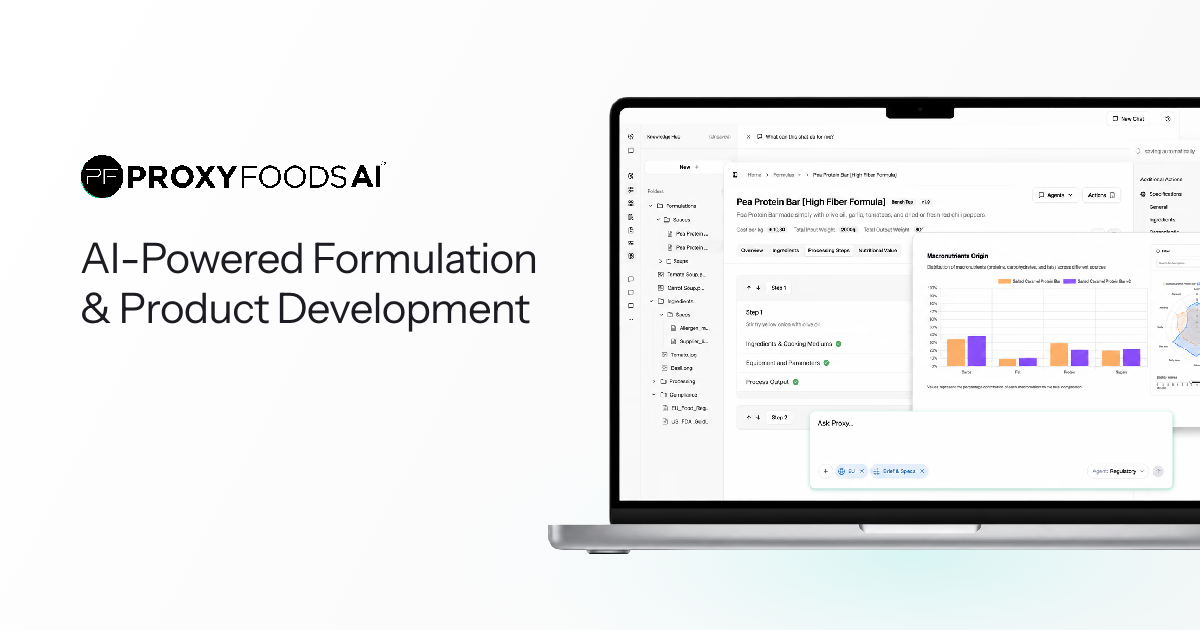
Proxy Foods describes itself as an AI-powered formulation and product development platform for food and beverage R&D teams. The workflow shown on its website is not an empty chat box. It is organized around formulas, ingredients, processing steps, nutrition values, sensory evaluation, and regulatory requirements.
That distinction matters. Food R&D is not a writing task, and it cannot be solved by generating more versions of text. A formula has to be manufacturable. It has to pass internal quality standards. It has to comply with rules in different markets. It also has to work in the consumer’s mouth. Proxy Foods therefore looks less like a general AI assistant and more like a system built for R&D judgment.
The company lists Proxy agents such as Recipe Formulation, Food Scientist, Processing Optimizer, Regulatory Compliance, Ideation/Concepting, and Data Analyst. In business language, it is trying to pull several previously separate roles into one product development flow: one layer handles formulation, another supplies food science reasoning, another watches production process, another checks regulation, and another reads experimental data.
This is also the boundary between Proxy Foods and a generic ChatGPT-style tool. The most valuable data inside a food company is usually not sitting on public web pages. It lives in historical formulas, ingredient specifications, production experience, sensory tests, and internal records of failed experiments. Proxy Foods says its platform is built on more than one million formulas and more than five million product records, and that it can connect to enterprise systems so AI can adapt to a company’s products, consumers, and R&D process. Those claims are company statements and have not been independently audited, but they explain why the product moves from “content generation” toward “managing R&D decisions.”
The reason food companies may pay is not just saving a few hours.
In the Business Wire announcement, Proxy Foods said customers have achieved 80% fewer iterations in new product development and reformulation, 2% to 10% lower reformulation costs, prototype timelines compressed from months to days, and that one incremental successful launch can pay back the platform investment. The Proxy Foods website gives similarly direct metrics: 80% fewer iterations, 70% less regulatory validation time, a first prototype in three days, and 20% lower formulation cost. These numbers come from the company or its website and should not be treated as universal results. They do, however, point to a clear procurement reason: food R&D teams are not buying “advanced AI”; they are buying fewer wrong experiments.
For a large food company, that reason is very concrete.
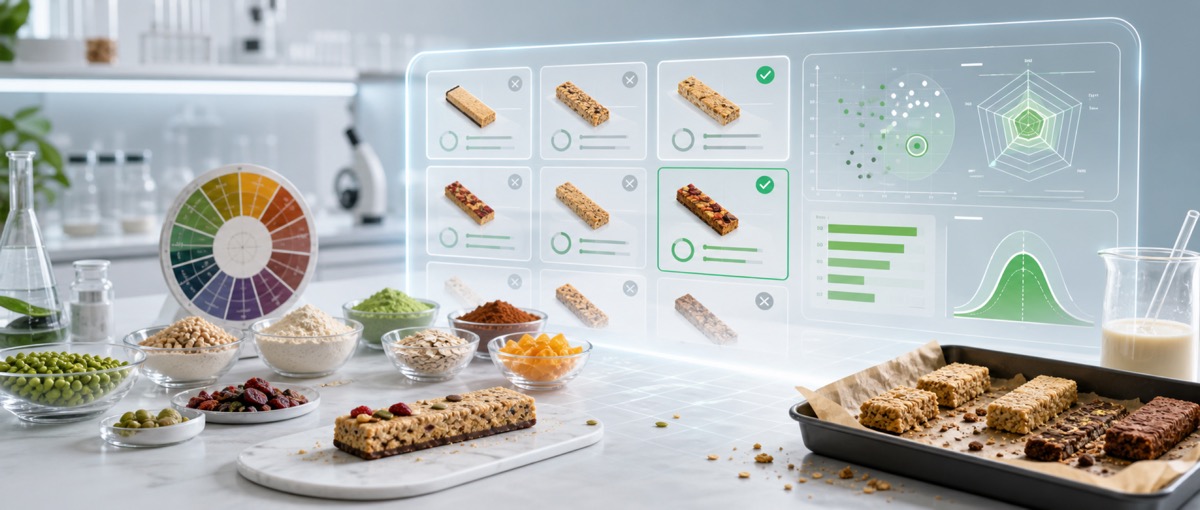
Imagine a team reformulating a protein bar so it has more protein, less sugar, the same mouthfeel, and lower cost. The traditional path is for R&D staff to use experience to design several directions, prototype them, test them, adjust them, and prototype again. Every round consumes ingredients, lab time, sensory evaluation, cross-functional coordination, and opportunity cost. If AI can tell the team which combinations are more likely to fail and which directions deserve lab time, the value is not just efficiency. It is a reallocation of scarce R&D capacity.
The non-obvious part of Proxy Foods is that it does not package food AI as a creativity machine. It turns the dull cost of trial and error into the product’s main economic argument.
There is some technical support for that argument. Food System Innovations launched the Food Intelligence Lab in 2026 to use machine learning to improve the taste and texture of sustainable protein products. Related coverage said the lab has worked with Proxy Foods to test Expert-Guided Bayesian Optimization, a method that keeps human experts in the optimization loop. In a plant-based Greek yogurt test, the system ran five days and 10 formulation rounds, improved sensory performance by 29%, and produced a final product that approached the animal-based benchmark on thickness, creaminess, and sourness.
Dan Jurafsky’s Stanford page also lists “Expert-guided Bayesian optimization for sustainable protein design” as an ICML 2026 Workshop AI4Science paper. This does not mean Proxy Foods can automatically solve every food R&D problem. It does show that the company is not merely wrapping a large language model in a form. It is trying to shorten the experimentation loop through food science, experimental design, machine learning, and human expertise.
From a commercialization perspective, Proxy Foods looks like sales-led enterprise software. The website has Book a Demo and login entry points, but no public price list. For large CPG and restaurant customers, that makes sense. Each company has different internal formula libraries, regulatory markets, production lines, food safety constraints, and data-access requirements. Procurement is likely to involve pilots, system integrations, security reviews, and ROI evaluation.
The expansion path for this type of product will not look like a consumer AI tool that breaks out through one beautiful feature. A more likely path is narrower and slower: enter through one new product or reformulation project, prove that the team can remove several trial rounds, connect more historical formulas and experimental data, and then become a recurring workbench for the internal R&D organization. At that point, Proxy Foods is no longer selling one-off optimization. It is selling a way to organize food development knowledge.
The risks are obvious.
First, food R&D depends heavily on enterprise data. Without clean enough formula, ingredient, process, and sensory data, AI recommendations can stay at the level of “seems reasonable.” The more Proxy Foods moves into large accounts, the more data integration and governance cost it will inherit.
Second, the outcome metrics on the website should be read carefully. Fewer iterations, a three-day prototype, and lower formulation cost are attractive claims, but they are mainly company-disclosed figures. Categories vary widely. Yogurt, protein bars, beverages, sauces, and pet food do not fail in the same way.
Third, the real purchasing decision may depend less on model capability than on trust. Food companies will not casually give a new platform access to core formulas and R&D data. Proxy Foods emphasizes ISO 27001, enterprise security, Zero Trust, and encrypted compute. That tells us the company understands the sales reality: the closer the product gets to core R&D, the more security and compliance become prerequisites rather than features.
Those limits are exactly why the case is useful.
Many AI products still sit in the familiar promise of helping employees write faster or think of more ideas. Proxy Foods shows another vertical AI path: find an industry workflow where trial and error is already expensive, place AI before the trial, and help customers spend less money, avoid bad paths, and reserve lab time for higher-probability ideas.
For AI product builders, the lesson is not about food alone. It is about the entry point. A strong AI product does not always have to create the final work product for the customer. It can reduce the number of wrong attempts before the customer commits resources. In R&D, engineering, healthcare, industry, and supply chain, the budget is often not unlocked by “give me an answer.” It is unlocked by “do not let me invest scarce resources in the wrong direction.”
“Fewer trial rounds in food R&D” may not sound glamorous. But if those rounds represent months of cycle time, dozens of people, one product launch window, and the cost of a production line, they are enough to become a real AI software business.
Reference Sources
- Business Wire: Proxy Foods AI Raises $6M Seed Round to Accelerate AI-Native Food and Beverage Development Platform: https://www.businesswire.com/news/home/20260805888751/en/Proxy-Foods-AI-Raises-%246M-Seed-Round-to-Accelerate-AI-Native-Food-and-Beverage-Development-Platform
- Proxy Foods website: https://proxyfoods.ai/
- Complete AI Training: Food System Innovations launches Food Intelligence Lab to build open-source AI for sustainable protein: https://completeaitraining.com/news/food-system-innovations-launches-food-intelligence-lab-to/
- Dan Jurafsky Stanford page: https://web.stanford.edu/~jurafsky/?source=post_page---------------------------