
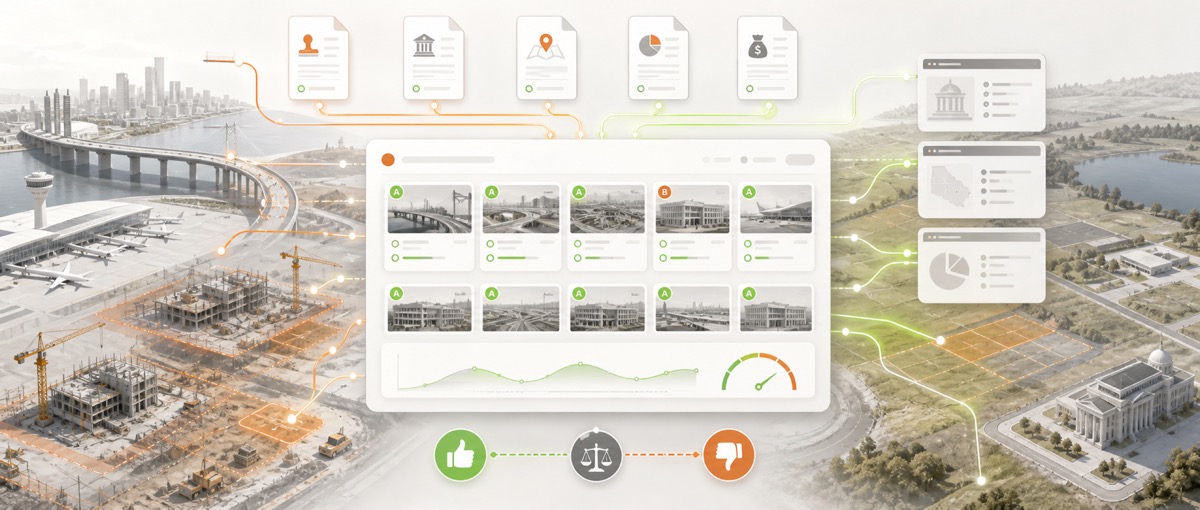
The most expensive failure for a construction company is not always losing a bid. Sometimes it is never knowing the project existed.
On July 22, 2026, TechCrunch reported that Cascade, a New York AI startup, had raised a $3.5 million seed round from investors including Andreessen Horowitz Speedrun, Ada Ventures, and Snowball VC. Cascade is not building generic project management software, and it is not merely adding AI to proposal writing. It helps architecture, engineering, and construction firms discover projects earlier and win more of the right ones.
One detail in the report matters more than the size of the round: Cascade already had signed contract customers, including companies that had built JFK, LaGuardia Airport, Four Seasons hotels, and data centers. For a native AI product launched in 2025, that customer profile is the signal. It shows the company is selling into a workflow where the pain is already clear.
AEC revenue does not originate inside a clean CRM. Project opportunities are scattered across state, city, county, school district, and federal portals. They hide inside budget announcements, capital plans, permits, land transactions, meeting minutes, and developer relationships. When the formal RFP appears, many firms are only starting to gather information. The best-prepared competitors may have known months earlier who was buying land, where a bridge might be funded, or which agency was preparing to release money.
Cascade is attacking that timing gap.
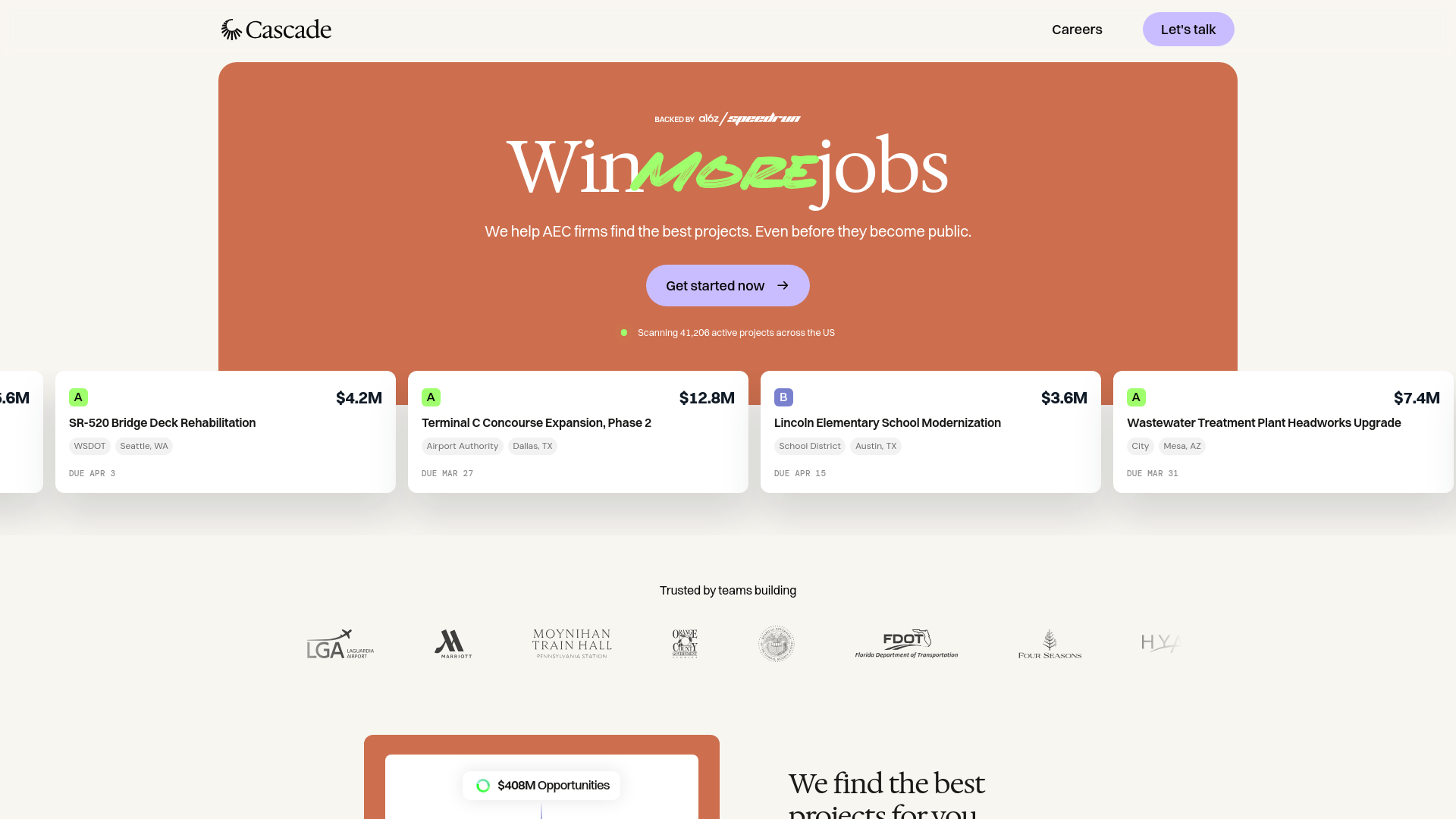
Cascade’s website describes the promise directly: AI surfaces RFPs that match a firm’s capabilities and helps teams make go/no-go decisions in minutes instead of days. The company also claims that teams can see their first opportunities in five minutes, start with zero integration, and uncover more than $120 million in additional monthly project opportunities. Those are company claims, not independently audited results, but they explain the wedge.
This is not a “make the proposal sound better” tool.
Proposal generation is part of Cascade. Its website lists Proposal Writing and Project Spec Analysis as live capabilities. The first helps draft proposals; the second analyzes project specifications, clarifies scope, and flags inconsistencies. But if you only look at that layer, you miss the product’s commercial position. Cascade wants to own the upstream work that happens before the proposal: project discovery, project prediction, fit scoring, relationship paths, and teaming opportunities.
In TechCrunch’s article, co-founder Hannia Zia described project hunting in construction as a constant treasure hunt. If a firm specializes in suspension bridges, it must search across state, city, district, county, and federal portals one by one. Cascade connects those fragmented signals, then uses historical bid data and project characteristics to judge which opportunities fit the firm and which developers are most likely to win a newly funded project.
The example from the reporting is useful. If a state announces a $100 million affordable housing grant, Cascade can look at who won similar grants in the past, infer which developers may be likely winners this time, and tell a customer whom to contact now.
The value is not writing a prettier sales email. It is moving the question of “who should sales talk to?” earlier in the process.
The Next Web added another layer of evidence. Cascade said its customers had discovered more than $10 billion in project opportunities through the platform. That number is also company-disclosed and unaudited. But the same article cited a more concrete customer story: Tim Johannesson, a principal at luxury architecture firm Smallwood, said Cascade helped the firm discover and win a $6 million project it otherwise would not have seen.
That is the kind of vertical AI opportunity that is easy to underestimate. The product does not replace the customer’s deepest professional expertise. It compensates for an information asymmetry around that expertise.
Construction firms are good at construction, design, engineering, cost control, resource organization, and delivery. They are not advantaged by asking business development teams to open 20 websites every Monday and copy RFP snippets into spreadsheets. Cascade’s own customer quotes point to the same pain. One general contractor says it previously tracked more than 20 websites for RFPs. Another business development leader says the team used to spend half a day every Monday opening portals and moving information into a spreadsheet, while more relevant opportunities can now surface directly.
Those quotes are company-hosted evidence, so they should not be treated as neutral third-party proof. But they explain why Cascade can sell into AEC firms without first convincing buyers that AI is useful. It is taking on a tedious, expensive, already painful workflow that teams do not want to keep doing manually.
The product has three layers.
The first layer is discovery. Government Project Finder is already available and scans state, local, and federal websites, then matches opportunities by scope, timeline, and historical projects. Cascade also marks Pre-Bid Intelligence and Private Market Signals as upcoming products. Those would look earlier than public RFPs by reading budget announcements, tax changes, government meeting minutes, land purchases, permits, and tax incentives.
The second layer is judgment. More opportunities are not automatically better. AEC firms can burn scarce proposal capacity on projects they have little chance to win. Cascade scores opportunities so teams can make go/no-go decisions in minutes. That step matters because it changes how bid teams allocate labor, executive attention, and partner conversations.
The third layer is delivery. Proposal writing, specification analysis, future bid leveling, and team-up workflows move a project from “found” toward “won.” If the chain works, Cascade is not just a lead tool. It becomes a workflow that stretches from the front edge of business development to the revenue outcome.
That is also how Cascade differs from older bid databases. Traditional tools often behave like project directories. Customers search, filter, judge, copy, and follow up on their own. Cascade is closer to a pursuit operating system: it reads external signals, decides what a specific firm should pursue, and then helps organize the work needed to win.
The commercialization logic becomes clearer once you see that position.
Cascade does not disclose pricing, ARR, customer count, or retention. Its website uses a sales-led “Let’s talk” motion, which suggests the company is still selling through direct conversations rather than a fully self-serve funnel. But TechCrunch’s report of signed contract customers, The Next Web’s $6 million customer win anecdote, and Cascade’s claim that one successful project can cover years of cost all point to an ROI story that fits AEC buying behavior.
The point is not that the software is cheap. The point is that the buying case is aligned with revenue.
Many AI products sell from efficiency: save hours, reduce manual work, shorten a cycle. Cascade can make that argument too by reducing go/no-go research time and accelerating proposal work. But the stronger pitch is different: see projects you would otherwise miss. For a construction or engineering firm, one incremental $6 million project is easier for leadership to understand than a weekly time-saving metric.
The risks are also clear.
First, project opportunity is not the same as revenue. Claims such as $10 billion in discovered opportunities or $120 million in additional monthly opportunity volume sound large, but without conversion rates, win rates, and retention, they remain early company metrics.
Second, AEC is regional and relationship-heavy. Procurement rules, qualification thresholds, political context, developer networks, and local partner dynamics can vary sharply by market. A signal that works in one city may not work in another state. Cascade has to prove that its data coverage and scoring logic can transfer across regions without becoming a brittle local consulting product.
Third, competition is not limited to AI startups. GovWin IQ, ConstructConnect, and other incumbent platforms have operated in bid discovery for years. Cascade must prove that “AI-native” is not just positioning. It has to show earlier discovery, better fit scoring, higher win rates, or a tighter workflow loop.
That tension is exactly why the case is worth studying. Cascade is not adding AI to an existing button. It is rearranging the revenue front office for an industry where project knowledge arrives before formal demand.
For AI builders, the lesson is specific. Vertical AI does not always have to start with a document the customer is already writing. It can start with an opportunity the customer has not yet noticed. The company that can read fragmented outside-world signals earlier may earn a place in the decision chain before the customer even creates the task.
Writing the proposal is downstream. Finding the right project is upstream.
Cascade is betting that, in construction, the first valuable AI is not the one that makes a proposal sound more polished. It is the one that tells the firm: this project is about to appear, and you should move now.
Sources
- TechCrunch: Cascade raises $3.5M to help construction firms find and win projects: https://techcrunch.com/2026/07/22/cascade-raises-3-5m-to-help-construction-firms-find-and-win-projects/
- The Next Web: Cascade raises $3.5M to spot construction projects before the bid exists: https://thenextweb.com/news/cascade-3-5m-construction-pursuit-ai
- Yahoo Finance / GlobeNewswire: Cascade raises $3.5M to help construction firms predict the future and win more projects: https://finance.yahoo.com/technology/ai/articles/cascade-raises-3-5m-help-133000964.html
- Cascade: https://www.usecascade.ai/