
On July 15, 2026, TechCrunch reported that San Francisco voice AI company Rime had raised a $24 million Series A. The easiest line to overlook in that funding story is that Rime had already won enterprise customers including Mayo Clinic, Dialpad, Upstart, and Asurion.
This is not another story about somebody building an AI customer-service agent.
Over the last two years, the front stage of voice AI has been busy. Vapi, Retell, and LiveKit are building infrastructure. Decagon and Sierra are building support agents. ElevenLabs and Deepgram are expanding across voice and speech models. Large companies want AI to handle sales calls, marketing calls, support calls, appointments, restaurant orders, and insurance workflows. But real phone calls are much harder than demos: callers interrupt, backgrounds are noisy, proprietary terms are mispronounced, latency makes conversations feel like old IVR systems, and compliance teams ask where the data actually runs.
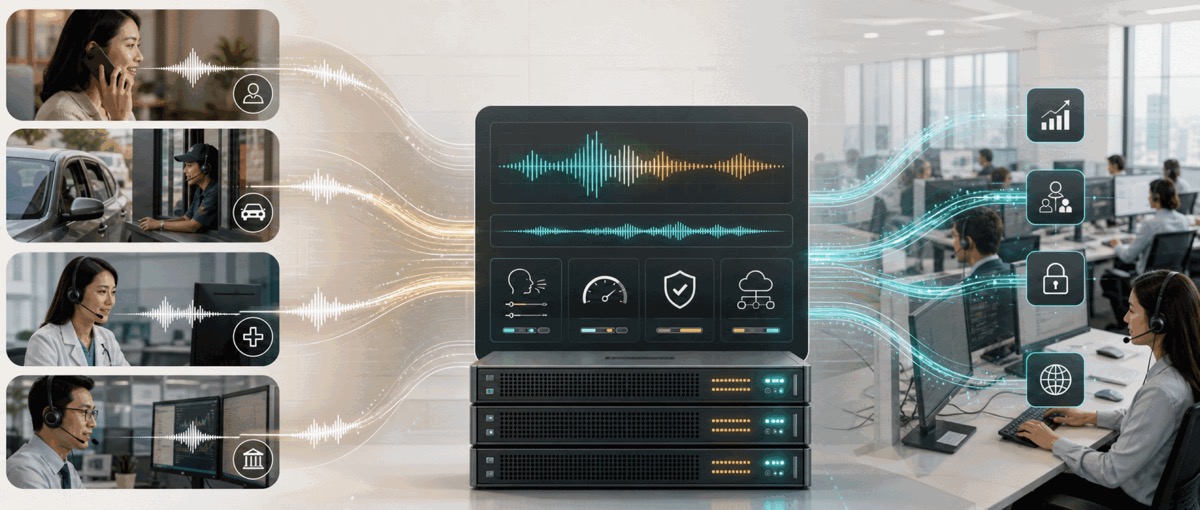
Rime is not entering as a complete support application. It is working one layer lower: the voice and real-time interaction model for enterprise voice agents.
That layer sounds like an aesthetic problem. It is actually a business problem. On a phone call, the voice is the interface. Patients, cardholders, restaurant guests, and hotel customers do not care which large model sits behind the call. They judge whether the call feels natural, credible, and worth continuing.

Rime describes its product as AI voice models for real-time conversations. Its website says it offers more than 600 voices and more than 50 languages. It lets companies adjust accent, pace, and tone, and control pronunciation for brand names, addresses, alphanumeric strings, and domain-specific terms. It also emphasizes low latency, streaming output, and deployment in the cloud, a VPC, or a customer’s own environment. These product claims come from Rime’s website and have not been independently audited.
The more important point is that Rime has turned this capability into something companies can buy, test, and scale.
Rime’s pricing page lists Starter pricing from $0.03 per 1,000 characters, or about $0.03 per minute of audio. Enterprise plans use custom large-scale pricing and include unlimited concurrency, custom voice cloning, SLAs, dedicated support, cloud, VPC or on-prem deployment, HIPAA BAA, and SOC 2 reports. This pricing is company-sourced and not independently audited, but it shows that Rime is not only selling bespoke voice projects. It is packaging the voice model as a metered API.
That packaging matters. For a voice-agent company selling into enterprise production, the hardest part is often not making a demo work. It is getting that demo into real operations. A production voice model has to answer a specific set of questions: can it respond with low latency on a call? Can it reliably pronounce drug names, menu items, financial products, and brand names? Can it adjust to regional accents? Can it hold up under high concurrency? Can it run locally or in a VPC for medical and financial use cases? Can the company test with small usage first, then scale with call volume?
Rime’s commercialization path is organized around those questions.
TechCrunch reported that Rime does not simply scrape web audio to train voices. Instead, it built a recording studio in San Francisco to collect its own conversational data. It also uses a phoneme-based architecture, with the goal of adapting to different pronunciations and reducing the burden on customers who would otherwise need to retrain models for industry vocabulary.
Behind that detail is a real gap in voice AI. Enterprise phone calls are not podcasts or short-form video voiceovers. They contain many words that cannot be misread. Healthcare providers, banks, insurers, and restaurant brands cannot accept an AI that pronounces key terms like outsourced recording software. Naturalness matters, but determinism matters more.
Rime’s anonymous Fortune 500 customer case gives one example. The customer was a large equipment protection, repair, and insurance company whose button-based IVR had stalled at 50% call containment. According to Rime’s website, the customer first used Rime’s AI voices to train agents by simulating callers with different tones and accents. Rime says newly trained agents improved sales by 23% in the early rollout. The customer then expanded testing into consumer-facing voice interaction and found, across 30 voices, that users were more willing to continue speaking with a younger female voice that sounded more natural and relatable. This case is company-published and anonymous, and it has not been independently audited.
Another case comes from ConverseNow. Rime says ConverseNow provides phone and drive-thru voice AI for restaurant brands including Domino’s, Hardee’s, and Wingstop. As ConverseNow entered different regions, franchise operators and customers had different expectations for naturalness, accent, and clarity. Rime’s role was not to take over the full ordering system. It was to make that ordering AI sound more local, react faster, and pronounce branded menu language more controllably in real phone channels. Rime says the partnership produced double-digit guest engagement gains, without disclosing the exact percentage. That is also a company-published claim and not independently audited.
Put together, these signals show that Rime’s product lesson is not “make the voice sound nicer.”
More precisely, Rime decomposes voice into a set of controls that enterprises will pay for: latency, pronunciation, accent, language, concurrency, deployment mode, compliance documents, custom voices, developer access, and enterprise support.
That is the opposite of a common early AI product mistake. Many teams treat “model capability” as a single selling point and try to prove that their system is smarter, more natural, or more humanlike. But enterprise buyers often do not pay for abstract capability. They pay for controllable variables. Almost every enterprise item on Rime’s pricing page corresponds to a procurement risk: unlimited concurrency maps to scale, SLAs map to availability, VPC and on-prem deployment map to compliance, HIPAA BAA maps to healthcare, SOC 2 maps to security review, and dedicated engineering and language support map to rollout failure risk.
That is why Rime is still worth studying in a crowded category.
Competition in the voice-agent application layer will keep getting harsher. Being able to answer a phone, schedule an appointment, collect a debt, take an order, or handle support is moving from novelty to baseline expectation. The more application-layer companies appear, the more the underlying market needs stable, controllable, deployable voice models. Rime is betting that enterprises will not necessarily train voice themselves, solve low latency themselves, or want every agent team to repeat pronunciation and compliance work.
It wants to become the voice infrastructure layer that gets called, metered, and embedded.
That judgment still carries risk. Rime has not disclosed ARR, net retention, paid customer count, or contract value. Its claims about 1.5 million minutes of conversations, millions of daily customer interactions, and customer-case outcomes come from Rime’s own website or company materials and have not been independently audited. The company also faces pressure from ElevenLabs, Deepgram, LiveKit, Vapi, Retell, and other players operating at different levels of the stack. Application-layer customers may also integrate upward or downward over time.
But Rime’s commercialization move is already clear. It is not packaging voice AI only as “a more human voice.” It is packaging it as an infrastructure variable inside enterprise phone production.
For AI product founders, this case is useful because it broadens the meaning of infrastructure. Infrastructure does not always start with GPUs or databases. If one layer of capability is frequent enough, affects conversion enough, is hard enough to reproduce reliably, and can be metered and embedded, it can become infrastructure.
Voice agents ultimately sell outcomes: more calls answered, fewer users hanging up, more orders completed, more patients willing to keep talking. Rime does not sell the whole outcome. It sells the second before the outcome becomes possible: the moment of trust in the call.
On the phone, that moment is the voice.
Sources
- TechCrunch: Rime picks up $24M Series A to help enterprises field customer calls
- Rime website
- Rime pricing
- Rime company announcement: $24M to Build the Future of Voice Intelligence
- Rime customer story: Why a Gen-Z AI Voice Outperformed Every “Pro” Voice in a Fortune 500 IVR
- Rime customer story: How ConverseNow Drove Double-Digit Gains in Guest Engagement with Rime