

An AI marketing tool that is only a little more than a year old is already listing plans at $95, $245, and $579 per month.
That is not the most interesting part. Promptwatch is worth studying because, when it announced a EUR6 million seed round in July 2026, it also pushed its positioning from AI search visibility monitoring toward Agentic AI Search Optimization.
In other words, it does not only want to tell a brand whether it appears in ChatGPT, Claude, Gemini, Perplexity, or Google AI Overviews. It wants to keep going: why the brand does not appear, which pages AI systems cite, where competitors are winning, what content the site is missing, and how a Content Agent can write articles, schedule them, connect to the CMS, and even publish automatically.
That is the core of this case: AI search optimization is moving from reporting software into the execution layer of marketing teams.
Start with the commercial signals.
Tech.eu reported on July 14, 2026 that Promptwatch raised a EUR6 million seed round led by seed+speed Ventures, with participation from Blum Ventures and Arches Capital. Promptwatch’s own funding announcement says the company launched in April 2025, exceeded EUR2 million in ARR in May 2026, adds more than 150 customers per month, and serves customers including Duolingo, Fireflies, Monks, ABN AMRO, WPP, and iO Digital. Its About page says the platform is used by more than 1,840 organizations and collects more than 100 million AI search data points every day.
Those ARR, customer, and data-point figures come from the company and have not been independently audited. Even if we treat them only as commercialization signals, they point to an important shift: GEO is no longer just a concept. It is starting to enter budgets.
The pricing page is even more direct evidence. Promptwatch lists brand plans at Essential for $95 per month, Professional for $245 per month, and Business for $579 per month. The tiers limit projects, prompt volume, response volume, Agent Credits, and AEO Articles, while progressively unlocking Knowledge Base, Agent Analytics, Shopping Insights, Ads Radar, MCP, and API capabilities.
The first monetization form of a new category often reveals what the product is really selling.
On the surface, Promptwatch sells AI visibility. But the pricing details show that it is selling three scarce resources: monitored prompts, analyzed AI answers, and the agent credits and AEO article credits that turn analysis into action.
That differs from traditional SEO tools. Traditional SEO is built around webpages, keywords, and rankings. In the AI search era, the primary objects become questions, answers, and citations. A user may not click a search results page. They may not see ten blue links. They may simply ask an AI system: “What is the best CRM for a mid-sized team?” “Which mental health service works for remote employees?” “Which project management tool should I buy?”
If your brand is missing from the answer, you may not even know where you lost.
Promptwatch is built around that gap. It lets brands put a set of business-relevant prompts into the system and track brand mentions, competitor mentions, citation sources, sentiment, position, clicks, and AI crawler visits across AI platforms. Its FAQ says it does not rely only on backend APIs. It captures the everyday LLM interfaces people actually use, including ChatGPT, Gemini, AI Overviews, and Perplexity.
That is the monitoring layer.
But if the product stops there, it risks becoming an AI version of a ranking report. The marketing team looks at a new dashboard every week, sees that the brand is not recommended, and then returns to the old content calendar to keep guessing.
Promptwatch’s recent product updates show it trying to move beyond that.
In May 2026, its changelog introduced Unified Actions: an AI-generated GEO task board. The system turns content gaps, untracked pages, potential pages, Reddit opportunities, site setup issues, and off-site mentions into task cards that can be accepted, ignored, or moved to Done.
In June 2026, it added Framer publishing, CMS field mapping, Meta AI crawler tracking, a Page Tracker API, and MCP tools. That means the product is moving closer to the website backend and the developer or operations toolchain instead of staying in observation mode.
On July 28, 2026, Content Agent became available to all plans. The official changelog is explicit: it plans, writes, and schedules GEO-optimized content based on content gaps, prompts, and competitor data. Users can review, edit, or reject work in a review inbox, or let the agent run fully automatically. After publication, the system can track draft and live URLs.
That is the crucial turn.
Most early GEO products first solve “how does AI evaluate me?” That is reasonable because there is no optimization without measurement. But measurement itself is not the result. The brand ultimately wants its pages, products, and company to enter the answer when a buyer asks an AI system a purchasing question.
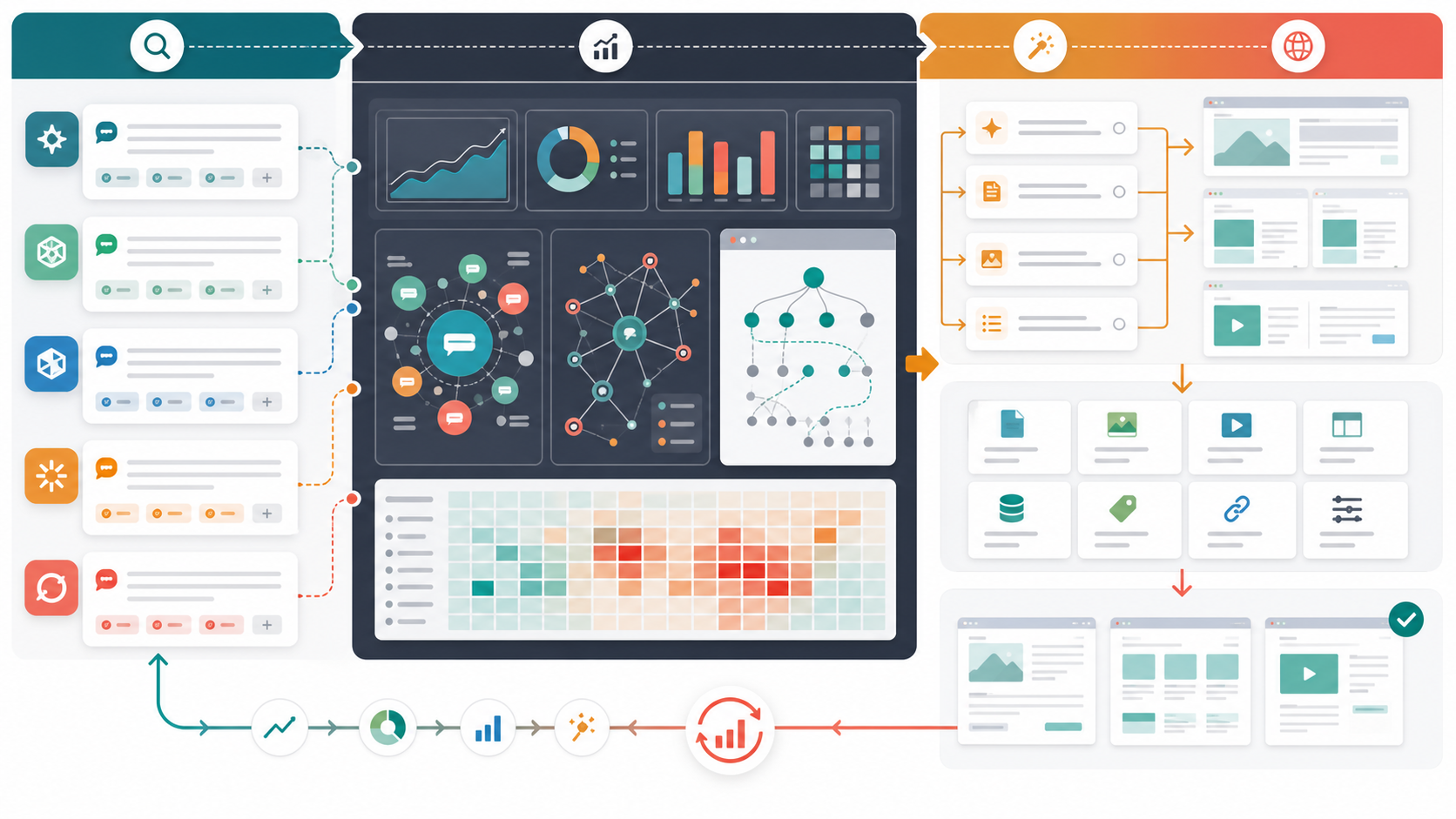
Promptwatch’s product path turns that process into a sellable loop:
- Monitor AI answers.
- Identify citation sources and content gaps.
- Generate action recommendations.
- Write content that AI systems are more likely to cite.
- Publish into CMS systems such as WordPress, Webflow, and Framer.
- Track the result through crawler logs, citations, and AI traffic.
This also explains why Promptwatch can sell to both brands and agencies.
For brands, AI search is a new acquisition entrance. Promptwatch’s case-study page says Crisp found that AI traffic converted at twice the rate of other channels and scaled content production to five to ten pieces per day. That is an official customer case and not an independent audit, but it explains the buying logic well. If AI-referred users are closer to purchase decisions, being recommended by AI is not only brand exposure. It is a revenue entrance.
For agencies, the value is more operational. Agencies need to explain to multiple clients how they perform inside AI search and then continuously deliver improvement work. Promptwatch’s agency page emphasizes multi-client management, white-label dashboards, API and MCP access, Data Studio, and client portals. That means the product is not only selling to one marketing team. It is trying to embed itself into the agency delivery workflow.
The clever move is to package an uncertain new channel as a manageable old workflow.
“AI is changing search” is a large statement, but it is hard for a budget owner to pay for a statement. “We monitor 350 high-intent buying prompts every month, track 42,000 AI answers, identify the pages that competitors are cited from, generate 10 AEO articles, and track AI crawler visits and conversions” is different. That sounds like a renewable, expandable, reportable marketing system.
So the lesson from Promptwatch is not “go build an AI SEO tool.” That market already includes Profound, Peec, Searchable, and many others, and differentiation will get harder. The more useful lesson is the productization sequence.
Promptwatch did not treat AI search as just a new reporting surface. It first defined new measurable objects: prompt, answer, citation, crawler hit, and AI-referred traffic. Then it connected those objects to an action layer: Actions, Content Agent, CMS publishing, API, and MCP. Finally, it used pricing to turn those objects into quotas and plans.
When a new channel emerges, many products stop at “helping you see it.” But after the user can see the problem, the sharper pain is often “what should I do today?” Promptwatch is trying to productize that answer as well.
There are clear uncertainties.
First, AI search optimization is still an early market. How different AI platforms cite, rank, and present brands changes quickly. A content strategy that works today may need to be rewritten a few months later.
Second, there is a long attribution chain between being cited by AI and generating revenue. Promptwatch can track AI traffic and crawler visits, but whether a customer can prove incremental revenue depends on site analytics, CRM attribution, buying cycle length, and category characteristics.
Third, automatically generating and publishing content can drift toward low-quality content farms. Promptwatch’s review inbox and CMS field mapping act as control valves, but the closer the product gets to automatic publishing, the more brands need content governance, fact checking, and voice control.
Those risks do not weaken the case. They show that Promptwatch is touching a commercially tense problem. As AI becomes a discovery entrance, brands do not only need to know whether they are visible. They need a system that continuously makes them easier for AI systems to cite.
There is a common mistake in AI product commercialization: assuming that finding a new trend is enough to charge for a dashboard. In practice, it is rarely that simple. Dashboards can create anxiety, but execution layers are closer to budget.
Promptwatch’s route is a reminder that the value of new-channel software is often not turning the unknown into charts. It is turning charts into the next action.
The point where AI search optimization really starts to charge may not be “where do you rank inside the AI answer?” It may be “which gap did the system find today, which article did it prepare, which page did it publish, and did AI later cite it?”
Sources
- Tech.eu: https://tech.eu/2026/07/14/promptwatch-raises-eur6m-to-expand-its-end-to-end-ai-search-optimisation-platform/
- Promptwatch funding announcement: https://promptwatch.com/blog/promptwatch-raises-6-million-in-seed-funding
- Promptwatch pricing: https://promptwatch.com/pricing
- Promptwatch About: https://promptwatch.com/about
- Promptwatch changelog: https://promptwatch.com/changelog
- Promptwatch case studies: https://promptwatch.com/case-studies