

FUN.com is a useful place to study AI recommendations in commerce.
It is not a small store that simply needs more traffic. It is a vertical commerce business with more than $300 million in annual business volume. Malachyte says that after its system went live at FUN.com in August 2025, recommendation revenue increased 142.5% year over year, revenue per visitor rose 31%, and 56% of orders were influenced by its intelligence layer.
The caveat should come first. These figures come from Malachyte’s own customer material. They have not been independently audited, and they do not automatically isolate the effect from promotions, seasonality, site redesigns, or traffic mix. Even with that caveat, they deserve attention because the common weakness of many commerce AI products is not that the model sounds boring. It is that the merchant cannot tell how much more money the AI actually made.
Malachyte tells a narrower story. It does not position itself as a universal shopping assistant. It does not say it will replace the ecommerce operations team. It focuses on one surface: when a visitor enters the site, what product should appear next?
That sounds like an old recommendation problem. The real challenge is the old operating model behind recommendations.
Traditional ecommerce personalization often depends on three inputs: purchase history, login profiles, and audience segments. The system decides which bucket a user belongs to, then applies a strategy to that group. The problem is that most visits are incomplete. A shopper may not be logged in. They may be visiting for the first time. Their current buying intent may have little to do with what they bought last year.
A person who bought a Halloween costume last season may now be shopping for a child’s birthday gift. A visitor who arrived from search may have no stored profile, but their clicks, dwell time, query terms, scrolling path, and cart actions already reveal intent.
If the recommendation system waits for overnight batch processing or only looks backward, it can miss the short moment before the transaction happens.
Malachyte’s wedge is to move from “who is this user?” to “what is this user trying to do right now?”
The company’s technology page breaks the workflow into three steps. First, it captures clicks, searches, hovers, scrolls, and add-to-cart events. Then Vector AI creates a continuously updated behavior profile. Finally, visual transformer technology maps the product catalog to that profile and adjusts ranking and recommendations in real time.
Malachyte uses a simple analogy: just as an LLM predicts the next likely word, Malachyte’s Vector AI predicts the next likely behavior.
The analogy is useful because it defines the product rather than merely decorating it with AI vocabulary. The system is no longer distributing products from a static audience profile. It is trying to predict the next action from live behavioral context. For the merchant, AI moves from a back-office optimization tool into the transaction layer: product discovery, search results, upsell positions, and recommendation modules.
TechCrunch reported on August 6, 2026 that Malachyte raised a $10 million seed round co-led by Bessemer Venture Partners and Gradient Ventures, with Harpoon Ventures participating. The report also noted that founders Sidd Motwani, Ian Anderson, and Shivaditya Sinha had worked on behavioral intelligence and recommendation infrastructure at Spotify. Their Vector AI approach, TechCrunch reported, had supported roughly 90% of Spotify recommendations for an audience of about 800 million users.
This is the easiest part of the story to misread.
Malachyte is not simply moving “Spotify-style recommendations” into ecommerce. Music recommendations optimize for listening, skipping, retention, and engagement. Commerce recommendations face a harsher question: did revenue per visitor rise? Did more people add to cart? Did more orders touch a recommendation unit? Can the merchant attribute enough incremental revenue to the system?
That is why Malachyte’s commercial challenge is not to explain that it uses AI. It is to convince retailers that the AI belongs inside a revenue dashboard.
The company’s customer claims follow that logic. Beyond FUN.com, Malachyte says Brunt Workwear saw a 6.5% lift in revenue per visitor in a Q4 2025 pilot, an 80% increase in upsell click-through, and a projected $9.75 million in annual incremental revenue based on a $150 million baseline. It also says Jordan Craig saw a 17% increase in revenue per visitor among new visitors. These are company-published results and not independent audits, but they show the language Malachyte is using in sales conversations. The value is not abstractly “understanding users better.” The value is higher session value.
That matters for AI product builders.
Many AI products get stuck in an awkward commercial position. Users agree the product is useful, but the company does not know which budget should pay for it. It improves efficiency, but the efficiency does not map cleanly to a budget line. It improves experience, but the experience does not map to a tracked operating metric. It looks smart, but smart is not a purchasing reason.
Malachyte chose a surface where metrics already run the business: on-site commerce ranking. Recommendation revenue, revenue per visitor, add-to-cart rate, click-through, influenced orders, A/B tests, and attribution windows already exist. If the system works, value can be shown quickly.
In other words, Malachyte is not first selling AI capability and then searching for a business result. It selected a result-dense workflow and embedded AI there.
This is the broader lesson from many vertical AI products. A startup does not need to build the largest general-purpose capability. It needs to find a process that is frequent, feedback-rich, and measurable. Clicks, searches, hovers, scrolls, and add-to-cart events already exist. Malachyte reorganizes them into a real-time learning loop.
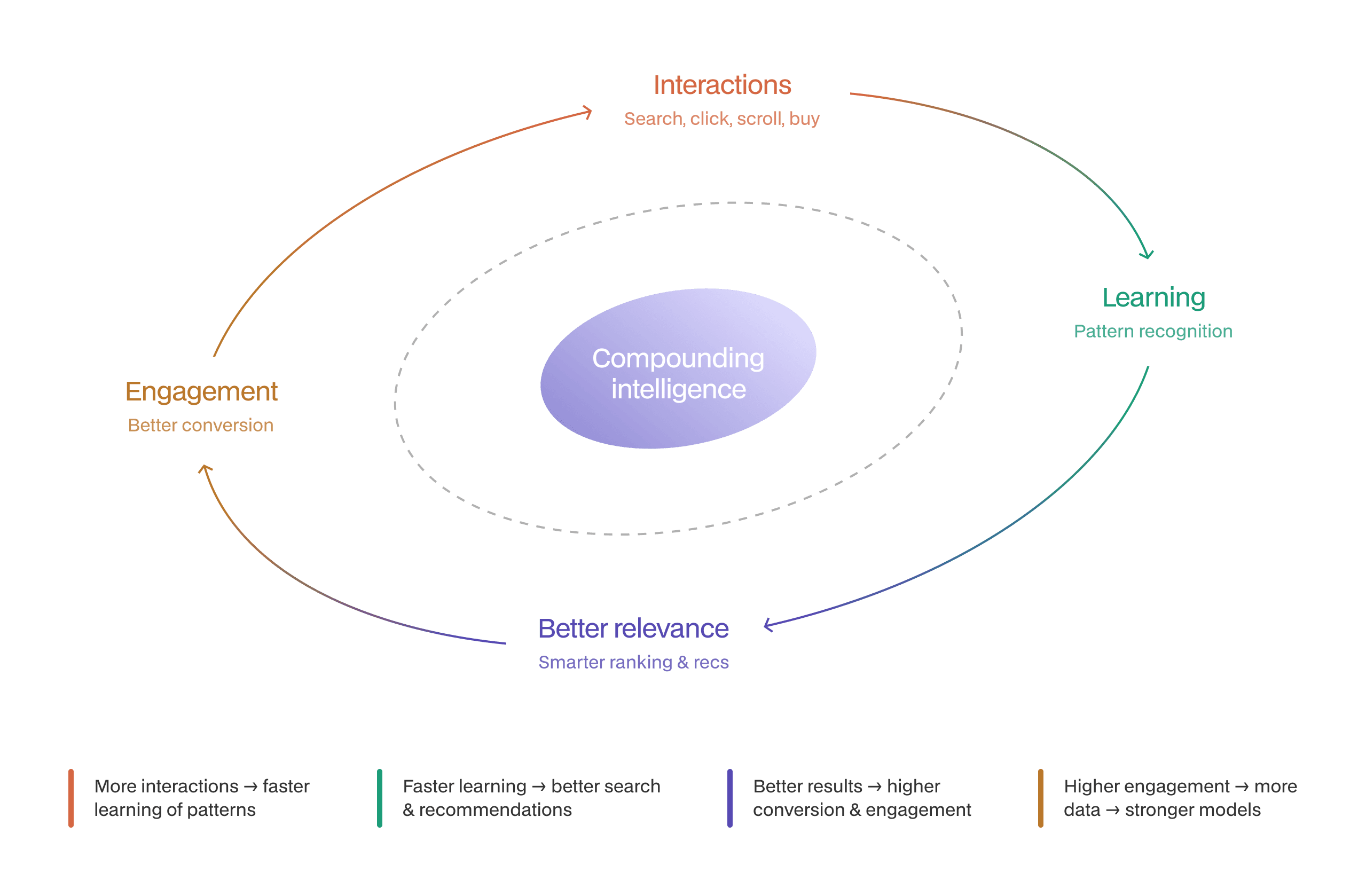
When every interaction becomes input for the next ranking decision, the product can develop compounding structure: more interactions create faster learning, faster learning creates more relevant results, more relevant results create higher conversion, and higher conversion creates more data. That is what the company means by compounding intelligence.
The risks are equally clear.
First, company-published metrics are not independent validation. Ecommerce recommendation results can be affected by traffic sources, promotion timing, seasonal categories, and other site changes. These numbers should be treated as commercialization signals, not audited financial conclusions.
Second, Malachyte is not entering an empty market. Shopify, Adobe Commerce, Salesforce Commerce Cloud, Algolia, Bloomreach, and other players are investing in search, recommendation, and personalization. Malachyte has to prove that real-time intent vectors deliver enough incremental value to justify integration cost and platform risk.
Third, this product is likely best suited to mid-market and large retailers. Real-time personalization needs enough traffic, enough catalog depth, clear event data, and attribution discipline. For a small merchant, integration cost may exceed the benefit.
Those limits are exactly why Malachyte is worth studying. It is not packaging AI as a universal new entrance. It is putting AI inside an existing transaction node that already has budget, metrics, and a buyer.
The product is not selling a smarter customer profile. It is selling the possibility that present intent can become an order faster.
For AI founders, the lesson can be compressed into one sentence: do not only ask what the model can understand; ask at which moment understanding becomes most valuable.
In commerce, that moment may be the few seconds after a shopper searches, pauses, scrolls, hovers, or adds an item to the cart.