
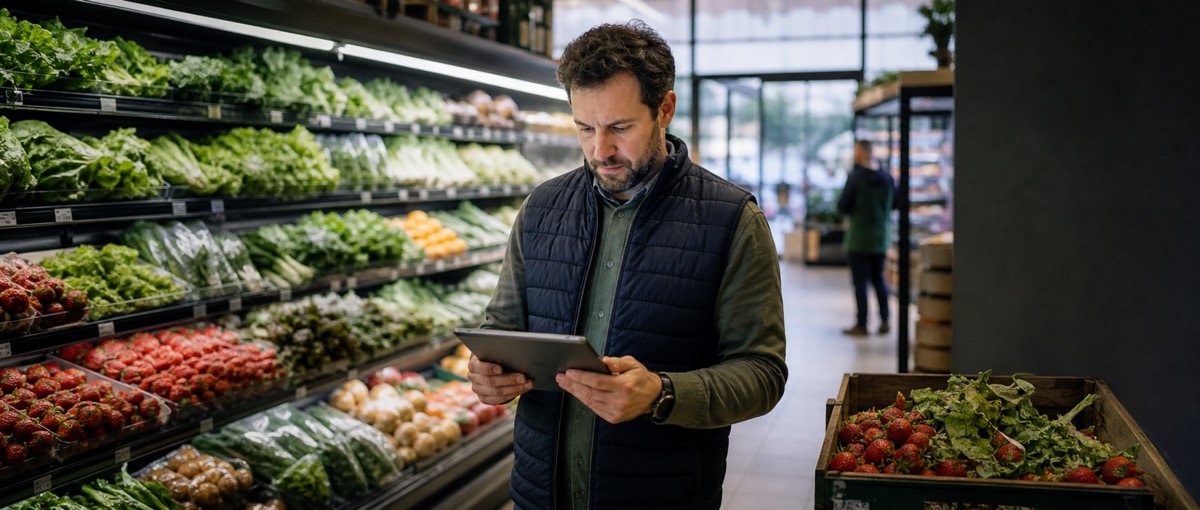
A rural German supermarket had a problem that many AI products would ignore because it looked too ordinary. The produce section was short on experienced staff. Much of the daily ordering work was handled by local students who were still in school. To avoid empty shelves for apples, strawberries, or potatoes, the store ordered conservatively. Anything that did not sell quickly became waste.
The store later adopted Freshflow. Instead of asking a young employee to guess tomorrow’s demand from instinct, the system forecasted sales for each fresh item and showed ordering recommendations on a tablet.
The Next Web reported the store’s experience: according to Freshflow’s founder, produce waste fell by nearly 30%. The store location was not disclosed, and the result was not independently audited. Still, the story makes the product’s value unusually concrete. A junior employee could now execute a decision that affects gross margin every morning.
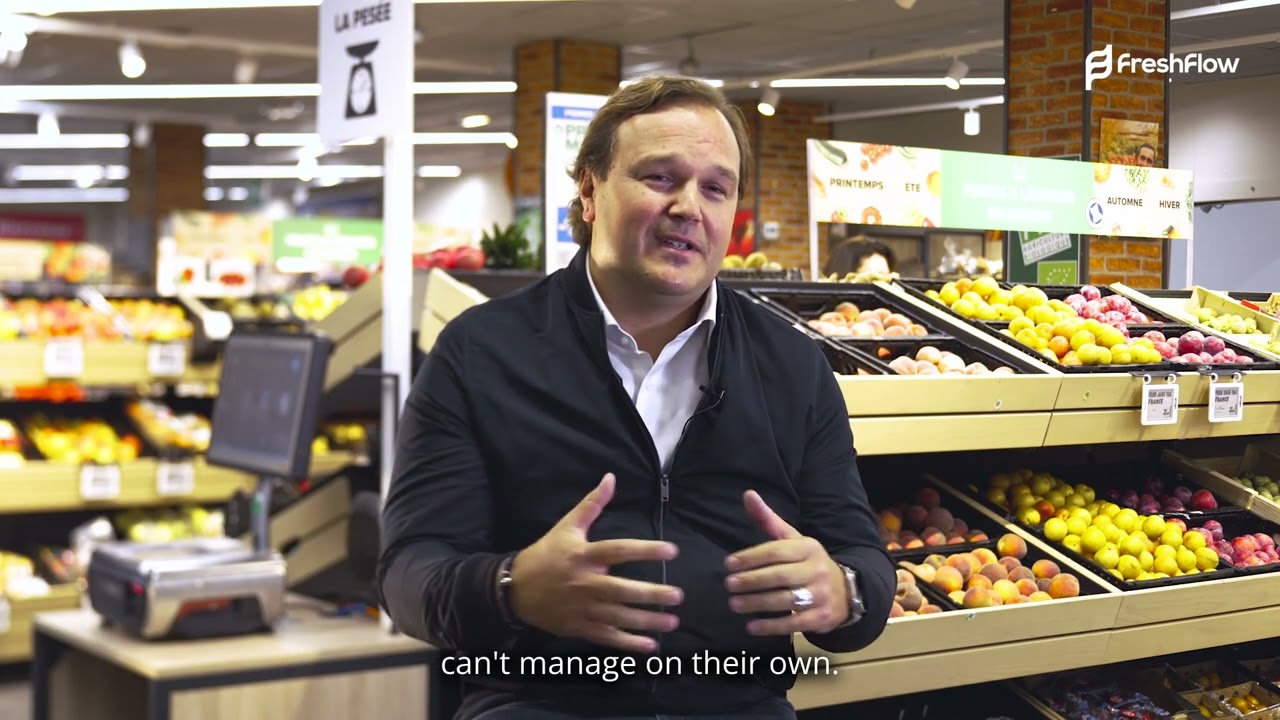
Image source: promotional thumbnail from an embedded Freshflow customer video. It shows a produce shelf, store staff, and an ordering tablet, and is used here to explain the in-store workflow rather than to verify customer results.
Fresh Ordering Is a Daily Guess
Replenishment for ordinary packaged goods is already highly systematized. If inventory falls below a threshold, the store replenishes based on history. Fresh produce is harder. Strawberries have different remaining shelf life from one delivery to the next. Watermelons may be sold by weight, while the system may not know how many are still sitting on the shelf. Weekends, weather, promotions, and local events can all shift demand quickly.
Ordering too much creates spoilage. Ordering too little creates empty shelves and disappointed customers. The store pays either way.
TechCrunch wrote in its early coverage of Freshflow that many supermarkets still rely on employees’ eyes, noses, and experience to order fresh food. Experienced staff can be very good at that job, but their judgment does not transfer cleanly through a rota. When a skilled department manager leaves, the store may lose the decision model along with the person.
Freshflow turns that judgment into a repeatable operating process. The system reads sales, ordering, and waste data from the store. It adds weather, holidays, promotions, and local events. It estimates how much sellable inventory remains on the shelf, forecasts future demand for each item, and calculates the economic cost of ordering too much or too little.
The next morning, the employee sees item-level recommendations on a tablet. If something unusual happened locally, the employee can still adjust the order.
That design matters. Freshflow does not try to replace the entire produce department. It preserves the local work that still belongs to humans: presentation, selection, exception handling, and store knowledge. The AI standardizes the repetitive quantity decision, the part most exposed to uneven experience.
Freshflow says 93% of its AI recommendations are accepted by frontline employees. That figure is company-disclosed and not independently audited, but it is more useful than a standalone accuracy claim. If store staff ignore the suggestions every morning, the forecast never reaches the purchase order.
One Order Affects Waste and Sales
Many AI products can only prove that they save time. Freshflow is selling into a more direct ledger. On one side is inventory that will be thrown away. On the other side is revenue lost when shoppers face empty shelves. A small daily improvement per SKU can compound into store-level margin.
In its June 2026 Series A announcement, Freshflow said it had entered systems at nine leading German and French retailers, including stores under EDEKA, Carrefour, Intermarche, and Stroetmann. The company also said stores can reduce waste by up to 30% and increase revenue by 2% to 4%. Freshflow announced a $10 million Series A led by Reimann Investors.
Those customer counts and performance figures come from the company and have not been independently audited. But the combination of financing, retailer deployments, and store-level claims still shows why the product has crossed beyond a single-store experiment. It gives buyers a way to test AI against a spreadsheet they already understand.
Freshflow’s customer page provides more specific store narratives. One EDEKA operator says ordering time was cut in half and waste fell by 40%. A Carrefour store says weekly losses fell by about 1.5 percentage points. These are official customer-marketing claims, not universal benchmarks, but they explain the buying motion.
The retailer can begin with one store and three metrics: waste, out-of-stock rate, and ordering time. The buyer knows what each percentage point is worth. The vendor can use the same store profit-and-loss logic to discuss renewals and expansion.
From One Store to the Fresh Supply Chain
Freshflow works as a lightweight layer on top of existing retail ERP systems. It receives store data and sends recommendations to the tablet used by store employees. The company describes implementation in weeks and first results in six to eight weeks. For retailers with old systems and long transformation cycles, that lightweight entry point lowers the pilot barrier.
Once one store proves the case, the same workflow can expand to more stores and more categories. Freshflow plans to move from produce into meat, bakery, and in-store production, then further upstream into warehouses, distribution centers, and suppliers. Each step gives the system more supply-and-demand information. Each step also moves the product from a store tool toward a fresh-food supply-chain operating layer.
There are real limits. Forecasting systems can fail when traffic or consumer behavior deviates suddenly from normal patterns. In The Next Web’s article, retail analytics researcher Patrick Brandtner warned that models need continuous monitoring in these conditions. That is why Freshflow keeps store employees in the loop and lets them override orders.
The German rural supermarket leaves a more tangible lesson than the headline waste figure. A few young employees with limited produce-ordering experience gained a decision process they could repeat every day. In the short period before the store opens, the question “how many strawberries should we order?” becomes a profit decision that software can help distribute across the organization.
For AI founders, the lesson is not simply that supermarkets need better forecasts. The sharper lesson is that the best AI wedge may be a decision people already make daily, where mistakes are visible, costly, and measurable.