
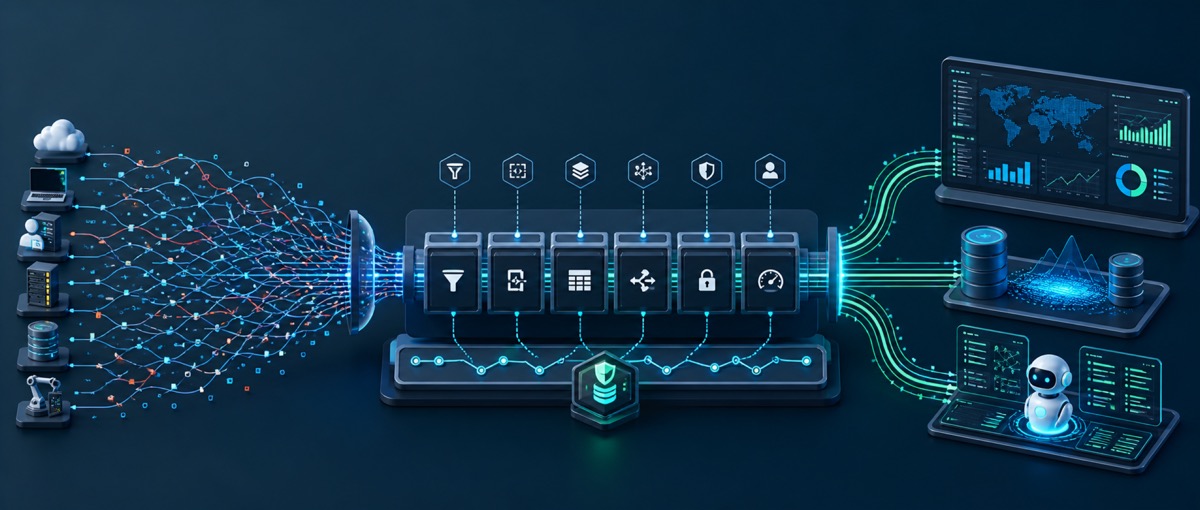
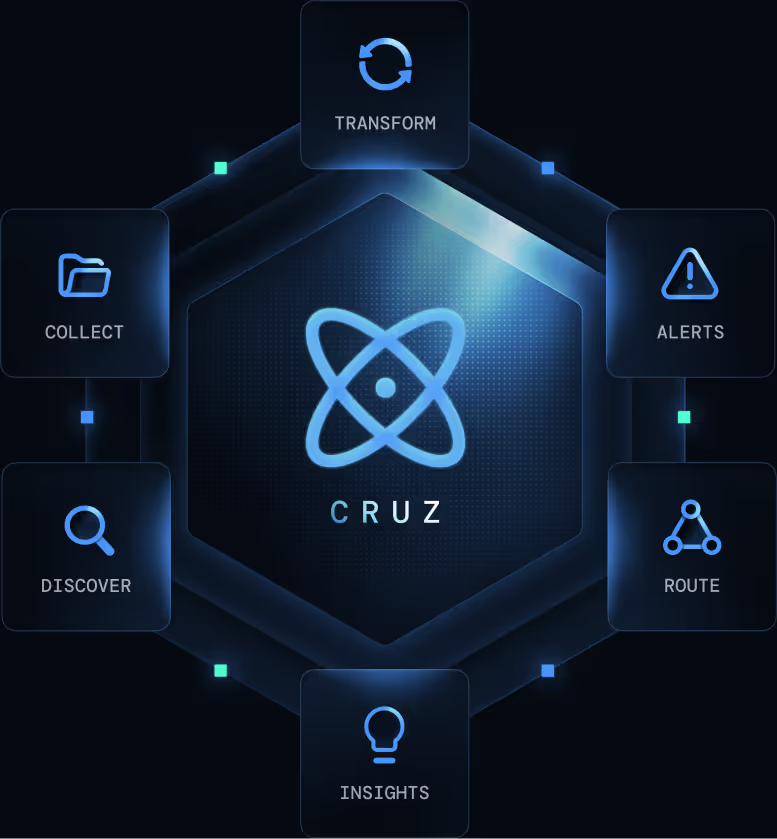
Image source: DataBahn official Cruz product page. The visual explains the AI data engineer mechanism; it is product material rather than audited third-party evidence.
The obvious thing for enterprise security AI to do is chase alerts.
That makes sense at first glance. SOC teams are buried under logs, alerts, false positives, tickets, and incident reports. Security copilots, AI analysts, and autonomous SOC products all promise a similar result: let AI understand threats faster than humans can.
DataBahn starts earlier in the workflow.
It focuses on the layer before the alert is generated: where logs come from, whether their formats drift, which data deserves to enter the SIEM, which data only inflates storage bills, which context should be reserved for AI agents, and which actions need governance and auditability.
The company’s bet is simple: security AI should not rush to analyze every alert until the data pipeline has been made usable.
That position is becoming valuable. In July 2026, DataBahn announced a 40 million dollar Series B led by Insight Partners, with participation from Forgepoint, GTM Capital, and S3 Ventures. The same announcement said the company had reached more than 400 percent year-over-year revenue growth, 180 percent net revenue retention, zero customer churn, and a 97 percent proof-of-concept win rate. Those figures are company-disclosed through a press release, not independently audited.
The interesting part is not only that a data pipeline company raised money. DataBahn calls itself an agentic data control plane. It is not serving ordinary reporting ETL. It is serving the telemetry layer that security teams, SIEMs, data lakes, copilots, and AI agents all depend on.
The old data problem gets worse when AI arrives
Before AI entered enterprise security, security teams already had a data problem: too much data, too much noise, too many formats, and too much cost.
Every cloud service, endpoint, SaaS product, identity system, network appliance, and operational technology device adds more logs. SIEMs ingest those logs. Data lakes store them. Compliance teams ask where they came from and how long they were retained. Analysts need to search them during investigations.
Now AI also needs those logs as context.
But AI does not automatically make bad data good. If log formats drift, fields are missing, sources are duplicated, noise dominates the pipeline, and access boundaries are unclear, a copilot merely reads a larger mess faster. If an enterprise wants agents to investigate alerts, write KQL, connect assets, explain risk, and recommend action, the agent needs trusted, traceable, cost-controlled data.
That is DataBahn’s product entry point.
It sells context control, not just a pipeline
DataBahn’s public platform material describes products such as Highway, Cruz, Reef, Federated Search and Orchestration, and Security Data Fabric. The names vary, but the core job is consistent: filter, parse, normalize, enrich, govern, and route enterprise telemetry before it reaches security tools and AI systems.
Cruz is the clearest AI mechanism. DataBahn describes Cruz as an “AI Data Engineer in a Box.” Its product page says it automates data transformation, normalization, parsing, and pipeline management for security operations. The platform page also presents autonomous parsing, pipeline automation, and proactive monitoring.
That is different from the usual security AI story.
A typical security AI assistant sits beside the analyst: it reads an alert, summarizes an incident, generates a query, or drafts a report. DataBahn sits at the data entrance: which source should be connected, which field should be parsed, which format drifted, which data should be deduplicated, what should go to Microsoft Sentinel, and what should move to cheaper storage or another destination.
This work used to rely on security engineers and data engineers maintaining connectors, parsers, scripts, and routing rules. It is not glamorous. It is expensive and fragile.
DataBahn’s commercial move is to convert that work from a project into a platform purchase. Its financing announcement says the platform can ingest, normalize, enrich, govern, and route telemetry from more than 600 sources while remaining source-, destination-, and model-neutral. If that promise holds for customers, the buyer is not paying for a few fewer parsing scripts. The buyer is paying for a control layer that keeps adapting as log sources, SIEMs, data lakes, and AI systems change.
Microsoft distribution matters
DataBahn’s relationship with the Microsoft security ecosystem strengthens the commercial story.
Microsoft Learn lists a DataBahn data connector for Microsoft Sentinel, meaning DataBahn platform audit logs, operational alerts, device inventory, and related telemetry can be pushed into Sentinel. Microsoft Marketplace also lists the DataBahn Data Fabric Solution for Microsoft Sentinel. DataBahn’s own partner messaging emphasizes faster deployment through Microsoft Marketplace and Sentinel Content Hub, including the ability for customers to use existing Azure consumption commitments.
For enterprise software, that matters more than a generic integration claim. It places DataBahn inside an existing security procurement path. Security teams may already be buying Sentinel, Defender, and Security Copilot. DataBahn positions itself as the layer that helps those systems receive cleaner, cheaper, more governable data.
That is a credible distribution strategy because the product does not ask buyers to abandon their security stack. It tells them the stack works better if the telemetry layer is controlled first.
Why security teams pay for this layer
Security data pipelines affect both cost and effectiveness.
If too little data is ingested, detection has blind spots. If too much data is ingested, SIEM and storage bills grow quickly. If formats drift, detection rules fail. If new data sources take too long to onboard, new systems can remain effectively invisible. For a CISO, this is not a minor productivity problem. It touches budget, risk, compliance, and accountability.
DataBahn’s customer quotes in the financing announcement speak to that pressure. MVB Bank’s CISO describes using DataBahn’s agentic data control plane to modernize workflows, support AI agents, and bring regulatory requirements, audit controls, and validation into one approach. A CPPIB security architecture leader describes a common enterprise pain: telemetry spread across multiple platforms and teams, new log sources requiring custom engineering, and uncertainty over whether critical systems are actually sending logs.
Those examples are company-published customer quotes, not independent benchmark studies. They still show the buyer value clearly: faster onboarding, fewer data gaps, less manual engineering, lower SIEM and storage pressure, and stronger auditability.
DataBahn is not selling analysts a smarter chat window. It is selling the CISO confidence that security data has been governed before it reaches AI and the SIEM.
The expansion path
Once a customer uses DataBahn for telemetry ingestion, parsing, routing, and governance, expansion becomes natural.
Each new log source can pass through the platform. Each SIEM migration or data lake strategy can use the same control point. Each Security Copilot or AI-agent workflow creates more demand for cleaner context. MSSPs can also benefit because onboarding customers and sources faster is directly tied to service margin.
That means revenue does not have to grow only by adding seats. It can grow with telemetry volume, destinations, AI use cases, compliance requirements, and partner-led deployments.
This is why the category is more strategic than a backend utility might suggest. The control plane becomes a budget entry point because it decides what data is usable, what data is too expensive, and what data an AI system is allowed to trust.
The builder lesson
The transferable lesson is not simply “build a security data pipeline.” That is a heavy market with long sales cycles and deep domain requirements.
The broader lesson is that when everyone looks at the task AI can perform, commercialization often appears in the prerequisites for that task.
AI coding needs repository context, permissions, tests, and deployment paths. Sales AI needs CRM records, emails, calls, product materials, and approval boundaries. Customer-support AI needs knowledge bases, orders, refunds, identity checks, and escalation paths. Security AI needs clean, traceable, cost-controlled data.
Those prerequisites used to be treated as backend engineering. They are now becoming AI product budgets.
The reason is straightforward: as models become stronger, customers ask whether AI can actually take over more work. Once AI takes over real work, the system must handle data quality, permissions, cost, governance, audit, and recovery. Products that sell only smart answers are vulnerable to better models. Products that package the operating constraints of real work can stay closer to the customer’s core workflow.
DataBahn applies that logic to security telemetry. It does not compete for attention in the alert console. It stands at the entrance to the data flow and argues that without a governed data control plane, security AI can only reason on top of noise.
For many AI product categories, that same argument will repeat. The next durable AI businesses may not be the agents that look most impressive in a demo. They may be the control layers that make agents safe, affordable, auditable, and useful in production.