

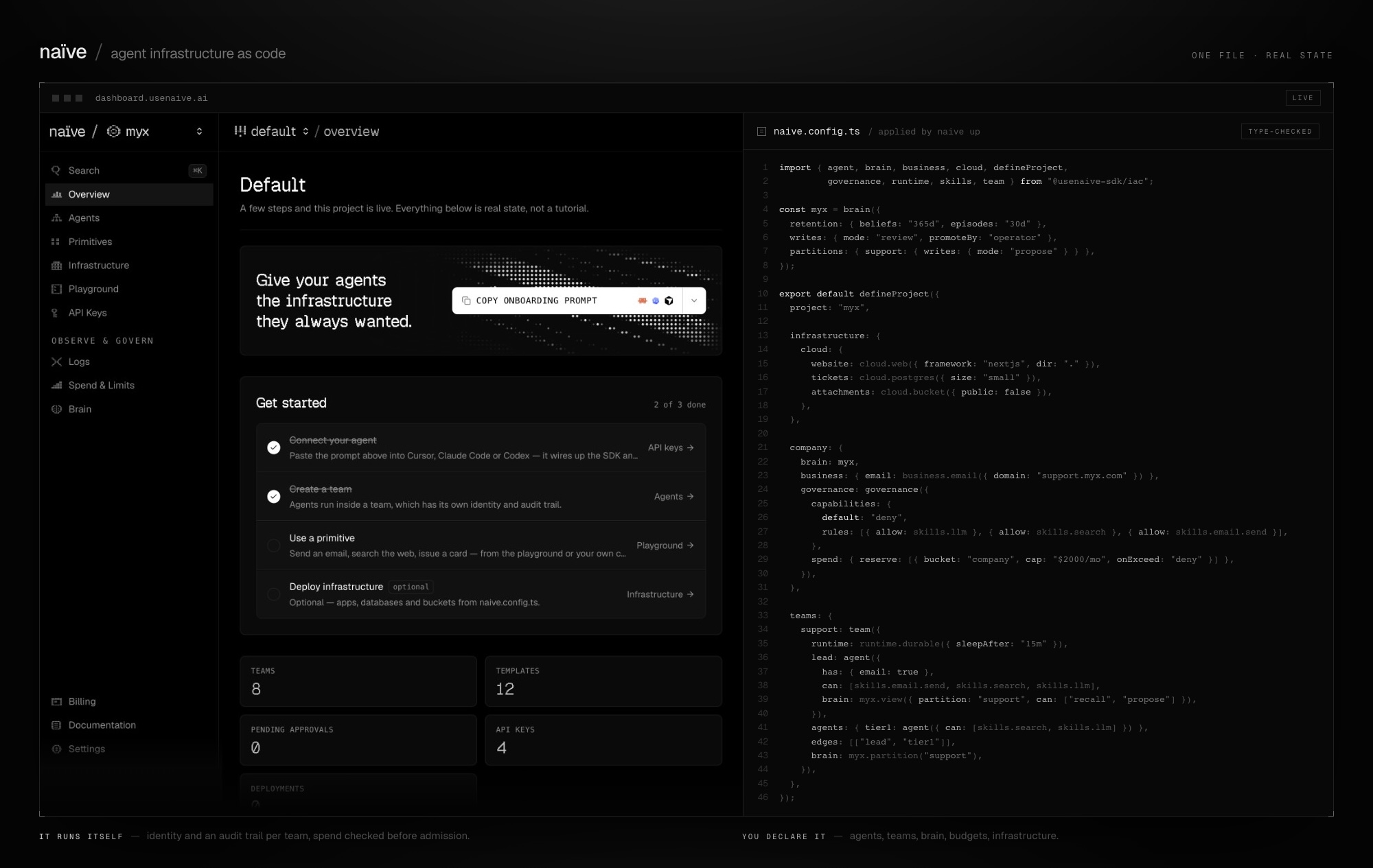
Image source: Naïve product screenshot via the source report. It shows an infrastructure console and configuration file rather than a simple chat interface.
The last year made one AI founder workflow feel almost normal: open Cursor, Claude Code, or Codex, describe an idea, and watch a working app prototype appear. A few hours later there may be screens, a database, authentication, and even a checkout button.
Then the less glamorous work begins.
Should the company be formed? Who handles EIN, KYC, and KYB? Which email inbox, phone number, virtual card, Stripe account, QuickBooks connection, database, cloud resource, object store, budget limit, API permission, and audit log will the product use? None of that is as exciting as generating an interface, but it decides whether an AI demo can become a business.
Naïve is aimed at that layer.
It is not another code assistant. It is trying to provide a company runtime for AI agents: a set of APIs and configuration primitives that connect identity, money, communications, cloud resources, model routing, governance policies, and logs. In other words, once AI can help generate the app, Naïve wants to answer the next question: how does that app get a runnable, billable, controllable company back office?
That problem is narrow enough to be concrete and large enough to matter.
From app generation to company generation
Naïve describes itself as AI agent infrastructure and a research platform. Its product language revolves around primitives, control planes, policies, and runtime rather than chat.
That vocabulary matters. Many AI applications are no longer blocked because a model cannot write a component. They are blocked because real business actions cannot be completed by prompts alone. An agent that opens a company, sells a service, collects payment, sends email, launches a campaign, or calls external tools needs controlled access to the real world. It needs spending limits, approval rules, resource ownership, system logs, and accountability.
Naïve compresses those interfaces into a developer workflow.
The source report cites TechCrunch saying developers can prompt inside tools such as Cursor, Claude Code, or Codex, then connect Naïve’s API to configure the infrastructure required by the business. The platform can help orchestrate parts of United States LLC formation, while compliance-sensitive steps such as KYC, KYB, and payment verification still require the user to complete the required checks. A business back office can also include inboxes, virtual cards, phone numbers, databases, compute resources, and connections to systems such as Stripe and QuickBooks.
That is a different posture from a normal coding assistant. The goal is not just to produce source code. The goal is to give the agent a governed environment in which generated software can operate.
The commercial signal is stronger than the buzzword
Naïve announced a 28.5 million dollar Series A in August 2026 led by Nexus Venture Partners, with participation from YC, Zetta, Liquid2, and others. The reported total funding is about 32 million dollars.
Funding is not the most interesting signal here. The useful part is the combination of adoption, revenue, and pricing. The source report says TechCrunch cited CEO Sean Dorje saying Naïve had registered more than 30,000 developer customers within months of launch and had increased annual run-rate revenue tenfold in the prior six months to the low double-digit millions. Those figures are company-disclosed and media-reported, not independently audited.
Naïve’s own pricing page adds another important detail. The product is packaged with a 7-day free trial, a 49 dollar per month Starter plan, a 149 dollar per month Pro plan, and usage beyond the plan priced at 0.05 dollar per credit. The measured units are not only seats or text generation. The pricing page references compute, models, storage, and real-world actions.
That pricing shape is important. It looks less like a content tool and more like a hybrid of developer infrastructure, cloud platform, and operations layer. Customers may begin with a fast AI business build, but recurring value depends on how often agents run, how many resources they connect, and how much real work the system governs.
The real product is a feeling of control
AI-agent infrastructure sounds broad. Naïve’s practical wedge is more specific: it sells the confidence that agents can touch real resources without running wild.
The source report says Naïve includes a governance layer where users can set budgets, restrict agent capabilities, and require human approval before sensitive actions. The company also emphasizes a control plane, with policy enforcement before primitives execute.
That is not decorative enterprise language. It is a prerequisite for commercial agent systems.
An AI tool that summarizes a meeting mostly risks wasting time. An agent that opens accounts, connects Stripe, creates virtual cards, sends customer emails, calls cloud services, and consumes compute can create direct financial, legal, customer, and compliance consequences. The closer AI gets to real business execution, the more buyers need budgets, permissions, approvals, logs, and rollback paths.
Without that layer, agents remain advisors. With that layer, they can be allowed to do work.
Naïve’s idea is not that responsibility disappears. It is that responsibility becomes easier to route through a product. KYC, KYB, payment rules, tax obligations, and company liability still exist. The value is placing those obligations into a more automated, observable, and agent-callable framework.
Why this is not just another infrastructure story
Naïve is interesting because it finds a counterintuitive position inside the AI startup stack.
Most attention goes to models, applications, and agents themselves. Naïve points at the work behind the agent: identity, inboxes, phone numbers, payments, ledgers, cloud resources, budgets, logs, and permissions. Each module looks ordinary when viewed alone. Combined around an autonomous or semi-autonomous business workflow, they become a new product question: what operating system does an agent need before it can run a company-like process?
That is also what separates Naïve from a normal cloud platform. Cloud platforms assume humans configure resources, while AI helps around the edges. Naïve assumes agents will participate in configuration, execution, and operations, so the product starts with boundaries for authority and real-world actions.
The difference is subtle but commercially meaningful. A cloud account sells raw infrastructure. A company runtime sells the right to let AI touch infrastructure, communication, money, and records under policy.
The builder lesson
Naïve’s case points to a broader shift in AI product commercialization.
The crowded part of the market is the interaction layer: code assistants, search assistants, general chat, and app generators. But every time that layer becomes more powerful, it creates new demand underneath it. If more people can generate software quickly, more people also need a faster way to form, connect, meter, secure, and operate the business around that software.
That is where Naïve is trying to charge.
The deeper lesson is that AI differentiation will increasingly come from the ability to absorb consequences. Generating a suggestion is easy. Generating a page is becoming cheaper. Letting AI take an action in the real world, then explaining it, limiting it, billing for it, auditing it, and assigning responsibility for it, is harder and more valuable.
Naïve is worth watching because it is not trying to make the prompt box a little better. It is trying to give agents a company back office. If vibe coding shortened the distance from idea to app, Naïve is betting the next bottleneck is the distance from app to operating business.