

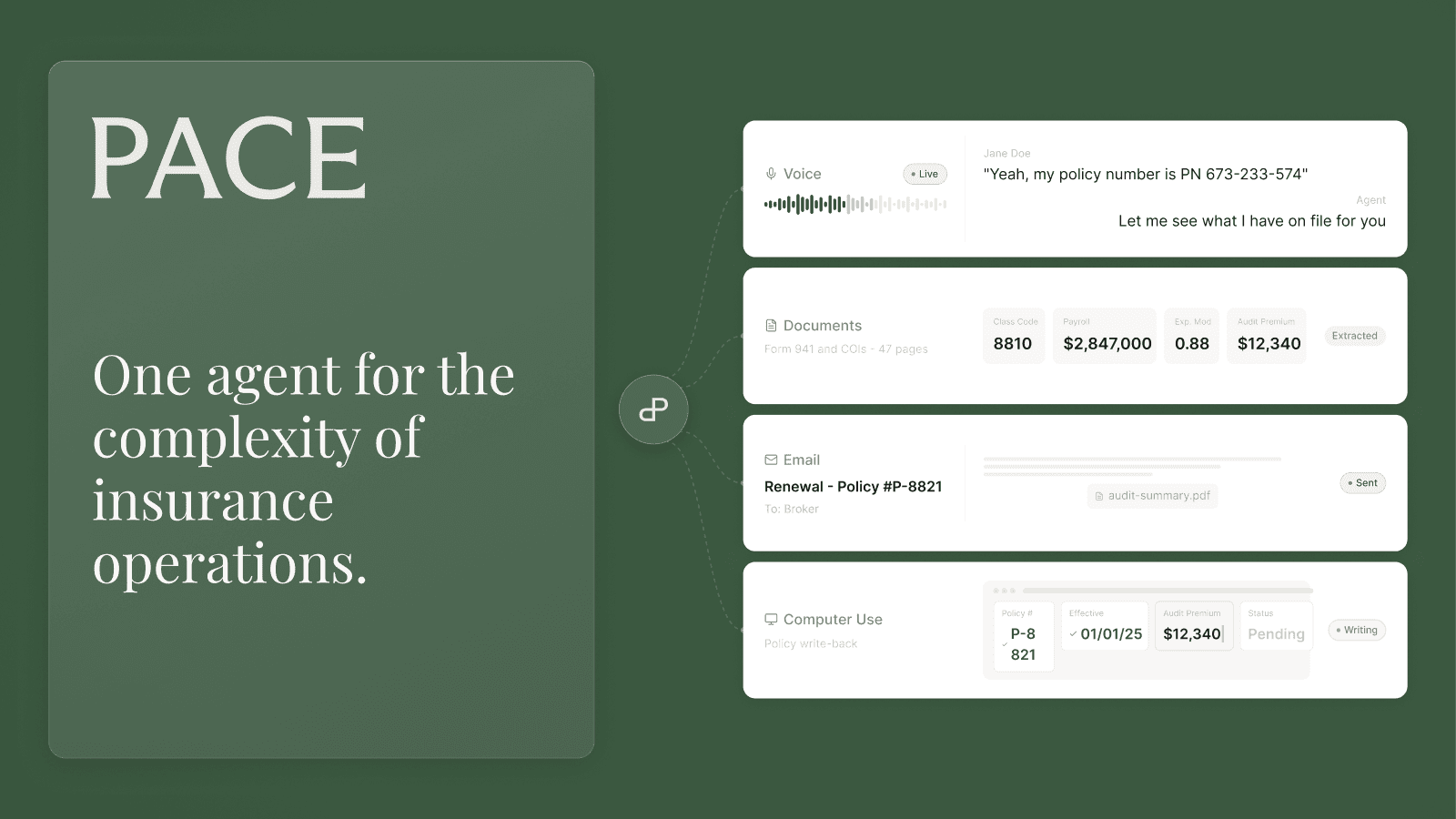
Image source: Pace product visual. The product is framed around insurance operations workflows across documents, calls, emails, and system updates.
Insurance AI is often discussed through the most sensitive decision in the business: underwriting. Can a model price risk? Can it approve a policy? Can it decide whether a claim should be paid?
Those questions matter, but they are not necessarily the best starting point for a commercial AI company. Underwriting and claims decisions carry regulatory, financial, reputational, and actuarial weight. Selling into that core decision can mean long proof cycles, heavy governance, and cautious buyers.
Pace takes a more pragmatic route. It starts with insurance operations: submissions, renewals, servicing, claims intake, document processing, email triage, phone calls, data extraction, and system write-backs.
That may sound less glamorous than replacing the underwriter. It is also easier to buy, easier to measure, and closer to the work that consumes huge amounts of labor before any strategic judgment happens.
This is the central lesson of Pace’s case: in regulated verticals, the first AI product does not have to own the final decision. It can win by taking over the messy work that surrounds the decision.
Insurance has a large layer of work before judgment
Commercial insurance is full of operational friction. A submission can arrive through email with attachments, ACORD forms, spreadsheets, PDFs, loss runs, supplemental applications, and broker notes. A renewal may require comparisons across expiring policies, changed exposures, updated schedules, and carrier-specific forms. Claims intake may involve calls, emails, documents, photos, policy details, coverage questions, and follow-up tasks.
Much of that work is not intellectually glamorous, but it is essential. Someone has to read the material, classify it, extract the correct fields, verify completeness, route the case, ask for missing items, enter data into legacy systems, and keep the customer or broker informed.
Traditional automation struggles because the inputs are variable. Pure chatbots struggle because the job is not simply answering a question. Insurance teams need agents that can operate across documents, voice, email, and internal systems while leaving an audit trail.
Pace positions itself in that layer.
The funding signal points to workflow ownership
Pace announced a 46 million dollar Series B led by General Catalyst, with participation from investors including Felicis, SignalFire, Bessemer, and Y Combinator. The round is useful context, but the product metrics are more revealing.
The company says its agents have executed more than 250,000 insurance workflows and that customers use the platform across policy checking, claims, underwriting, and back-office operations. Customer examples in the source material include Palomar and Maritime Program Group, with Palomar describing more than 90 percent of certain cases handled without human touch.
Those are company and customer-published claims, so they should be read as evidence of direction rather than audited market averages. Still, they show the product is being measured by completed workflows, not by model novelty.
That is the right unit for this market. Insurance buyers do not only care whether AI can understand a document. They care whether the workflow was completed accurately, traceably, and with fewer manual touches.
Purpose-built agents beat generic assistants
Pace’s language is deliberately vertical. The company talks about purpose-built agents for insurance operations rather than a general copilot. That distinction matters.
A generic assistant can summarize a policy, draft an email, or answer a question. A purpose-built insurance agent has to know which fields matter in a submission, which missing items block progress, how a renewal package differs from a new submission, where a claim should be routed, which systems need updates, and when a human must stay in control.
It also has to work across channels. Insurance operations still happen through email, phone, portals, attachments, and older core systems. A product that only sits in a chat window cannot absorb enough of the workflow to justify a strategic budget.
Pace’s product story includes voice, documents, email, and computer use. That matters because the operational bottleneck is not in one interface. It is in the handoff across interfaces.
Why starting outside the final decision is smart
The temptation in insurance AI is to aim directly at underwriting or claims adjudication because that is where the economic stakes are obvious. But taking over final judgment too early creates risk.
The back office is a better first wedge. It is large, painful, repetitive, and measurable. It creates value even if the human underwriter or claims professional remains responsible for the final call. It also gives the AI system a way to learn the insurer’s documents, terminology, systems, and exception patterns before asking for deeper trust.
This is a common vertical AI pattern. Start by doing the work around the expert, not by replacing the expert. If the product reduces queue time, eliminates duplicate entry, improves completeness, and updates systems reliably, it earns more surface area over time.
In insurance, that surface area can expand naturally. The same operational layer that ingests submissions can support renewal comparisons, policy checking, claims intake, billing service, broker communication, and data cleanup.
The audit trail is part of the product
Insurance buyers need more than speed. They need to know what happened, who approved it, which source document supported a field, and whether the system stayed within policy and regulatory boundaries.
That is why vertical workflow design matters. A useful insurance agent must preserve traceability. It should not simply output a confident answer. It should connect extracted data to source documents, route exceptions, respect human approval thresholds, and write back to systems in a way the organization can inspect.
The source case frames Pace as a platform for regulated operational work, not merely a document parser. That framing is important. The product must commercialize through trust, control, and repeatable execution.
The builder lesson
Pace’s case is a warning against over-aiming in regulated AI.
The biggest decision is not always the best first product. If a vertical contains a large amount of pre-decision and post-decision work, an AI company can create value by automating that operational layer while keeping humans responsible for judgment.
For insurance, that means emails, forms, calls, documents, routing, checking, and system updates are not secondary tasks. They are the work surface where AI can prove itself.
The broader pattern applies beyond insurance. In healthcare, legal, finance, logistics, and government contracting, the first durable AI product may not be the one that makes the final expert decision. It may be the one that makes every case ready for that decision faster, cleaner, and with stronger evidence.
Pace is interesting because it treats back-office work as the wedge, not as the leftovers. That is often where vertical AI becomes a real business.