

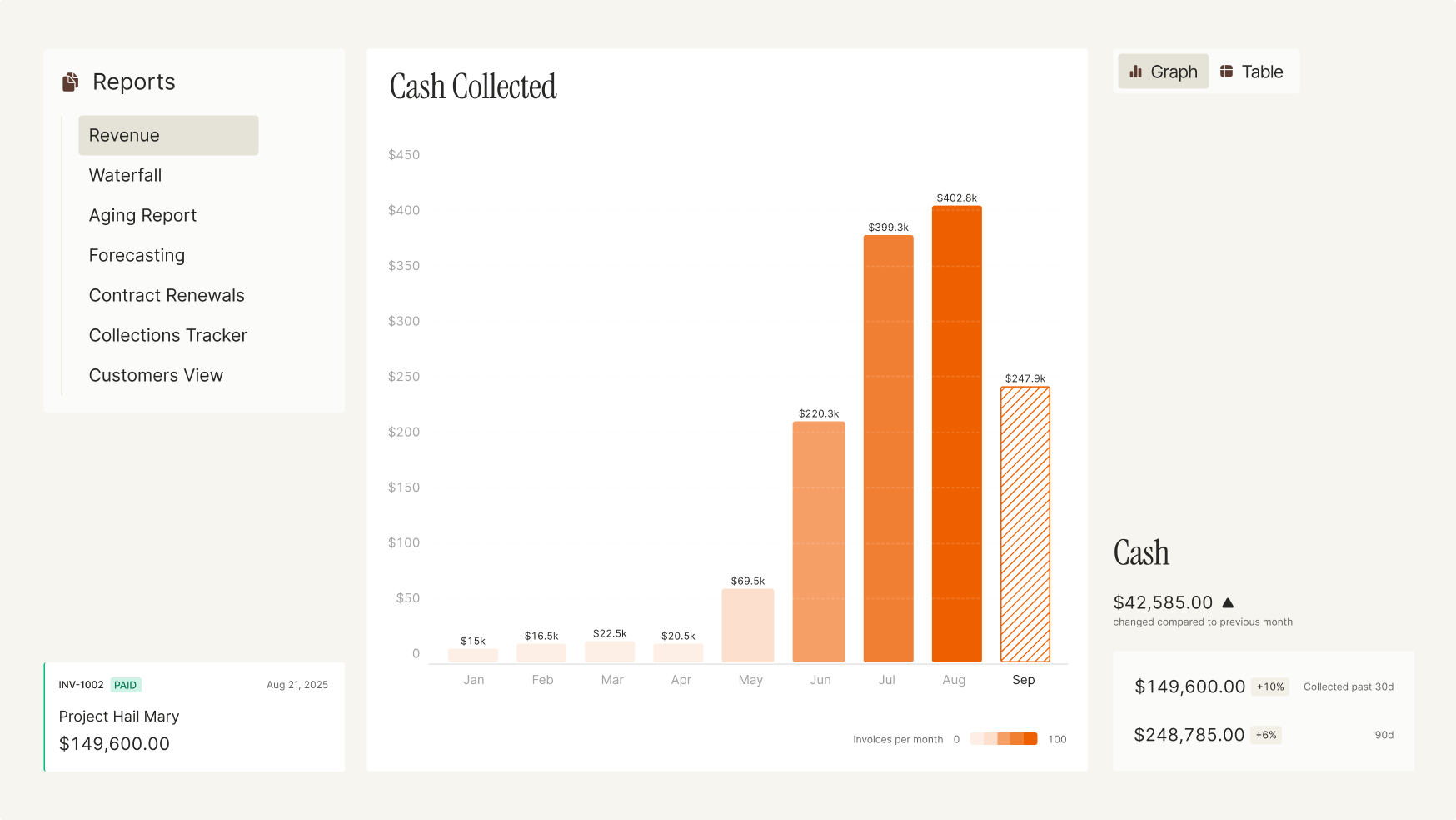
Image source: Monk product visual. The workflow is built around accounts receivable execution, not just finance reporting.
Many finance AI products sell the same promise: ask a question, get a report, close the books faster, and let the CFO see the business more clearly.
Those are useful outcomes. But they are not always the first place where AI can create urgent value. A company can survive with imperfect reporting longer than it can survive with cash stuck in receivables.
Monk starts with that pressure point. It is building an AI-native accounts receivable platform that turns invoices, collections, disputes, customer portals, payment matching, and cash forecasting into an execution layer. Instead of stopping at analysis, Monk tries to move work forward until approved revenue becomes collected cash.
That is why the company is a useful case study. The product does not ask the buyer to believe that AI will transform finance in the abstract. It points at days sales outstanding, manual collection work, customer response rates, and cash visibility.
For operators, that is a sharper budget argument.
Accounts receivable is messy enough for AI to matter
Accounts receivable sounds like a simple finance category. An invoice goes out, the customer pays, the payment is matched, and the ledger updates.
In real companies, especially in logistics, trucking, manufacturing, wholesale, and other operationally heavy industries, the process is not so clean. Invoices depend on proof of delivery, rate confirmations, accessorial charges, customer portals, purchase-order references, credit memos, disputes, partial payments, and follow-up messages. Finance teams chase missing information across email, spreadsheets, ERP systems, TMS tools, portals, and bank feeds.
That is a strong environment for vertical AI because the job is repetitive but not purely rules-based. The system has to read documents, prioritize follow-up, draft and send messages, detect exceptions, reconcile payments, and know when to ask a human for approval.
Monk’s positioning fits that shape. It does not present AI as a side assistant beside AR. It presents AR itself as the operating workflow.
The commercialization signal is cash, not novelty
Monk announced a 25 million dollar Series A in August 2026 led by global venture firm Left Lane Capital, with participation from executives and founders connected to Ramp, Freshworks, ShipBob, Motive, and Ryder.
Funding alone is not proof of product-market fit. The more useful signal is the type of claim Monk makes. The company says customers have reduced DSO by up to 40 percent, saved more than 25 hours per month, increased collections response rates by 24 percent, and manage more than 1 billion dollars in accounts receivable through the platform.
Those are company-published figures and should not be treated as average guaranteed results. But the category of measurement matters. Monk is not selling “AI generated insights.” It is selling lower working-capital drag and fewer manual AR hours.
That makes the buying conversation more direct. If the CFO, controller, or AR leader believes the product can pull cash forward, the software can be priced against an outcome the organization already tracks.
The product wedge is broader than reminders
The simplest AR automation product would send email reminders before and after invoices are due. That is useful, but easy to commoditize.
Monk’s broader ambition is to connect the contract-to-cash lifecycle. In practice, that means the product has to understand what should be billed, what evidence supports it, where the customer expects to receive the invoice, what objection is delaying payment, what payment has already arrived, and what the cash forecast should assume.
This is where AI has a credible reason to exist. A rule engine can send a reminder on day 30. A vertical AI system can read the customer’s payment behavior, detect a missing proof-of-delivery document, route a portal task, generate the right follow-up, and update the expected collection date after a dispute.
That does not remove finance control. It changes where the human work sits. Instead of manually assembling context for every overdue invoice, the AR team reviews exceptions, approves sensitive communication, and manages the process at a higher level.
Why logistics and trucking make sense
The source case emphasizes Monk’s relevance for logistics and trucking. That is not accidental.
Transportation businesses often have thin margins, high transaction volume, and many operational documents tied to payment. A carrier may need proof of delivery before an invoice is accepted. A broker may reconcile charges against contracted rates. A shipper may use its own portal. One missing detail can delay payment even when the work was completed.
In that environment, AR is not only finance administration. It is operational execution after the service has already been delivered.
That makes Monk’s product more defensible. A generic collections tool can write polite emails. A logistics-aware AR layer can understand the documents, timing, and customer-specific workflow that decide whether cash moves.
The platform opportunity
Once a product controls AR execution, several extensions become natural.
It can improve cash forecasting because it sees payment behavior and dispute patterns before the bank balance changes. It can improve credit decisions because it knows which customers reliably pay and which customers create operational drag. It can help finance leaders spot recurring billing errors, customer portal issues, and process bottlenecks. It can feed better data into ERP and planning systems.
That is the larger product story. Monk starts where pain is acute, then builds a control layer around revenue that has already been earned but not yet collected.
This is an important distinction from many finance AI products. Reporting AI creates visibility. AR execution AI creates movement.
The builder lesson
Monk’s case suggests a practical rule for vertical AI: find the workflow where the buyer already has a number that hurts.
For accounts receivable, the number is DSO, overdue balance, collections response rate, hours spent chasing payment, and cash forecast accuracy. Those metrics make the ROI argument easier than a broad “AI finance copilot” message.
The product also shows why execution is more valuable than summarization. A summary of overdue invoices is helpful. A system that finds the missing document, sends the right message, updates the portal, matches the payment, and escalates exceptions is closer to the buyer’s operating need.
Finance teams do not only need AI to explain what happened. They need cash to arrive. Monk’s wedge is strong because it treats that arrival as the product.