
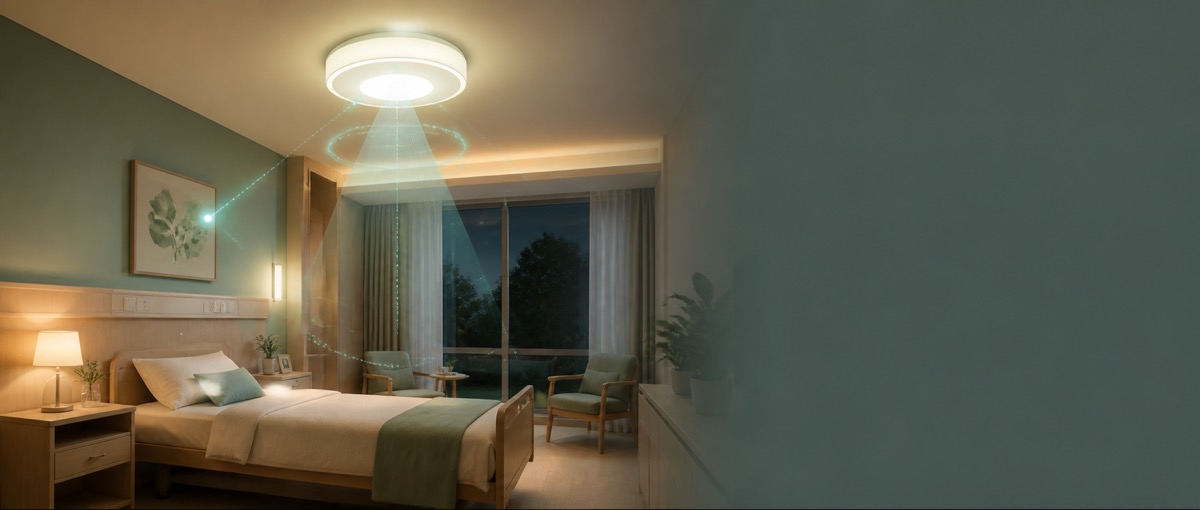
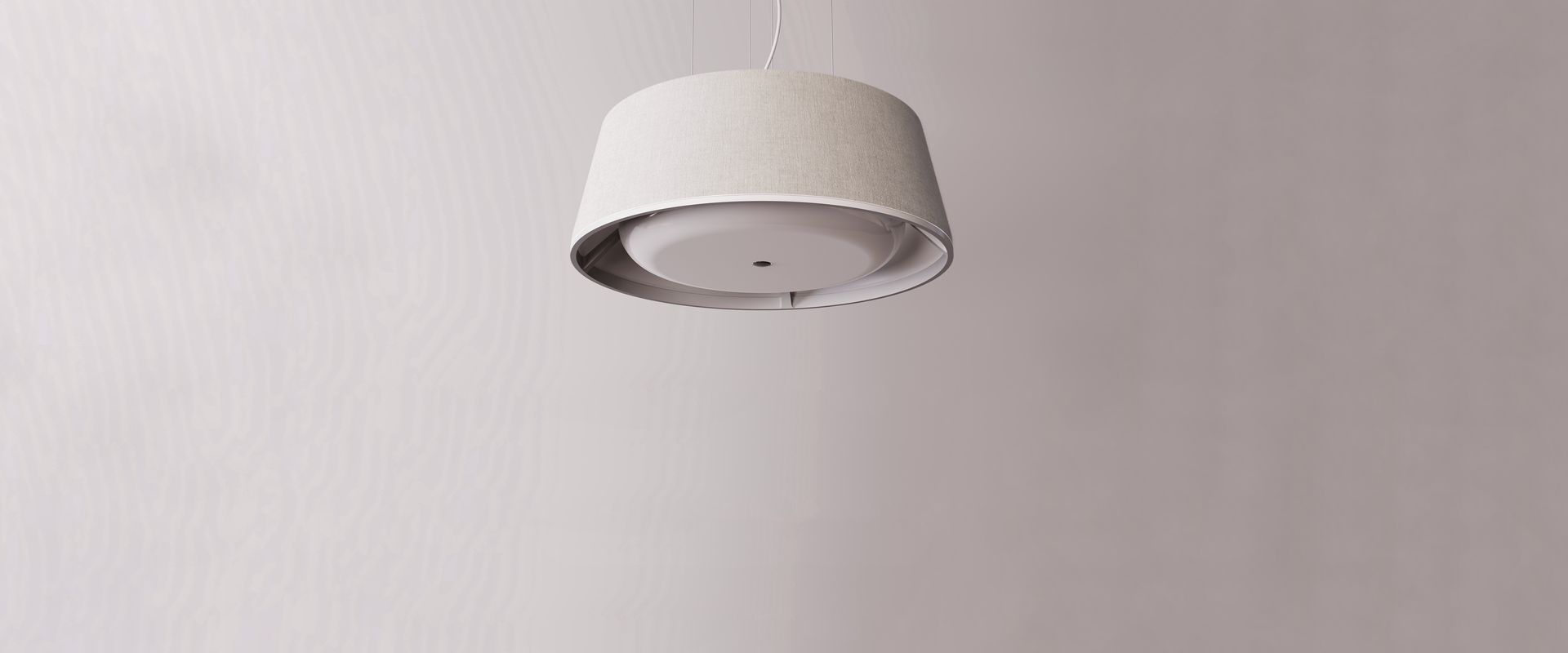
Image source: Nobi product visual. The important design choice is that the AI is packaged as room infrastructure rather than as another device the resident has to operate.
Most care AI pitches start with a screen. They promise remote monitoring, dashboards, alerts, and analytics, then quietly assume that older adults, nurses, families, and administrators will all accept one more digital workflow.
Nobi starts from the opposite end. It looks like a lamp.
That packaging choice is not cosmetic. In residential care, the first commercial problem is not whether AI can recognize a fall. It is whether the product can sit in a private room, avoid asking frail residents to wear or charge anything, alert staff fast enough to matter, and satisfy families, operators, and regulators that the system is helpful rather than invasive.
Nobi’s product is a ceiling-mounted smart lamp that combines lighting, fall detection, activity sensing, and care analytics. The device can detect a probable fall, ask the resident whether help is needed, alert staff if there is no answer, and use lighting to reduce night-time risk. The company positions the system around faster response, fewer severe consequences after falls, and operational insight for care teams.
The lesson for builders is clear: in high-friction healthcare environments, the winning interface may be the object that already belongs in the room.
The product hides AI inside accepted infrastructure
Nursing homes do not need more novelty for its own sake. They need interventions that reduce risk without creating a new burden for residents or staff.
Wearables can fail because residents forget them, dislike them, remove them, or cannot keep them charged. Cameras raise obvious privacy objections. Mobile apps do not fit residents with cognitive decline, limited mobility, or low digital confidence. A lamp avoids many of those problems. It is already expected in the room, it has power, it has a stable vantage point, and it can combine sensing with immediate environmental action.
That last point matters. Nobi is not only a passive alarm. Lighting itself becomes part of the care workflow. Better night lighting can reduce risky movement. A fall-detection signal can trigger a response. Room-level patterns can help staff understand whether a resident’s behavior is changing.
This is a useful pattern for vertical AI. Instead of asking buyers to adopt a new software habit first, the product embeds the model inside an existing operational surface. The AI becomes easier to buy because the object explains the job.
The evidence frame is stronger than a demo
Care operators are not buying an entertaining AI demo. They are buying risk reduction, staff leverage, family trust, and evidence that a new system will not make care delivery harder.
Nobi has leaned into that evidence frame. A frequently cited deployment involved Intelligent Care and the ICB Group installing 800 Nobi lamps across 80 care homes. Lancaster University conducted an independent evaluation of that deployment. The reported findings included a 32 percent reduction in falls, 23 percent fewer ambulance calls, and staff response times under three minutes.
Those figures should still be read carefully. They come from a specific deployment context, and independent evaluations do not automatically guarantee identical results for every care home. But they give Nobi something many AI products lack: a concrete operational claim linked to a real environment, not only a model benchmark.
The business argument is also framed in economic terms. The case material reports estimated annual savings of about 4,400 pounds per resident and about 1,560 pounds per fall avoided. Whether a buyer accepts those exact numbers or not, the pricing conversation moves toward avoided harm, fewer emergency calls, reduced staff load, and measurable care quality.
For healthcare AI, that is a better commercial language than “more automation.”
Privacy is part of the product, not a footnote
Fall detection in a private room immediately creates a trust problem. Families and residents may want safety, but they do not want the feeling of surveillance. Care homes may want data, but they cannot create a new privacy liability.
Nobi’s product design responds by making privacy a core sales point. The public positioning emphasizes privacy-preserving processing and an approach that does not require a conventional visible camera feed for routine monitoring. The buyer is not only evaluating detection accuracy. The buyer is evaluating whether the product can be explained to residents, relatives, staff, and inspection bodies without sounding like a surveillance system.
That is the real compliance lesson. In sensitive environments, the AI capability and the consent story have to be designed together. If the privacy story is weak, the model’s performance may not matter, because deployment will be blocked by people who never reach the demo.
Why this is a commercial product, not just a care gadget
Nobi is interesting because it connects several buyer outcomes in one physical form factor.
For care staff, it promises faster alerts and fewer blind spots. For administrators, it creates a measurable quality and risk-management story. For families, it can support confidence that a resident will not be left on the floor for a long period after a fall. For insurers and public systems, it suggests a way to reduce ambulance use and severe downstream costs. For the resident, it avoids a wearable or app habit.
That multi-sided value is why the lamp matters. A pure dashboard would mostly speak to management. A pure sensor would be harder to explain to families. A pure app would push work onto the resident. A lamp can serve as infrastructure, interface, and care signal at once.
This also changes expansion. Once a lamp is installed across rooms, the company can deepen from fall alerts into care analytics, activity patterns, night-time support, workflow routing, and portfolio-level insights across facilities. The initial wedge is physical safety. The broader platform is operational intelligence for elder care.
The builder lesson
Nobi’s case is a reminder that “AI product” does not always mean a chat interface, a dashboard, or an app.
In many verticals, especially healthcare, the more durable path is to ask what object, workflow, or trusted surface already carries the job. Then the product can hide the AI behind that surface and sell the outcome in the buyer’s language.
For elder care, the buyer does not wake up wanting a model. They want fewer falls, faster response, less staff stress, fewer ambulance calls, stronger family confidence, and evidence they can show to boards, regulators, and payers.
Nobi’s lamp is a good product metaphor because it literally illuminates the room, but the deeper lesson is less poetic: AI becomes easier to commercialize when it stops asking vulnerable users to change behavior before it creates value.