
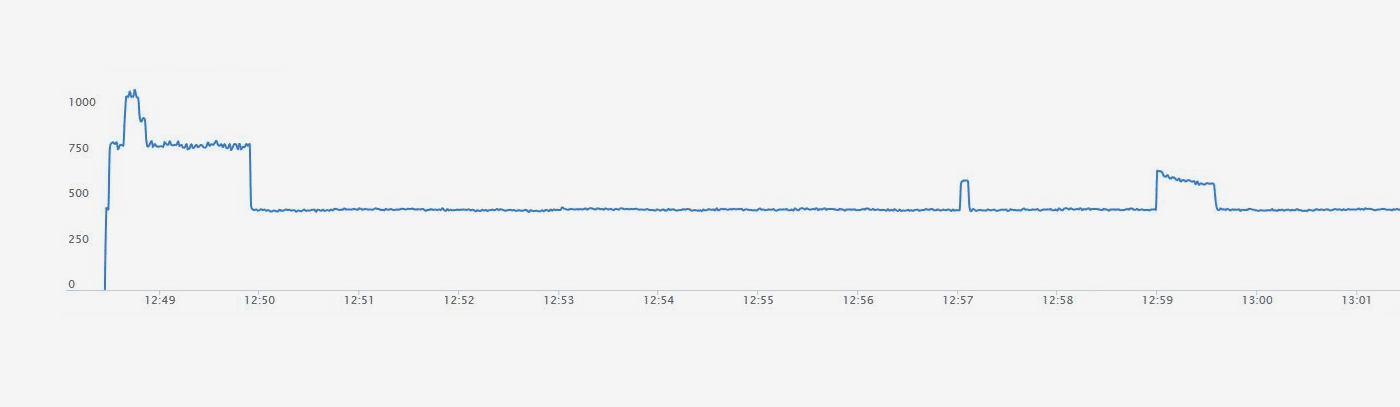
Image source: Wint technology page. The chart explains that the AI is learning what normal water flow looks like inside a building.
In some buildings managed by CBRE, certain rooms cannot get wet.
Not because repairs would be inconvenient, but because those rooms may contain R&D space, server rooms, data centers, or high-performance computing infrastructure. Pipes hide behind walls and ceilings. When one breaks, the damage does not stop at the water bill. It can become equipment damage, business interruption, insurance claims, and loss of customer trust.
So CBRE did not only buy a water dashboard. It deployed Wint across 57 customer sites, letting the system monitor water flow 24/7, detect anomalies, and shut valves when necessary.
Wint’s official CBRE story says the system helped CBRE-managed sites reduce 236.4 million liters of wasted water in 2025, save $850,000 in one year, and protect a server room from a water-damage event that could have cost millions. These results come from Wint’s customer story and are not independently audited.
They still show the commercial point. In the physical world, AI often becomes valuable first not by explaining more, but by completing a dangerous action before the loss grows.
Wint is not selling “smart water.” It is changing leaks from post-event insurance claims into pre-event shutoff decisions.
Pipes are still a blind spot
Commercial buildings have many digitized systems: elevators, access control, energy management, HVAC, and security. Water systems are often quiet until they are not.
That quietness is the problem. Water moves through mains, branches, cooling towers, hot-water systems, HVAC loops, fire lines, and temporary construction lines. A loose fitting, a stuck toilet, or a valve left open can keep releasing water while no one notices. A traditional meter can tell how much water was used. It is much worse at deciding whether this specific flow should be happening now.
Wint breaks the problem into three parts.
First, hardware sensors and control units read flow in real time. Second, AI learns the normal pattern of each water system and detects micro-leaks, burst pipes, continuous flow, and HVAC anomalies. Third, alerts, location, reporting, and remote or automatic shutoff sit in one workflow, so facilities teams do not merely know that water is leaking. They can stop it before damage expands.
Wint says its AI is trained on tens of millions of hours of real water-flow data and continuously adapts to each building. It also says the control unit includes backup power and local autonomy, so protection can continue during network or power failures. These are company technical claims, not audit results.
The product design is still clear. Monitoring says “there may be a problem.” Wint tries to connect the judgment to the valve.
Commercialization happens after shutoff
If Wint were only a smarter dashboard, its budget might sit under water conservation software, facility dashboards, or ESG reporting. That can be useful, but it is easy to defer and easy to pressure on price.
Automatic shutoff changes the purchasing reason.
For a facilities manager like CBRE, the value is not only water savings. It is business continuity in critical spaces. For contractors and developers, it is fewer late-stage water losses, less rework, fewer delays, and less insurance trouble. For real estate groups, it is portfolio-level risk control.
Wint’s expansion data reflects that logic. In February 2026, Wint said its systems helped more than 1,500 facilities save 1.15 billion gallons of water in 2025, prevented about 1,300 water-damage events, avoided roughly $100 million in potential losses, and had sold 30,000 systems in total. Those figures come from a company news release and are not independently audited.
Inc. 5000 offers a third-party growth signal: Wint was founded in 2011, appeared on the 2025 Inc. 5000 list, and showed a three-year growth rate of 250%. This is not a native new product. It is an “old tree, new bloom” case: a long-running vertical hardware and software company entering a new cycle at the intersection of AI, insurance, and facilities procurement.
That matters for AI builders. Many products put AI in the recommendation layer and hope users act. Wint puts AI closer to execution by connecting sensors, models, valves, and risk responsibility. The budget moves from “efficiency improvement” toward “loss prevention.”
Insurance backing makes buyers braver
Physical-world AI has a special trust problem: when it is wrong, who carries the cost?
If a copywriting agent writes a weak sentence, the user can revise it. If a building water system makes the wrong call, it may shut off water that should remain on, or fail to shut off water that is causing damage. The closer software gets to real assets, the less customers accept vague accuracy claims.
Wint productized part of that trust problem.
It partnered with HSB to offer a water-damage guarantee. Wint’s HSB partnership page says the guarantee can cover up to $250,000. It also cites a joint study with Munich Re saying that 66 construction sites using Wint saw water-damage claim frequency fall 73% and claim amounts fall 90%. These figures are from Wint’s partnership page and not independent audit evidence.
The business meaning is still powerful. Wint is not only selling AI to facilities managers. It is selling AI into the logic of risk and insurance.
That is stronger than an accuracy claim. Insurance backing turns “we can detect leaks” into “someone is willing to carry part of the consequence based on this system.” In enterprise buying, that trust structure can be more valuable than a feature list.
In December 2025, Grosvenor made a strategic investment in Wint and planned to expand adoption across its global real estate portfolio. The announcement placed water risk, water waste, and sustainability in the same frame. Customers like this are not buying a gadget. They are buying infrastructure that can fit asset management, risk management, and ESG goals.
Physical AI needs a closed loop
The counterintuitive thing about Wint is that it may not look “AI-native” enough.
It has hardware, installation, valves, construction sites, property portfolios, and insurance terms. These are heavy ingredients. They are not as easy to spread as a chat interface, browser agent, or coding assistant.
But the heavy ingredients are also the moat.
Water-flow data is not a free internet corpus. Every building’s system is different. Every pipe scenario is different. Every asset class has a different risk threshold. Wint needs hardware to capture data, models to understand anomalies, operators to trust alerts, valves to execute actions, and insurance or customer stories to lower buying risk.
That chain is long, but it explains why the company can expand from individual sites to 57 CBRE customer sites, more than 1,500 facilities, and 30,000 systems. The value is not one AI answer. It is continuous protection.
For founders, Wint offers a very concrete question. Do not only ask where to add an intelligent assistant. Ask which high-cost workflow still fails because problems are discovered too late, human action is too slow, and responsibility is hard to assign.
If AI can only remind, customers may buy it as a tool. If AI can detect, execute, and attract third-party risk backing, it can become a system budget.
Wint still has unknowns. It has not disclosed revenue, gross margin, retention, or average contract value. Installation products face delivery cycles, local rules, and channel constraints. Company case studies need continued verification.
Even with those caveats, Wint shows a commercialization path far away from “better chat.” Before asking AI to run the whole building, let it shut the valve before the leak becomes a disaster.