

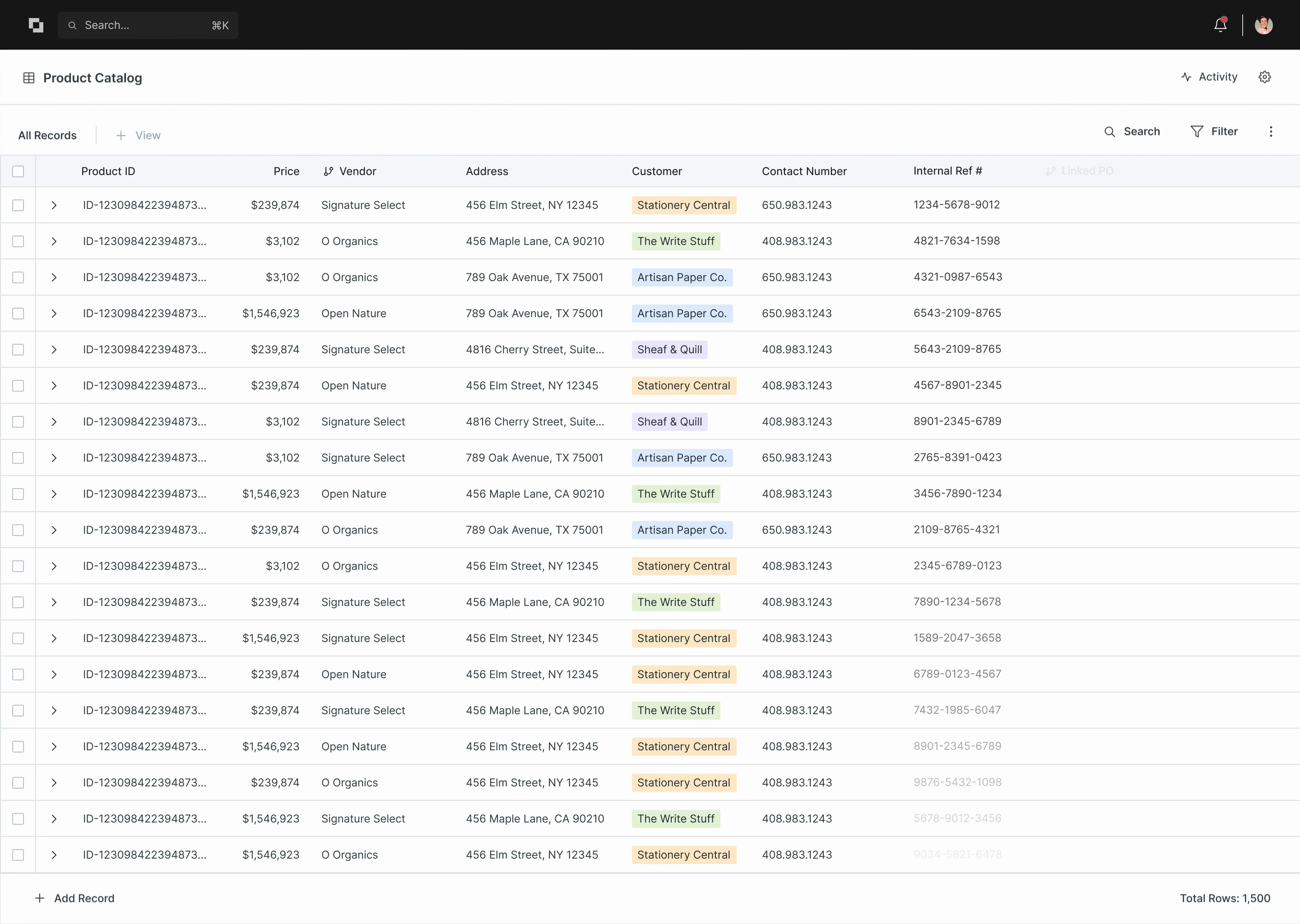
Image source: DOSS official product demo frame. It shows a product catalog and operating data table rather than a simple chat window.
AI-native finance ERP has been hot for the past two years. These products can automate accounts receivable, accounts payable, close, and reporting, promising to remove repetitive work from finance teams.
But for a company selling coffee, mattresses, snacks, or clothing, the mess often sits before the final line in the ledger: where the inventory is, which batch of materials has been consumed, which channel’s orders are unallocated, whether landed cost reached the general ledger, and whether supplier invoices match actual receipts.
If those inputs are wrong, even the smartest finance agent only automates on top of bad source material.
DOSS made an interesting choice. It did not keep trying to replace the finance ERP head-on. Instead, it placed itself between accounting systems and real operations, building an AI-native operations layer for inventory, procurement, orders, production, warehouses, and finance mappings.
TechCrunch reported in March 2026 that DOSS raised a $55 million Series B led by Madrona and Premji Invest, with participation from Intuit Ventures, Theory Ventures, General Catalyst, Contrary, Greyhound, and others. The report also said DOSS was founded in 2022 and had originally leaned toward a core accounting product before deciding to “play a different game.”
The sharper lesson is this: vertical AI does not always need to replace the system king. The higher-probability entry point may be the data field that the system king cannot trust.
DOSS started near accounting, then moved to inventory
Startup stories often begin with replacing the old system. ERP is a tempting target: expensive, slow, hard to implement, hard to customize, and hard to integrate. Every flaw looks like an invitation to an AI founder.
DOSS initially moved close to that direction. TechCrunch described an early product closer to core accounting. The problem was that AI-native finance ERP was also accelerating. Companies such as Rillet and Campfire were building more automated ledgers, AR, AP, and close workflows.
If DOSS continued straight into accounting, it would have entered a frontal fight: same AI story, same finance buyer, same migration argument.
Instead, DOSS stepped aside.
It now describes itself as an Operations Cloud. Its modules include Inventory Management, Procurement, Order Management, Finance & Accounting, Freight & Fulfillment, Warehouse Management, Production Planning, and Demand Planning. It is not only creating a purchase order. It is trying to place products, orders, suppliers, production, costs, and finance mappings into one configurable system.
That still sounds like ERP, but the position is different. DOSS does not always require customers to replace accounting first. It can cooperate with AI finance ERPs such as Rillet and Campfire, and many customers use it with QuickBooks.
This is a half-step retreat that becomes an attack. DOSS stands not in front of the finance system, but at the data entrance the finance system needs.
“Two ERPs” becomes the opening
This is not an obviously easy sale. DOSS still has to answer an awkward question: if the customer already has an accounting system, why buy an operations ERP too?
In traditional enterprise software, “add another system” means friction. Another vendor, another procurement cycle, another integration layer, another consistency problem. ERP projects already scare buyers because they can become long and expensive.
DOSS is betting that old ERP is too heavy, AI finance ERP is too light, and the middle layer has opened.
AI finance ERP can automate invoices, collections, expenses, bank transactions, and close. It cannot naturally know which batch reached the warehouse, why a purchase order and receipt differ by one line, how a production plan changed cost, or which split shipment should map to which order. Those are not just finance fields. They are constantly changing facts in operations.
Rillet’s partnership announcement with DOSS frames the issue directly: the partners want real-time operations and inventory data to flow into the GL so finance teams can close faster with more auditable books. Campfire says the same kind of connection is needed from warehouse to general ledger.
DOSS is not saying “we are also an AI ERP.” It is saying: before the finance agent automates the ledger, the ledger has to trust inventory and operations.
Where growth signals appear
DOSS has not disclosed ARR or standard pricing. Its website uses a sales-led demo motion and says pricing sits downstream of value. That suggests a mid-market and enterprise solution sale rather than a transparent self-serve SaaS tool.
It still has enough commercial signals for a case.
First is customer shape. TechCrunch says DOSS focuses on consumer brands with $20 million to $250 million in annual revenue and names Verve Coffee Roasters. These companies are complex enough to have channels, warehouses, POS, wholesale, DTC, suppliers, and finance systems, but not always large enough to absorb a long traditional ERP replacement.
Second is growth disclosure. Theory Ventures said DOSS grew revenue more than 10x in 2025, increased customers from 10 to more than 70, and processed 8.6 billion workflow events daily. Those are investor-reported figures, not audited numbers, but they show customers and usage expanding together.
Third is customer outcome. DOSS’s Verve Coffee story says Verve previously operated across a data warehouse, Cin7, POS, QuickBooks, and spreadsheets, and had suffered stockouts during events such as Whole Foods Prime Day. DOSS says it completed migration and master-data restructuring in eight weeks, saved the manufacturing team more than 20 hours per week, reduced unbatched orders from 30% to 1%, and improved QuickBooks finance mapping.
These results are company-published. They should not be treated as average market effects. They do show what DOSS sells: not a smarter chatbot, but a way to run more orders, inventory, and finance data with fewer people and fewer mismatches.
The real product is not Dossbot
The most AI-looking part of the website is Dossbot: a chat interface for querying, analyzing, and automating operational work.
But the hard product is not the chat.
Underneath, there must be structured relationships among product catalogs, orders, purchase orders, inventory, warehouses, production, suppliers, customers, costs, and finance accounts. Without those relationships, an agent can only say what seems likely. With them, it can map an operational action to goods, books, and people.
That is why DOSS has more commercial tension than many generic agents. General agents often have to stitch context across systems for every task. DOSS builds the road inside one vertical context: inventory-intensive companies.
For customers, the purchase is not about clicking fewer buttons. It is about reducing explanation cost between operations and finance. Why did purchasing rise? Why did gross margin move? Why did an order not ship? Why does physical stock not match the ledger? These questions used to require people to check tables, ask warehouses, and repair spreadsheets. DOSS tries to make them system-readable and agent-executable.
That is also why DOSS can cooperate with finance ERPs instead of swallowing them. Rillet and Campfire need clean operational input. DOSS needs finance systems as the destination. Two systems can coexist when the division of labor is clear.
The builder lesson
DOSS is useful because it did not worship the idea of replacing the whole system.
In enterprise software, replacing the old system is tempting because the market and budget look large. But the more central the system, the harder migration becomes. Customers do not keep old systems only because they are easy to use. They keep them because those systems are embedded in process, permission, reporting, and risk responsibility.
DOSS chose another path: find the place where old systems and new AI systems are both uncomfortable.
Old ERP is uncomfortable because process changes become projects. AI finance ERP is uncomfortable because it understands accounting objects better than warehouses, production, and order reality. DOSS stands between them and packages that system gap as a new budget.
The lesson for vertical AI is precise. Put AI on a real work object. Use ecosystem position when replacement is too slow. Tie value to job pressure, such as hours saved, orders batched, and migration time.
DOSS still has uncertainty. Its revenue and efficiency data come mostly from investors and company pages. Customers must accept a two-layer structure between accounting and operations. Traditional ERP vendors will not ignore the gap forever.
But the case is worth publishing because DOSS did not make AI the new universal entrance. It put AI into the field the universal entrance cannot understand.
When finance agents begin closing the books automatically, inventory, orders, and production data become infrastructure. DOSS is betting that this infrastructure can become a business of its own.