

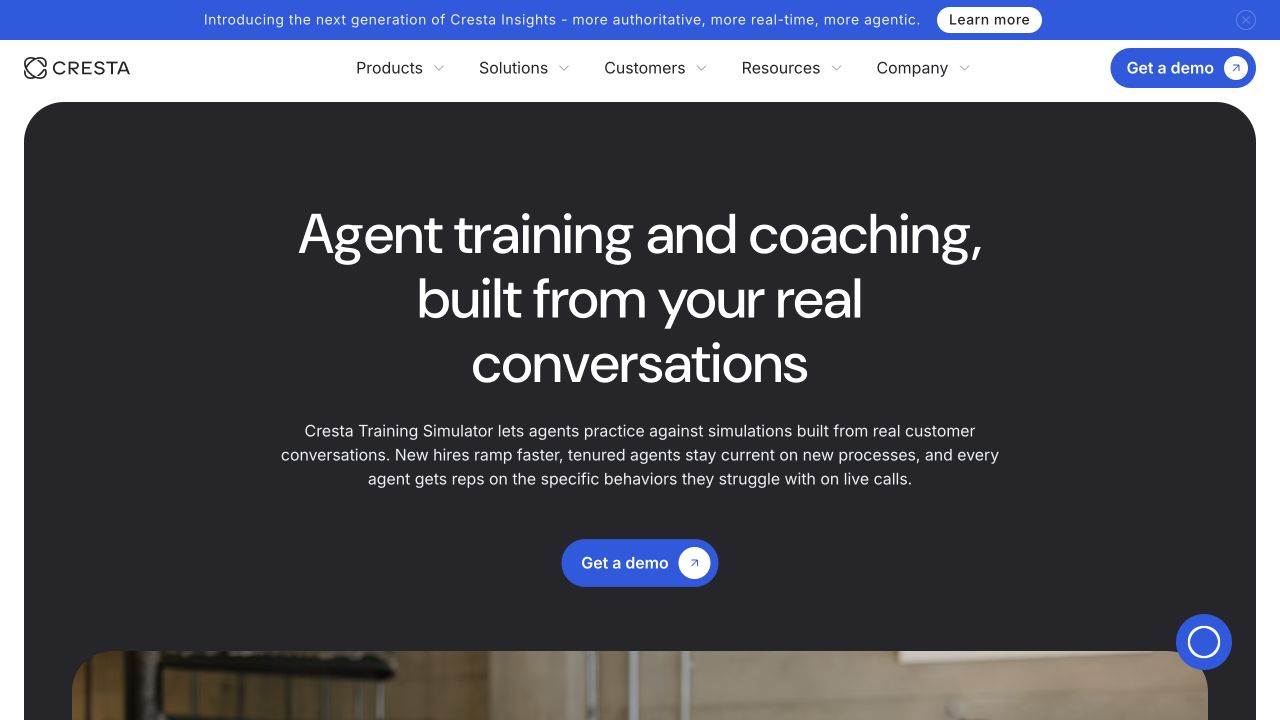
Image source: Cresta Training Simulator official page. Training scenarios are generated from a company’s real conversations.
The first time a new contact-center agent handles a retention call, the customer may already be threatening to cancel. In the old model, the agent memorized scripts, role-played with a supervisor a few times, and then learned from real customers. One wrong sentence could turn training cost into refunds, churn, or compliance risk.
Cresta’s choice was to move that first mistake into a simulator.
In July 2026, Cresta launched Training Simulator. It uses a company’s historical conversations to generate AI customers. New agents can speak with a simulated customer who objects, escalates emotion, and changes behavior based on the agent’s answer. Then the system scores the interaction against the company’s real quality standards.
The buyer is not paying for a toy character. Contact-center operations and training leaders are buying a practice field where difficult conversations can happen repeatedly without harming real customers. Traditional click-through courses rarely provide that.
Cresta is already a contact-center AI company with more than $100 million in ARR, according to company disclosure reported by Axios. That figure is not independently audited. The new product asks a sharper commercial question: can years of conversation data open a second budget line in training?
The hardest calls used to require real customers
Traditional training depends on scripts, recorded calls, and supervisor role-play. Scripts do not interrupt. Recordings do not push back. Supervisors do not have unlimited time to replay the same angry customer for every new hire. The real skill gap often appears only after the employee goes live.
Cresta says its simulated customer reacts dynamically to the employee’s response, showing emotion, objections, and escalation. After practice, the system identifies knowledge gaps and behavior issues. The agent can immediately try again. When managers discover a weak skill, they can place that scenario directly into a coaching plan.
AI role-play is not novel by itself. The valuable shift is that employees can experience rare, high-risk conversations at low cost. A mistake no longer has to wait for the next real customer to reveal itself. Training finally has a repeatable environment for failure.
Cresta turns customer data into a second product
A generic simulator can generate an “angry customer.” It does not know why a specific bank’s customers get angry, what answer violates policy, or what behavior counts as a successful save. Cresta’s existing conversation intelligence, real-time agent assist, and AI agent products already touch historical calls and quality standards. That context determines what the simulation practices and how it is scored.
That creates a production loop. Real calls expose gaps. Gaps become training scenarios. Training results flow into coaching plans. Future calls create the next feedback signal. Large models play the customer; the customer’s own data makes the practice commercially relevant.
The loop also changes how training content is produced. Traditional curricula are often updated quarterly by training teams, which means they lag behind new products, policies, and customer objections. Conversation data appears every day. New objections can enter practice faster.
This is the business reason Cresta can launch a training product. The same data and integrations that already serve operational efficiency and automation can now serve onboarding and coaching budgets. The company does not need to enter the customer system from scratch. A single account gains another reason to buy.
Cresta’s Achieve customer story says its existing products delivered 3x ROI and reduced after-call work by 75%. Those results are company-published and do not prove Training Simulator performance. They do show that Cresta already speaks in metrics contact-center leaders understand, and the new module can reuse that value language.
Three conditions make data a second product
First, the data must record real work, not only clicks. Calls contain objections, responses, policy boundaries, and business outcomes. That is enough to generate contextual practice. Ordinary usage logs would not have the same training value.
Second, the product must turn history into the next action. Cresta does not stop at analyzing which calls went wrong. It generates a customer to practice with and sends results back into coaching. Data creates a new purchasing reason only when it changes future performance.
Third, the result must connect to buyer metrics. Contact-center leaders care about ramp time, conversion, retention, compliance, and handling efficiency. If simulation cannot link to those outcomes, it remains an interesting feature. Cresta has the evaluation framework and existing customer proof, but Training Simulator still needs its own scorecard.
The simulator still needs proof
Training Simulator is newly launched. Cresta has not publicly disclosed its price, paid customer count, revenue contribution, or effect on retention. Simulated customers also need to prove that they can cover complex scenarios across industries. The more sensitive the conversations, the more important permissions, redaction, and evaluation governance become.
$100 million ARR proves that Cresta has a customer base. Prior customer results prove that its existing products can create value. They open the door for the new product, but they do not close the sale for it.
The next meaningful signal will be whether existing customers pay separately for this practice field.
Cresta’s move reveals a broader expansion pattern. When a company has accumulated enough real work data, the next growth curve may hide in the question: which expensive decision can this data improve next?
For Cresta, the answer is simple and memorable. Let the agent’s first bad answer happen in front of an AI customer, not a real one.