

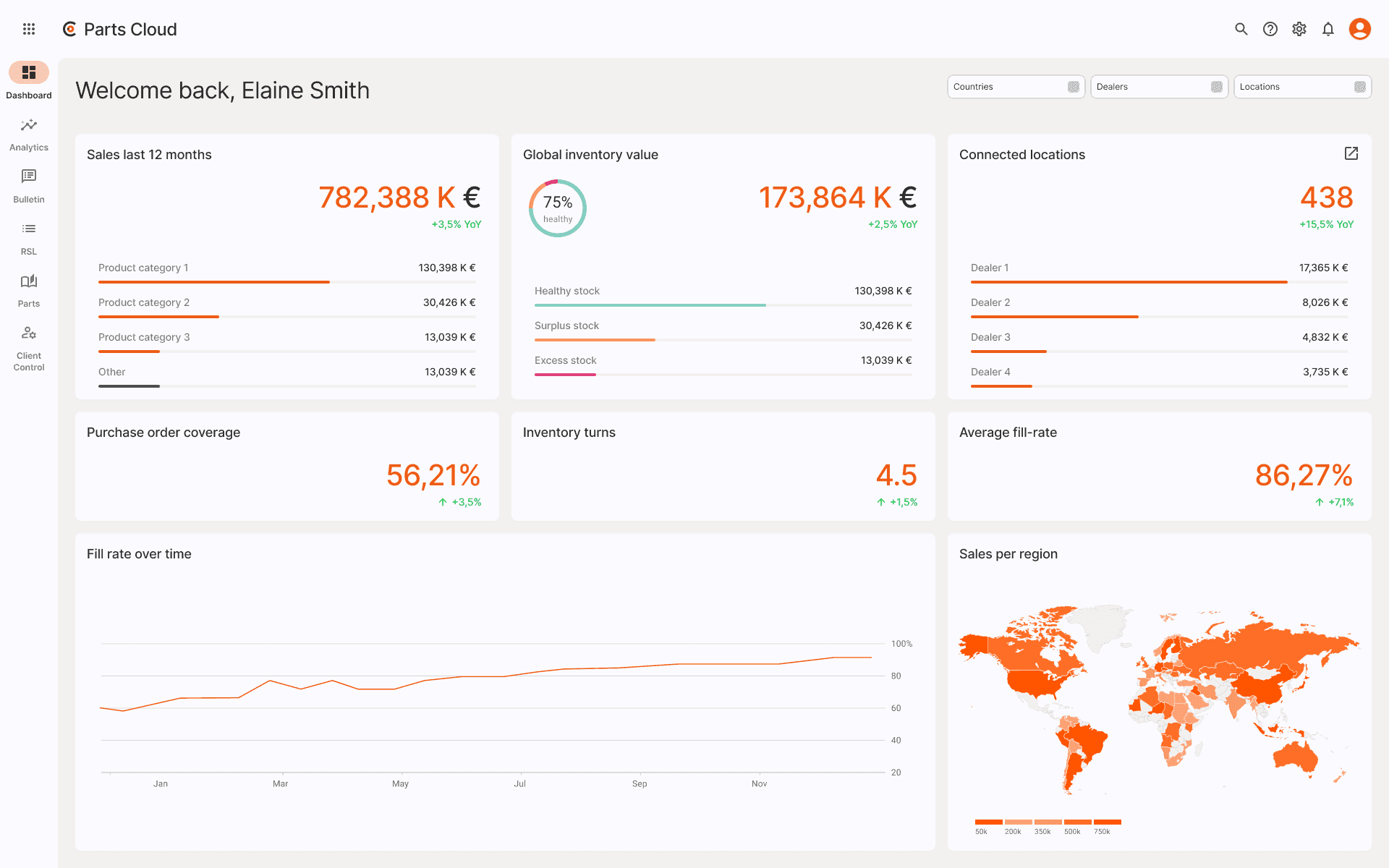
Image source: ClearOps public product material. The image explains the product interface and workflow and should not be treated as third-party audit evidence.
When an excavator stops on a job site, the expensive problem is often not the broken part itself. The expensive problem is why that part was not already in the right warehouse.
For industrial equipment companies, aftersales is not a customer-service department. It touches spare-parts inventory, dealer networks, technician time, machine downtime, customer satisfaction, and repeat purchases. The challenge is that the relevant data is often scattered across OEM ERP systems, dealer management systems, service tickets, warehouse spreadsheets, and machine telemetry. The more expensive the machine and the larger the network, the more valuable this broken connection becomes.
That is why ClearOps is worth writing about. It is not adding an AI chatbot for service staff. It connects industrial OEMs, dealers, service partners, and machines into an AI-powered aftersales platform, so spare-parts planning, demand forecasting, inventory recommendations, and service coordination can move into one control layer.
In May 2026, ClearOps announced an 8.6 million euro Series A led by Hitachi Ventures, with participation from Schoeller Group and Barkawi Group. Munich Startup also described ClearOps as an AI platform for industrial aftersales service and spare-parts processes. Tech.eu’s funding database records the same May 2026 financing.
The more interesting evidence is commercial. ClearOps says it serves thousands of dealers and millions of machines, with customers including AGCO, Terex, Jungheinrich, and Lippert. The company also reports that customers have improved spare-parts availability by up to 40%, increased spare-parts sales by 15%, and shortened repair time by up to two days. Those performance figures are company disclosures, not independently audited results. Still, they show the right value proposition: ClearOps is not selling “AI is smart.” It is selling fewer machine stoppages, fewer stockouts, and more controllable dealer networks.
Why aftersales is a strong AI entry point
Many AI products begin by searching for a visibly knowledge-intensive use case: writing copy, summarizing documents, generating email, or answering questions. ClearOps starts elsewhere. It looks for a long-standing break between legacy systems, business partners, and expensive operating consequences.
Industrial aftersales is not only a demand-forecasting problem. OEMs do not directly control every dealer warehouse. Dealers may not share complete data. Different regions use different DMS and ERP systems. Machine status, repair history, inventory turns, and replenishment rules are hard to see in one place.
That is why the ClearOps homepage emphasizes connection. It says the platform covers more than 2,500 dealers and more than 100 DMS integrations, and it emphasizes that it does not replace existing infrastructure. Instead, it connects manufacturers, dealers, and machines.
This is an important productization choice.
If a company only sells a forecasting model, customers will ask whether the forecast is accurate. If the company sells a connected aftersales control layer, customers are buying an operating result: which parts should be where, which dealers need replenishment, which machines are likely to create service demand, and which inventory is becoming trapped capital.
Turning spare-parts planning into a control console
ClearOps’s product modules are not flashy: Retail Inventory Management, Service Parts Planning, Workshop and Technician Management, and Data Connectivity. But those modules map to a real aftersales business chain.
The first step is connecting OEM and dealer systems. Without that foundation, AI can only guess from headquarters data.
The second step is making spare-parts inventory and demand computable. ClearOps’s Parts Cloud image shows metrics such as sales, global stock value, connected locations, purchase-order coverage, inventory turns, and fill rate. The product is not merely telling the user that a part may run short. It puts stockouts, redundant inventory, replenishment coverage, and regional sales into one operating view.
Only then does AI forecasting and automation become meaningful. ClearOps says it helps OEMs and dealers forecast demand and increasingly automate and execute key service and spare-parts workflows. The important word is not only “forecast.” It is “execute.” AI can move from analysis to execution only when it stands at the system connection point.
This is why ClearOps is more interesting than a generic analytics product. Its leverage comes from linking the organizations that must act together.
Why this can be a good business
ClearOps is an “old tree, new bloom” case. It is not a brand-new company less than three years old. Public materials give different founding-year signals, including 2015 and 2020. Either way, ClearOps is not simply a new AI wrapper. It is an industrial aftersales company using AI and connectivity to accelerate an old market.
That makes the case more useful. Some AI opportunities are not new needs. They are old needs that finally have a new execution mechanism.
Industrial aftersales has always mattered for OEM profit and customer loyalty. After equipment is sold, spare parts, repairs, service contracts, and downtime response continue to generate revenue for years. The problem is that traditional software has struggled to give OEMs real visibility into what is happening across dealer networks, and it has struggled even more to coordinate inventory and service actions across companies.
ClearOps’s enterprise sales motion fits that reality. Its site uses a book-a-demo path and its structured product data points to enterprise pricing rather than a cheap self-serve tool. It sells into OEM and dealer networks. The natural expansion path is also clear: begin with spare-parts availability and inventory planning, then move into service execution, technician coordination, dealer collaboration, and machine lifecycle data.
In other words, average account value does not have to depend on more AI calls. It can expand with more dealers, more warehouses, more product lines, and more service processes.
The moat is the network, not the model
This category is easy to misunderstand as “industrial demand forecasting.” If the product were only a model, the moat would be fragile. The harder part to copy is the connected relationship.
For aftersales AI to work, an OEM must connect ERP, DMS, dealer inventory, service tickets, machine data, and business rules. Every integration helps the platform understand how the network actually operates. Every replenishment and service coordination cycle leaves more data about demand, stockouts, inventory turns, and repair timing.
That is why ClearOps can look more durable than many general agents. A general agent can write an email from a blank page. It cannot immediately know why one dealer in one region always runs out of a specific part before the harvest season. That context is not chat history. It is operating data from an industrial network.
For founders, ClearOps offers a direct lesson. Do not only ask whether AI can automate an action. Ask which systems must be connected before the action, and what operating data is created after the action. If the product can stand at that connection point, it is not selling one automation. It is selling a new layer of business infrastructure.
What builders can learn
First, vertical AI does not need to start in the trendiest front-office category. The older, heavier, slower, and more cross-organizational a workflow is, the more likely it is to hide a valuable AI opportunity. Industrial aftersales, spare parts, repairs, warehouses, and dealer coordination may not sound glamorous, but they directly affect cash flow and customer delivery.
Second, AI products should move from recommendation toward control as soon as they can do so safely. Customers may pay for smarter suggestions, but they pay more for fewer stoppages, fewer missing parts, less idle inventory, and less manual coordination. ClearOps’s product language revolves around fill rate, parts sales, repair time, and machine uptime rather than model capability.
Third, AI opportunities in old industries often belong to teams that understand business bottlenecks, systems integration, and enterprise sales cycles. AI makes the old bottleneck newly productizable, but it does not remove the need to understand the field.
Many founders are still looking for the next chat interface. ClearOps reminds us that AI may first make money in the old world’s most expensive and fragmented operating nodes. The company that connects those nodes can turn AI from a feature into a system.