

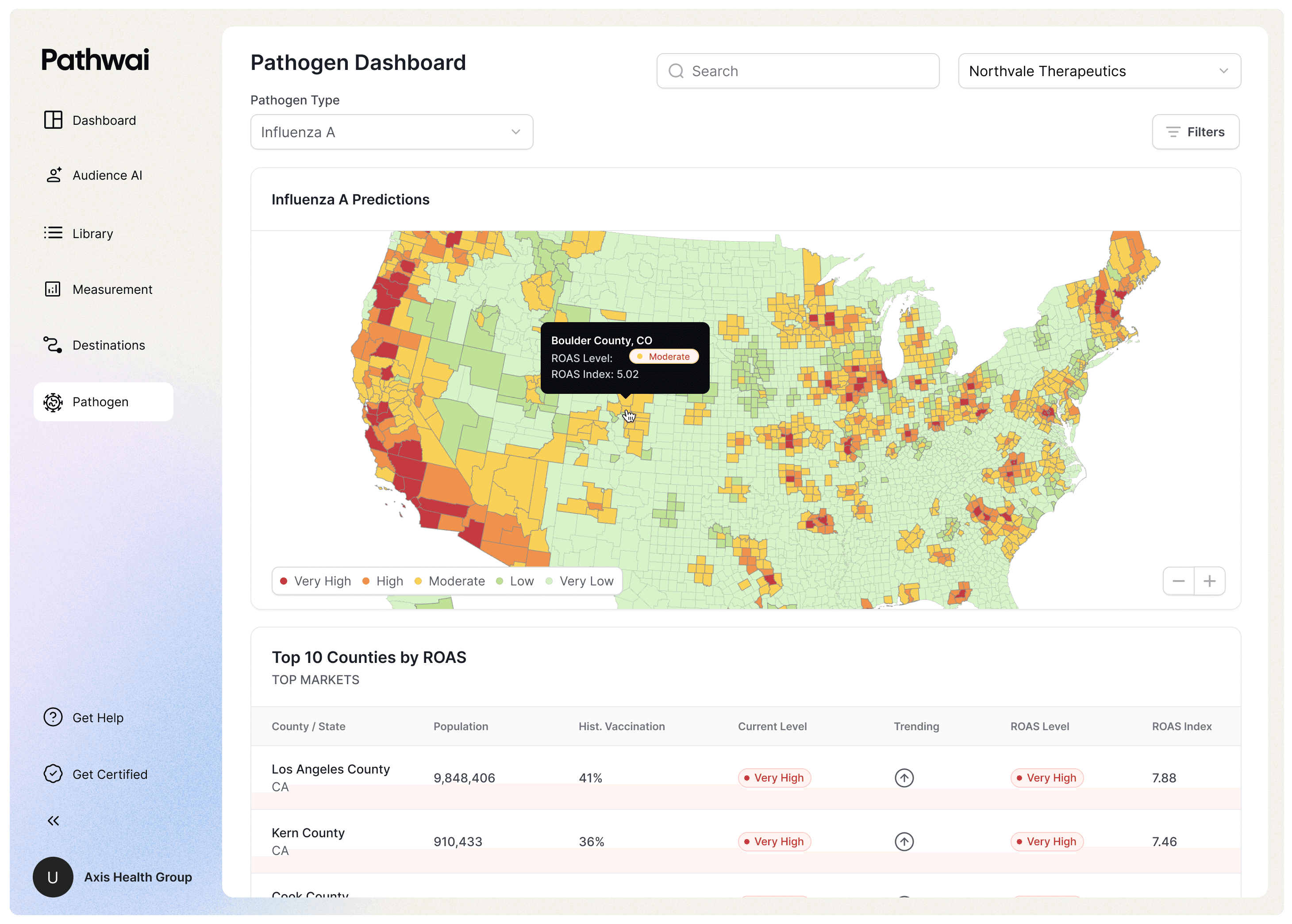
Image source: BranchLab official Pathwai page. The image shows Pathwai’s pathogen dashboard, county-level prediction heat map, ROAS prompts, and measurement table. It explains the product mechanism and should not be treated as third-party audit evidence.
The most expensive part of bringing a drug to market is not always inside the lab. After approval, the pharma company still has to answer a more concrete question: who is most likely to need this therapy, how can they be reached within privacy and compliance limits, and how can the company prove that the campaign produced real outcomes?
That sounds like a marketing problem. In practice, it is a regulated data-operations problem.
BranchLab works in that gap. It is not another AI drug-discovery story. Its product, Pathwai, connects patient identification, HCP audiences, media activation, and real-world outcome measurement for pharma commercialization. The entry point is not flashy, but it is close to budget, close to post-launch growth pressure, and close to two constraints AI products cannot avoid in healthcare: compliance and trust.
Pharma has data, but not enough action speed
Healthcare commercialization has a counterintuitive problem. The industry has enormous health outcome, prescription, clinical, media, and demographic signals, but those signals are hard to turn into action.
The reason is not that teams do not understand data. The reason is that the boundaries are everywhere. Protected health information limits what can move. Privacy laws, pharma legal review, media platforms, advertising agencies, data providers, and measurement vendors each own a different part of the workflow. A patient-audience insight often moves from question to model to audience to campaign to measurement through a series of organizational handoffs rather than a single product action.
BranchLab states the problem directly in its May 2026 Series A announcement. Pharma commercialization spans patient identification, audience segmentation, activation, and real-world measurement, but it has historically depended on fragmented vendors, delayed analytics, and manual processes. The company announced a $26 million Series A, bringing total funding to $35 million, with investors including McKesson Ventures, FCA Venture Partners, Sanofi Ventures, and AIX Ventures.
The funding amount itself is not the most important signal. The investor mix matters more. McKesson and Sanofi sit near healthcare distribution, pharma, and real-world medical systems. That suggests BranchLab is not selling a generic marketing AI tool. It is trying to enter the infrastructure layer of pharma commercialization.
Pathwai sells controlled prediction, not ad buying
Pathwai has a clear product boundary. It uses de-identified health data to learn patterns, then maps those patterns to non-sensitive demographic and media-side signals so pharma companies, agencies, and media partners can design, activate, and measure audiences without directly relying on individual-level health information.
BranchLab’s product page describes the workflow as Learn, Organize, Deploy, and Optimize. First, neural networks analyze de-identified longitudinal health data to identify pathways associated with specific outcomes. Then Pathwai clusters people into scalable clinical trajectory groups. It maps those groups to demographic, geographic, psychographic, and media signals to generate predictive audiences that can be activated across channels. Finally, it uses observed health events and campaign results to keep improving the models.
The key is not that AI is smarter than a human analyst. The key is that the product changes what pharma commercialization teams can directly operate.
In the old workflow, a pharma team might receive a static audience file, a post-campaign report, or a model output that requires data-science interpretation. Pathwai tries to turn the process into a system that can be opened, queried, filtered, and measured. The official screenshot shows a dashboard with a county-level prediction heat map, ROAS layers, top-county tables, and filtering controls. In other words, “who is worth reaching” becomes a product surface rather than a consulting deliverable.
That is what separates BranchLab from ordinary ad-tech. Standard ad-tech sells reach or media efficiency. BranchLab wants to sell a control layer that connects health outcomes, audience strategy, media activation, and result feedback inside a compliant boundary.
The stronger signal is channel integration
BranchLab’s site reports strong performance claims: 30 times faster execution, audiences three times higher quality than industry average, 20 times lower CPM, 90% lower target-audience reach cost, and an average commercial impact lift near 70% across therapeutic areas. These should be labeled as company disclosures or customer testimonials, not independent audit results.
Even if those numbers are discounted, BranchLab has a harder commercial signal. In February 2026, Dentsu announced that it had integrated its proprietary data with BranchLab’s Pathwai platform for healthcare audience modeling. The announcement says Pathwai uses anonymous data to create healthcare marketing audiences and lets Dentsu design, activate, and measure patient, caregiver, and HCP audiences.
This kind of partnership is more meaningful than a simple customer logo. In pharma commercialization, agencies and media data are the pipes through which budget moves. If BranchLab only sells to internal pharma data teams, the sales cycle can be heavy. If it enters an agency ecosystem like Dentsu’s, it can become the capability layer behind multiple brands and campaigns.
That means BranchLab’s commercialization does not have to start with every pharma company separately buying an AI platform. It can embed inside agency and media relationships, letting existing budgets shift toward faster audience design, clearer privacy boundaries, and more measurable outcomes.
Why this is a native new product opportunity
BranchLab is a native new product. Public company data indicates it was founded in 2024. As of August 1, 2026, it is still less than three years old.
The opportunity for a new company is that it does not carry the baggage of older ad-tech models. In traditional healthcare marketing, many companies monetize data resale, media arbitrage, static audience packages, and agency services. BranchLab’s narrative moves in the other direction: do not resell data, do not treat an audience as a static file, and let the customer explore, generate, activate, and measure audiences inside one system.
That is a useful lesson for AI builders. Vertical AI does not always need to replace the industry’s most core expert work. Drug discovery is huge, but research cycles are long and validation is extremely heavy. Pharma commercialization is different. The budget already exists, the problem is closer to revenue, feedback loops are shorter, and buyers can understand the cost of slow execution.
BranchLab did not choose “make AI a scientist.” It chose “put AI into the growth system after the drug reaches market.” That may be the more commercial product.
Regulated industries sell boundaries before automation
Many AI products fail not because the model is weak, but because customers do not know whether they should trust it. Healthcare commercialization makes this problem sharper. If a product begins by promising to find patients more precisely, the buyer immediately asks where the data came from, whether protected health information is involved, whether the model is explainable, whether it can be audited, and whether it triggers state privacy rules.
BranchLab’s smart move is to put the boundary at the front of the product story. The Dentsu announcement emphasizes HIPAA de-identified data, privacy compliance, and national activation. Pathwai’s own page emphasizes non-PHI data, de-identified health data, and continuous learning from real-world outcomes. BranchLab does not sell “AI automation” first and then add compliance language later. It makes “acting inside the regulated boundary” the prerequisite of the product.
That is a general rule for regulated AI. First, the customer must believe the system will not create unacceptable risk. Only then will the customer believe it can help them move faster and make money.
For builders, BranchLab can be summarized in one sentence: when an industry has high-value outcomes but is slowed by data restrictions, compliance, and organizational handoffs, the best AI entry point may not be a chat interface. It may be reconnecting the broken workflow into a controlled system.
The next wave of pharma AI commercialization may not be in the lab. It may start after the drug reaches the market.