
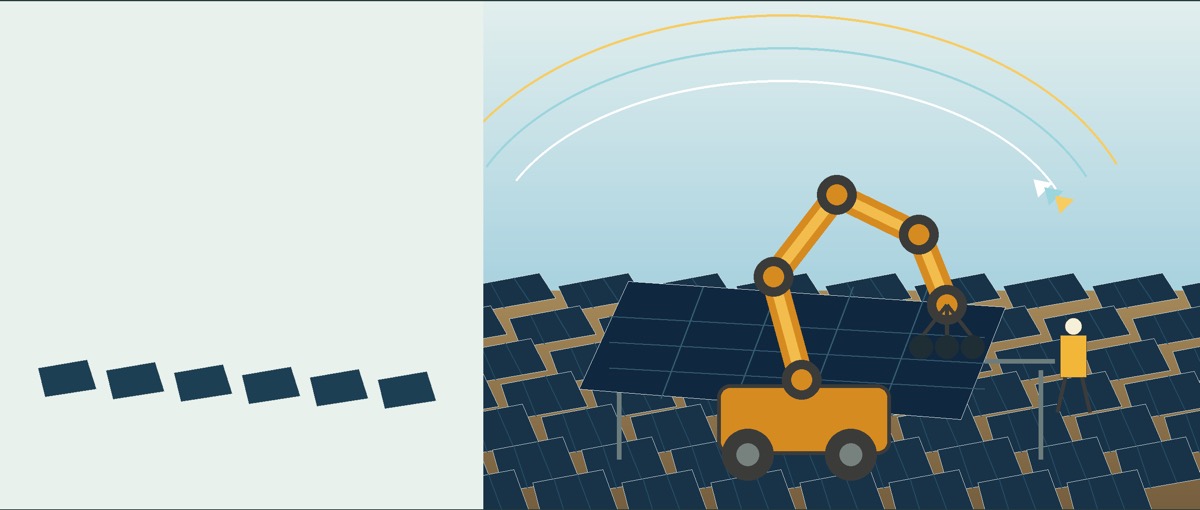
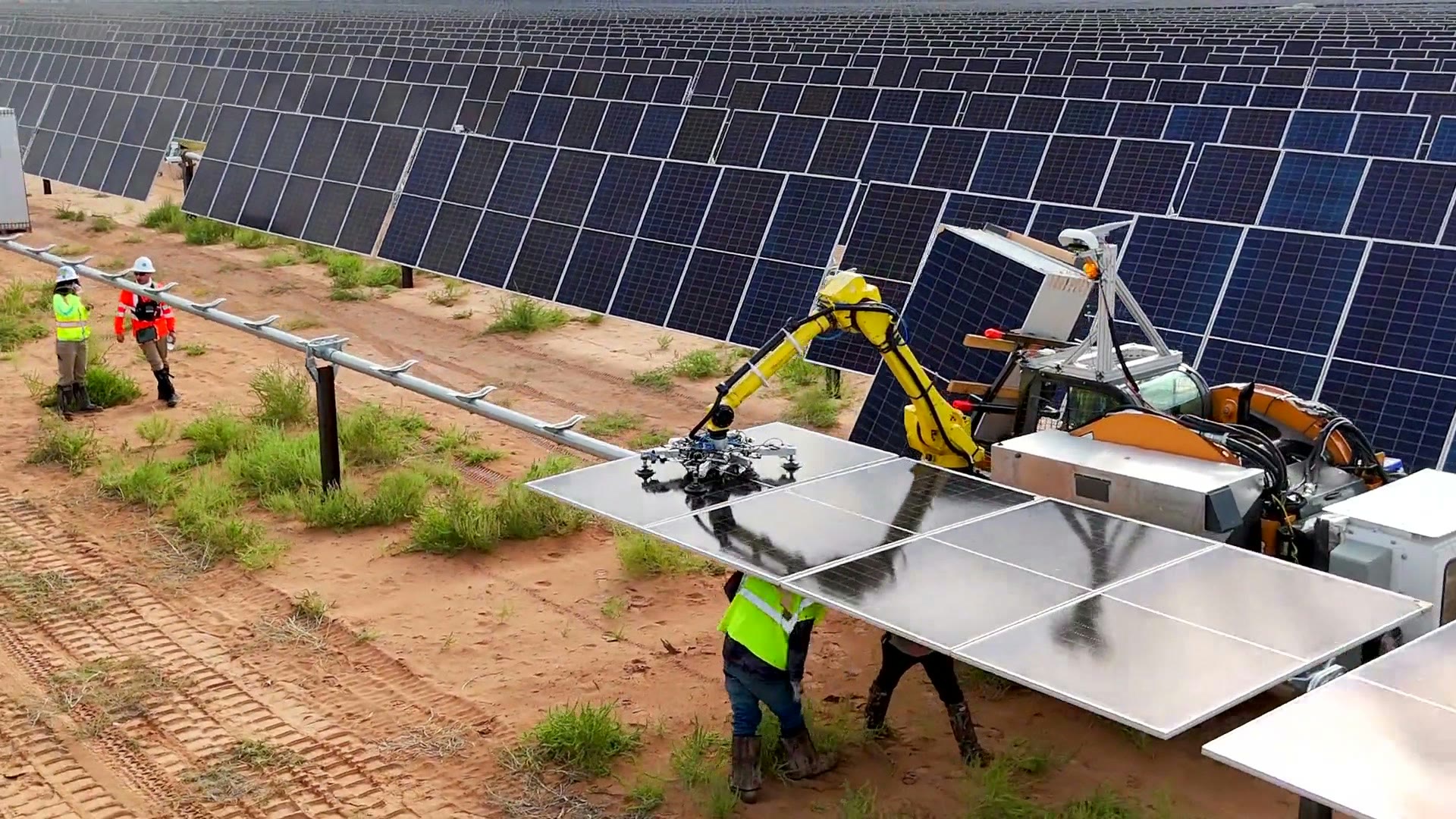
Image source: Gritt official Solar page. The image is official product or promotional material, not third-party audit evidence.
A large solar panel is not mysterious. The hard part is picking up thousands of heavy glass panels on a remote, hot, dusty jobsite, placing them precisely, fastening them safely, and doing it without slowing the project schedule.
That is where Gritt enters Physical AI. It is not starting with a story about general-purpose robots changing the world. It starts with a question contractors already ask every day: can the same crew install more panels, lift less weight overhead, and keep the project from being interrupted by labor shortages, heat, and weather?
TechCrunch reported in July 2026 that Gritt had emerged from stealth with $32 million raised, including a $26 million Series A led by Obvious Ventures. Funding is not the most important signal. The more useful signal is field demand: the same report said Gritt had two systems deployed and contracts covering 2.8GW of solar installations over the next 18 months, with customers including three of the top ten U.S. power construction companies.
Gritt’s own Solar page is more aggressive. It says the company has installed more than 30,000 solar panels and 18MW of solar, claims a fourfold EPC productivity improvement after deployment, and says costs are 50% lower than fully manual installation while heavy-load injuries fall 80%. Those are company claims, not independently audited numbers. Still, they reveal what Gritt is trying to sell: not a robot demo, but a set of productivity and safety metrics that project managers, EPCs, and asset owners can put into a schedule.
It sells construction certainty, not a robotic arm
Gritt’s strongest product decision is that it does not frame itself as a company building a universal robot from scratch.
TechCrunch reported an important detail: Gritt uses existing equipment and robotic arms, including rented skid steers and arms from suppliers such as Kawasaki, then connects its own AI models, visual perception, and control system. The first task is concrete. The system unloads large glass solar panels from a stack, moves them near the metal rack, places them with sub-millimeter precision, and lets workers fasten them.
That step does not sound flashy. It is valuable because the bottleneck on a solar jobsite is not only whether people are available. It is whether workers can safely, repeatedly, and predictably perform a high-intensity motion all day. TechCrunch quoted Gritt’s CEO saying that a typical eight-person crew installs about 800 panels per day, while the same crew working with Gritt can install 3,000 to 4,000 panels per day. That figure is also company-reported through media coverage rather than independently audited.
For buyers, this value is easier to purchase than “advanced robotics.” EPCs care about project delivery, labor organization, injury risk, delay penalties, and when an asset begins producing power. Gritt translates AI into variables those buyers already know how to calculate.
This is also why Physical AI commercialization differs from software AI. A SaaS tool can first sell an efficiency story and prove retention later. An AI system on a jobsite must prove early that it will not disrupt field operations, create safety risk, or force existing crews and equipment into an entirely new workflow.
By attaching itself to existing machinery and existing construction rhythm, Gritt lowers adoption friction. The customer does not have to believe a new robot will run the whole site. The customer only has to believe that this AI control layer can make existing equipment perform one frequent, dangerous, schedule-sensitive action better.
One motion can become a jobsite operating system
If Gritt were only a solar-panel installation machine, it would still be a credible robotics company. Its more interesting commercial opportunity is that panel handling can become an entry point into the jobsite data layer.
The Gritt homepage describes five categories of capability: pick-and-place, assembly, transportation, verification, and planning. In other words, the company does not only want to move and place objects. It wants to inspect work, produce logs, handle documentation, monitor site conditions, and recommend next steps.
Gritt’s launch announcement makes the same point. After connecting to common construction equipment, the system can capture completed work, material movement, and site conditions on large construction sites, then turn that real-time data into management decisions. The company’s site also says its machines capture terabytes of data each day and have been deployed across more than seven jobsites. Those are company claims, but they show the intended direction.
That path matters. Many AI products get stuck because they only advise and never enter execution. Gritt moves in the opposite direction: it first monetizes the execution motion, then lets the data produced by that motion become a larger management interface.
Solar is only the first panel. Gritt has said it wants to expand into purlin assembly, component transportation, supervision, and verification, and eventually into data centers and other large infrastructure projects. TechCrunch also reported that Gritt hopes to handle drilling, rack construction, rebar tying, and other repetitive construction tasks.
The growth path is not simply “sell more robotic arms.” It is “take responsibility for more repeatable, verifiable, schedulable actions on the same construction site.”
That can become a practical moat. Not model parameters. Not a demo video. The moat is field data, site integration experience, safety boundaries, customer schedule trust, and operational feedback from every deployment.
Why builders should study this case
The first lesson from Gritt is that the best AI entry point is not always knowledge work.
For the past two years, the most visible AI commercialization examples have appeared in support, sales, coding, legal work, finance, and healthcare administration. Those workflows are text-heavy, data-rich, and delivered on screens. Physical AI points to another large opportunity outside the screen: when work is repetitive, dangerous, and directly tied to revenue or delivery timelines, buyers will calculate whether AI can enter the field.
The second lesson is that AI in hard industries should often disguise new technology as an improvement to an old process.
Gritt does not ask customers to immediately accept a completely redesigned way to build solar farms. It starts with equipment customers already know, crews they already manage, and project metrics they already track. It places AI on one painful part of the process. That productization choice is plain, but it matches real procurement. Customers do not pay for the AI concept. They pay for fewer delays, fewer injuries, more installed panels, and less rework.
The third lesson is that in vertical AI, a narrow action with a clear service boundary may build trust faster than a broad general agent.
Solar-panel installation seems narrow, but it has three useful conditions. The action is highly frequent. The result is easy to verify. The payoff can be translated into schedule and cost. Only after this step works does Gritt earn the right to talk about a broader jobsite operating system.
Many AI founders reverse that order. They first build an agent that can cover many scenarios, then search for a customer willing to hand over a critical workflow. Gritt’s order is harder and more concrete: take one task that customers already hate and already pay to solve, then let AI grow outward from that task.
Physical AI’s first money comes from hard work
Gritt still carries real uncertainty. It has to deploy the planned 48 systems, keep safety and quality stable at scale, prove that tasks beyond solar can reuse the same intelligence system, and back up its efficiency and injury-reduction claims with broader third-party validation.
But the signal is clear. When AI moves into the physical world, commercialization may not start with the scene that looks most futuristic. It may start with the work that is heavy, repetitive, schedule-sensitive, and expensive enough to justify adding intelligence.
In software, AI first wrote text, code, and messages. In the physical world, AI may first lift panels, place components, verify work, and plan sequences.
The real opportunity is not whether robots can become human-like. It is which piece of real work is already expensive enough for intelligence to be inserted. Gritt’s answer is direct: go to the jobsite, take the hard task, and turn the schedule into the product.