

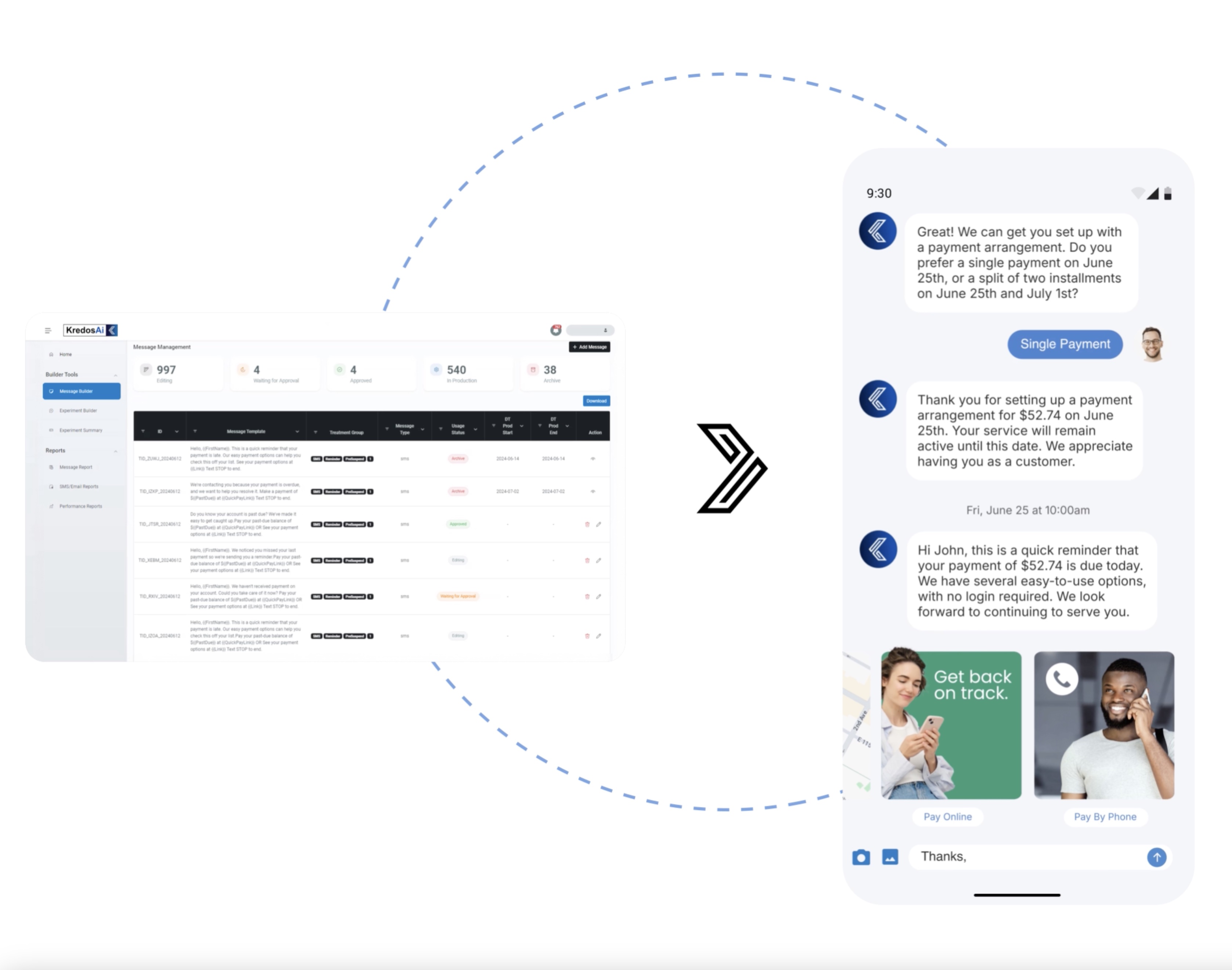
Image source: KredosAI website product material. The visual explains the product mechanism and is not third-party audit evidence.
After a bill becomes overdue, most companies do something blunt: send texts, make calls, and email the customer on a fixed cadence until the payment arrives.
That sounds like an operating detail. It is actually a cash-flow problem and a customer-relationship problem. Push too softly and the money does not come back. Push too hard and the customer may be pushed toward suspension, write-off, third-party collections, or churn.
KredosAI enters the middle window: the bill is late, but the account has not yet been written off or handed to a traditional collections agency. It does not present itself as an “AI debt collector.” It turns delinquent-payment communication into a continuously learning behavioral experiment system.
That angle is worth serious attention from AI product builders.
It chooses the next sentence, not just the collection task
GeekWire reported in July 2026 that KredosAI raised a $7 million Series A led by BMW i Ventures. The company was founded in 2021 by former T-Mobile executives Balaji Sridharan and Dave Thoms, and its core use case came from real experience with telecom billing, credit, and collections workflows.
KredosAI is not interested only in the word “collections.” It is interested in the pre-collections window where the customer relationship can still be saved.
An overdue customer may have forgotten to pay. They may be temporarily short on cash. They may be unhappy with the service. They may have no intention of paying. Traditional systems often force all of them through the same template: the same copy, same time, same channel, and same threat.
KredosAI’s logic is the opposite. It analyzes account attributes, historical payment behavior, communication preference, and previous response patterns. Then it decides what message to send, when to send it, whether to use SMS, email, or RCS, and which call to action to offer.
The KredosAI solution page breaks the workflow into four variables: customer data, messaging, timing, and channel. The productization point is not that AI writes a warmer reminder. It is that each contact returns a result: whether the customer opened, replied, chose an installment plan, or paid.
That is also how it differs from ordinary A/B testing. The website says the platform can test thousands of actions at once and use reinforcement learning to learn which strategy works for which customer. This is a company claim rather than audit evidence, but it shows the product ambition. KredosAI wants to be a payment-outcome optimization layer, not a reminder tool.
Why the market is valuable now
If the product only improved text-message open rates, it would not be very interesting. KredosAI matters because it connects to an outcome enterprises already price: fewer write-offs, faster recovery, fewer suspensions, and lower churn.
The New York Fed’s Q1 2026 household debt report said U.S. household debt reached $18.8 trillion and that 4.8% of outstanding debt was in some stage of delinquency. For telecom, auto finance, banking, and other companies with millions of consumer accounts, delinquency is not an edge case. It is a monthly operating reality.
GeekWire reported that KredosAI had processed more than 200 million customer interactions, grown revenue more than 6x over two years, served some Fortune 50 companies, and integrated with the FICO Platform. BMW i Ventures also said in its investment announcement that KredosAI showed an 11.5% reduction in write-off rate and a 13.6% increase in customer lifetime value in enterprise portfolios, translating into more than $50 million in annual bottom-line impact for large enterprises.
Those performance claims should be read carefully. They come from the company and investor, not from an independent audit. But even as directional evidence, they explain why buyers care.
Large enterprises are not buying KredosAI to “use AI.” They are buying it to handle overdue accounts more precisely before they become bad debt. For a CFO, this is loss recovery. For operations teams, it is a way to replace experience-driven fixed rules with a learning system.
Why BMW i Ventures led a collections AI round
At first glance, BMW i Ventures leading a KredosAI round looks surprising. Why would a carmaker’s venture arm invest in an overdue-payment communication platform?
The answer is auto lending.
KredosAI’s auto financing page states the problem directly: auto loan delinquency damages portfolio performance, while repossession is expensive. The page says enterprises using KredosAI can see 20x ROI, an 8% to 10% reduction in suspend rates, and more than 10% improvement in DSO. Those are also company claims, not audited results, but they point to a clear commercial logic. Auto finance does not only care whether the car can be recovered. It cares whether payment can be recovered before the customer relationship breaks.
That gives the BMW i Ventures investment industrial meaning. KredosAI began from telecom and is expanding into auto finance. BMW i Ventures supplies not only capital, but also credibility for auto-finance buyers.
The lesson for AI founders is that a vertical AI financing story should not stop at “we have a model.” A stronger story is: we are reducing a real, measurable loss point in an industry chain, and that loss point can be amplified through channels and strategic partners.
KredosAI is selling a result in the overdue-payment chain: faster payment, fewer write-offs, fewer harsh suspensions, and fewer customers pushed into a bad experience.
The moat is the feedback network
On the surface, KredosAI can look easy to copy. Connect an LLM that writes payment reminders to SMS and email, add a dashboard, and the product seems plausible.
The hard part is knowing which sentence in which situation actually produces payment.
One customer responds to “pay today to avoid suspension.” Another responds to “you can split this into two payments.” One person clicks a link on Monday morning. Another waits until payroll hits on Friday. Some customers prefer SMS, some respond better to RCS rich media, and some need an AI voice agent to continue the action.
That is not a pure text-generation problem. It is a business-result learning problem.
KredosAI emphasizes message mechanics, reinforcement learning, control groups, and ROI analysis. That suggests it is trying to turn collections into an experiment system. Each contact is an action. Each payment or nonpayment is feedback. Each industry and customer segment can accumulate new strategies.
If that feedback network compounds, the moat is not only the model. It becomes behavioral-outcome data and deployment templates across enterprises and industries. The larger the enterprise, the more accounts it has. The more accounts, the faster experiments converge. The faster experiments converge, the easier it is to prove ROI. The easier it is to prove ROI, the easier it is to enter the next large account.
That is why this case is more interesting than generic AI customer service. It puts AI inside a naturally closed-loop workflow.
What builders should learn
KredosAI is not a purely new product. It was founded in 2021, with stronger commercialization signals appearing in the past 24 months. Its value is not simply that it caught the AI narrative. AI gave an old operating problem a new product shape.
Old collections software looked like a rules engine and process system. KredosAI is trying to make it a dynamic learning layer: understand the customer, choose the action, observe the result, and update the strategy.
Similar opportunities exist in many industries.
Procurement, reimbursement, claims, renewals, compliance, scheduling, receivables, inventory, and quality inspection can all look like back-office work. But many share the same traits: high-frequency actions, clear outcomes, measurable losses, rigid human rules, and unused feedback data.
The easiest first revenue for AI products may not come from the flashiest surface. It may come from workflows that already have budget, already have losses, already have data, and still have not formed a learning loop.
KredosAI’s answer is restrained. Do not rush to make AI do everything. First let AI make the next step more accurate inside a narrow window. For the enterprise, one accurate action is money. For the product, repeated accuracy becomes harder to replace.
That may be one of the plainest and most durable paths in vertical AI commercialization.