
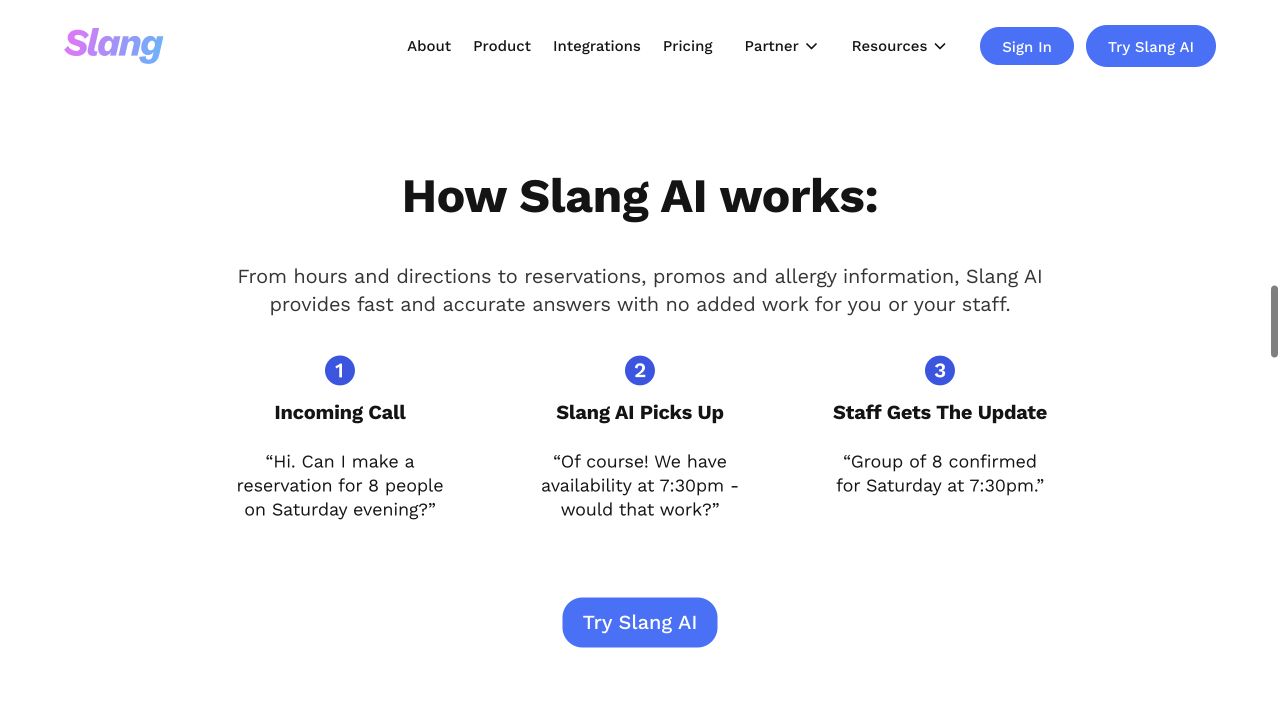
Image source: Slang AI website. The image is official workflow material.
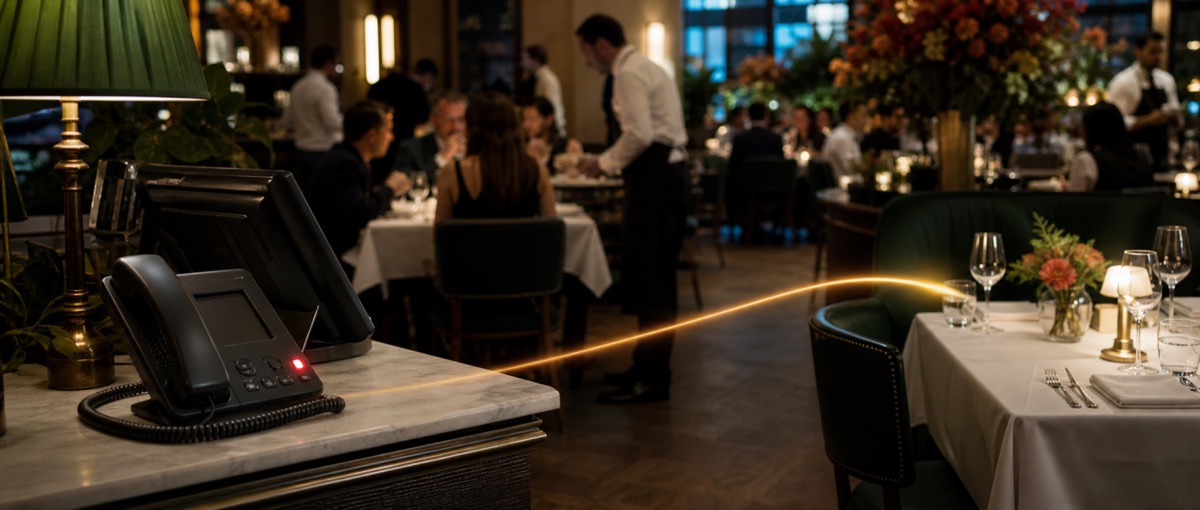
During a dinner rush, a restaurant team faces two kinds of customers: the ones already sitting in the dining room and the ones calling from the other end of the phone. Answer the call, and the in-person service flow is interrupted. Ignore the call, and a reservation, private event, or catering order may go somewhere else.
Slang AI has turned that conflict into a business. It uses voice AI to answer calls, respond to questions, complete reservations, and hand off requests that need staff attention. The company says its product is used by more than 2,000 restaurants, has handled 25 million calls, and has reached 10 million guests. These operating figures come from Slang AI’s own disclosure, not from a third-party audit.
In February 2026, Axios reported that Slang AI raised a $36 million Series B. The more interesting point is that Slang does not define phone calls as customer-service cost. It reframes each missed call as potential revenue that can be captured.
Restaurant calls contain demand that can close immediately
Consumers usually do not call a restaurant to make small talk. They may ask whether there is a table tonight, whether the restaurant can seat eight people, whether a gluten-free menu exists, or whether a private event can be booked. The need is concrete, time-sensitive, and often convertible into a transaction.
Slang AI’s official material says restaurants may miss as many as half of their call opportunities each day, and about 20% of demand occurs outside business hours. Those ratios are company data and have not been independently verified. But the underlying pain is easy for operators to feel. A missed restaurant call often does not come back.
That gives voice AI a narrow and strong job. It does not first need to prove the broad idea of an “AI employee.” It needs to prove two things: can it reliably answer the call, and can it move the call toward a reservation or a valuable lead?
This is why the restaurant phone is a better wedge than it may look. The call has urgency, clear intent, and measurable downstream outcomes. If the system books a table or captures a private-event inquiry, the value is legible.
The product connects conversation to transaction systems
A bot that only answers opening hours is easy to replace. Slang AI deepens the product by entering reservation and event workflows.
According to its public pricing page, the Core plan starts at $399 per location per month and connects to systems such as OpenTable, SevenRooms, and Yelp. It can handle reservations, SMS confirmations, special requests, and VIP transfers. The Premium plan starts at $599 per location per month and adds cross-location recommendations, real-time alerts, and a priority inbox. Enterprise plans add custom workflows and reporting for multi-location operators.
Cross-location recommendations show the product logic well. If one restaurant in a group is full tonight, the AI can check availability at a nearby location and keep the guest inside the same restaurant group. In that moment, the value of the voice model is not that it sounds human. It is that it can read inventory and complete the next transaction.
Once phone, reservation systems, SMS, and staff follow-up sit in the same chain, restaurants can see which calls turned into bookings and which events still need attention. The effect of AI can be measured in seats, leads, and revenue instead of generic automation.
Per-location pricing makes the buying case simple
Slang AI charges by location rather than by employee seat or call minute. That unit matches how restaurants operate. Each additional location has its own hours, menu, reservation inventory, caller demand, and subscription value.
For a single restaurant, the question is easy: is $399 per month cheaper than missed reservations and staff interruption? For a group, the Premium plan’s cross-location routing and enterprise reporting create an expansion path. Product value grows with the number of locations and call scenarios, and the commercial model grows with it.
That is more elastic than only selling labor savings. Cost savings can hit a ceiling. Revenue capture can expand into reservations, private events, catering, repeat visits, and group-level routing. Slang AI is also expanding from voice into SMS, guest memory, and follow-up, which suggests it wants to own more of the guest journey after the first call.
The key is that the initial wedge is not abstract. The restaurant already knows what a booking is worth. The system can be evaluated against missed calls, booked reservations, captured event leads, and response speed.
25 million calls become industry context
Restaurant calls have their own language: dish names, allergies, table types, party-size changes, late-arrival rules, and requests that customers do not always express clearly. A general voice model can transcribe speech, but that does not mean it can reliably handle restaurant operations.
Slang AI says it has accumulated 25 million real calls since launching in 2019 and uses that data to improve intent recognition, tone, and responses. That is still company disclosure. But it points to where vertical voice products may build an advantage: not in voice generation itself, but in the mapping between industry conversation and transaction outcome.
The product still has to pass operational reality. Restaurant brands care deeply about tone. Complex complaints and special requests still need people. If a reservation system sync fails, one incorrect promise can damage the guest experience. The closer the product gets to revenue, the more it must own reliability.
Slang AI’s path is therefore specific: find a communication flow that already exists, happens every day, and can be priced by outcome. Then connect the model to the systems needed to complete the transaction.
For restaurants, the phone did not become new. What changed is that demand that used to disappear into a missed call can now be recorded, routed, and converted.
The builder lesson: revenue beats novelty
Voice AI can sound like a technology category. Slang AI makes it a business category by narrowing the job.
The product does not ask restaurant owners to buy “conversational AI.” It asks them to buy fewer missed calls, more reservations, more captured event leads, and less interruption for staff. That is a stronger offer because the buyer already understands the metric.
Many AI founders try to sell human-like interaction as the main miracle. In vertical workflows, human-likeness is often secondary. The product has to know what the caller wants, connect to the relevant system, complete the action, and escalate exceptions before the experience breaks.
Slang AI’s case suggests a practical rule: if the conversation already contains buying intent, and the next action can be measured, voice AI has a path to commercialization. If the conversation is only a generic support surface, the business may be much harder.
That is why a narrow restaurant phone product can support a serious company. It is not because restaurants suddenly love AI. It is because missed calls already cost money, and the product gives operators a way to see that money again.