
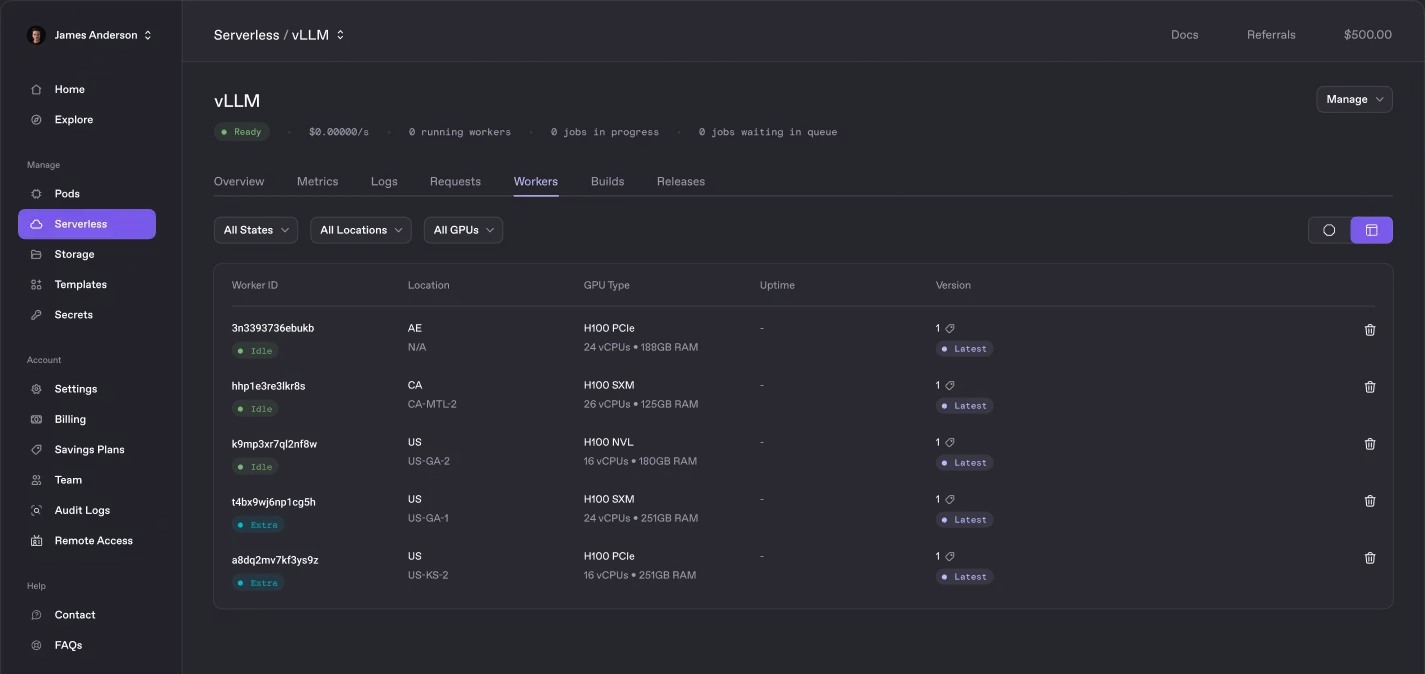
Image source: Runpod website. The image shows an official product interface.
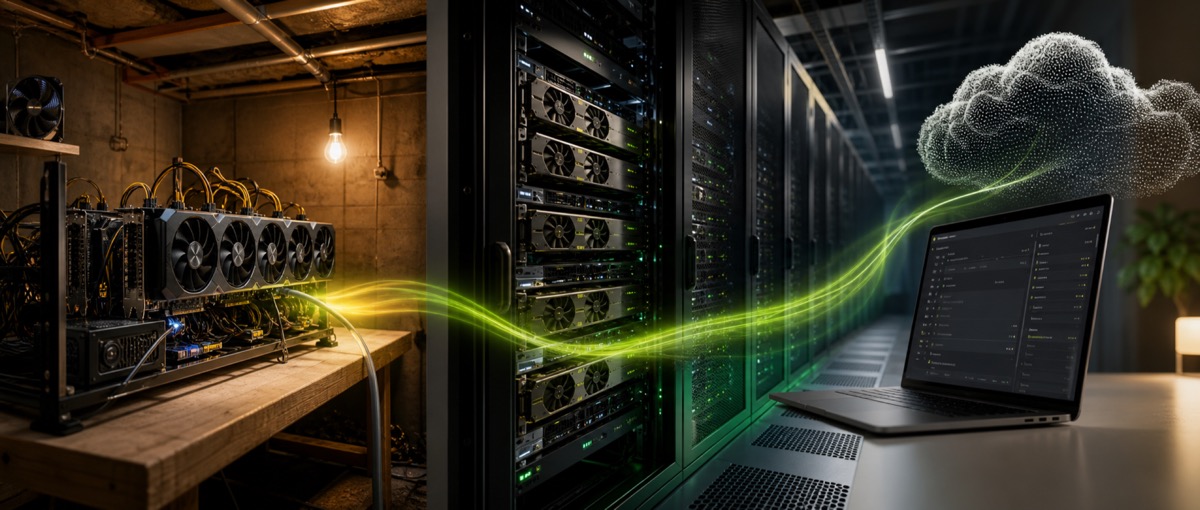
In 2021, two developers working at Comcast spent roughly $50,000 building Ethereum mining rigs in their basements. Mining did not repay the investment. So they repurposed the GPUs into AI servers and went to Reddit to find developers willing to test them.
Four years later, the product behind those machines, Runpod, had reached $120 million in annual recurring revenue.
According to TechCrunch, Runpod’s founders said the platform had 500,000 developer customers, covered 31 regions, and also served enterprise teams spending millions of dollars per year. Before raising its first outside capital, the company had reportedly passed $24 million in revenue. Those revenue and user figures are company disclosures to media, not independently audited metrics.
Runpod’s growth is not only a “miners became AI infrastructure” story. It is a productization case: how do you turn expensive, scarce, configuration-heavy GPU hardware into a cloud service that developers can try immediately and pay for as they go?
The first customers came from a Reddit post
Early Runpod had no mature brand and no enterprise cloud sales team. The founders posted in AI-related subreddits, offering free compute in exchange for feedback. Testers became paying customers. TechCrunch says the product reached $1 million in revenue nine months after launch, which led the founders to leave their jobs and build the company full time.
The channel worked because it reached people who were already feeling the problem. Around 2022, machine-learning developers had to deal with GPU drivers, environments, storage, instance setup, and a long chain of infrastructure choices before they could run workloads. Runpod’s first value proposition was not grand. It helped developers get a workload running faster.
Reddit and Discord later continued to matter. Users discussed available GPUs, configuration methods, deployment experience, and failure modes in public communities. That created feedback for Runpod and reduced trial friction for the next developer. Even Runpod’s first institutional investor reportedly discovered the company through Reddit.
That is a useful distribution lesson for infrastructure products. The best early market is often not a polished buyer persona. It is the dense community where frustrated builders are already trying to solve the problem themselves.
It turns expensive hardware into something consumable
The commercial challenge of cloud compute is utilization. GPUs still cost money when they are idle, while developer inference demand can spike suddenly or disappear for long periods.
Runpod uses two product lines to absorb different usage patterns. Pods provide dedicated GPU instances. Serverless turns containerized models into auto-scaling API endpoints. According to the Runpod Serverless page, instances can scale down to zero when idle, charge by the second, and run across multiple GPU classes. The public pricing page lists hourly prices for different cards directly at the buying surface.
Those choices translate complex infrastructure into three questions a developer can answer quickly: which GPU do I need, how long will it run, and does it need to stay online?
Transparent pricing also becomes distribution. Individual developers do not need to book a sales call to estimate an experiment. When the project moves toward production, spending can expand into steady instances, serverless endpoints, multiple regions, and enterprise capacity. Runpod uses one product path to connect individual experimentation with larger company budgets.
This is different from a hardware story. Hardware matters, but the product is the purchasing and deployment experience around the hardware.
No free tier forced a healthier supply model
Runpod used free compute early to collect feedback, but it did not build the business around a permanent free tier. TechCrunch reported that because the company operated without outside funding for much of its growth and refused to take on debt to buy GPUs, the business had to sustain itself through revenue.
That constraint shaped product decisions. Every unit of compute had to be priced. Supply expansion could not depend only on subsidy. Once basement machines were not enough for enterprise requirements, Runpod expanded through revenue-sharing relationships with data centers.
For infrastructure companies, that is closer to real market validation than “subsidize users first and search for revenue later.” Developer willingness to pay determines which configurations are worth offering. Stable demand determines whether data centers want to keep partnering.
When ChatGPT pulled AI applications into the mainstream, Runpod already had paying users, community trust, and an expandable supply relationship. Timing mattered, but timing amplified a structure that already existed.
Developer experience is an infrastructure moat
Runpod faces plenty of competition. The major cloud providers, CoreWeave, and many specialized GPU clouds can all offer compute. GPU model and price are difficult to monopolize for long.
The harder part to copy is the continuous developer experience from experiment to production. Containers, APIs, command-line workflows, serverless scaling, and public prices lower the start-up cost. Community tutorials and discussions make problems easier to resolve. Once a developer has built deployment, monitoring, and capacity planning around that workflow, migration is not only a comparison of hourly GPU prices.
That is the core lesson from Runpod’s growth. Infrastructure products do not always need to own the largest fleet first. They can win by making the target user purchase, use, and expand more easily.
The basement GPU origin story is memorable, but the more important transformation was not the hardware’s new use. It was the sales method for compute.
Runpod turned a scarce asset into a developer-friendly consumption product. It met users in a community where the pain was already visible. It charged early enough to validate demand. It let supply expand through partners instead of depending entirely on balance-sheet risk. And it made the first unit of GPU consumption simple enough that individual builders could begin without procurement.
That combination is why a small experiment could become a serious AI cloud business.
The builder lesson: package capacity as workflow
Many infrastructure founders focus on capacity: more GPUs, cheaper GPUs, faster GPUs. Those are necessary, but they are not sufficient product strategy.
Runpod shows that capacity becomes commercially powerful when wrapped in workflow. Developers need to know how to deploy a model, how billing works, how scaling behaves, how storage and images are handled, and how quickly they can move from test to production. Each piece of clarity reduces the psychological cost of starting.
The AI infrastructure market will continue to be shaped by hardware scarcity. But the companies that only sell access to scarce machines will be pushed into price competition. The companies that turn that access into a familiar operating path can own more of the developer relationship.
That is the real business hidden inside the mining-rig story. Runpod did not only find a second use for GPUs. It found a simpler way for developers to buy AI compute.