

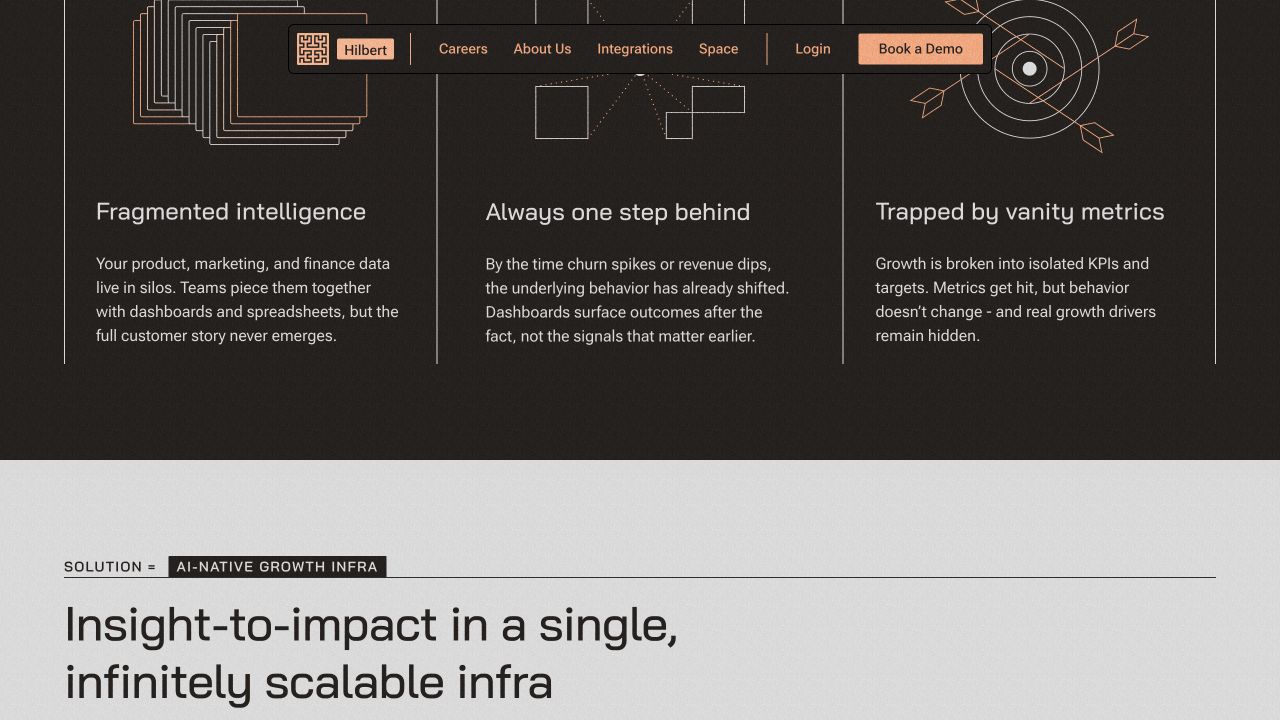
Image source: Hilbert website. The image is official product material.
A consumer company may have transaction data, inventory data, member data, advertising data, and store data. The data team builds dashboards. The growth team interprets movement. Management decides the budget and the action. The problem is often not a lack of data. It is that by the time the answer reaches the meeting table, customer behavior has already changed.
Hilbert compresses that chain into a product. It first finds an anomaly, then explains the cause, then recommends and executes a growth action. That claim is much heavier than an AI chatbot story, but it is already attracting high-value contracts.
Axios reported that Hilbert raised a $28 million Series A in April 2026. Customers include Walmart, FreshDirect, Blank Street, and Levain. The company’s contracts reportedly range from hundreds of thousands of dollars to millions, with pricing increasing by company size and data volume. Those customer and contract figures come from company disclosure to media, not independent audits.
The funding is not the most interesting part. The question is why enterprises would sign million-dollar contracts for a young growth infrastructure product.
More data can make decisions slower
Traditional business intelligence systems are good at answering “what happened?” A retention dashboard can show that a user cohort is churning. But it does not naturally complete the next steps: diagnose the reason, estimate the loss, identify the segment worth intervening on, and push the action into CRM or ad systems.
Those steps usually cross product, data, marketing, and finance teams. Every handoff costs time. Every interpretation layer makes it harder to ask the most important question: how much money is this recommendation worth?
Hilbert’s product boundary is therefore important. It does not treat natural-language querying as the finish line. It breaks growth work into four layers: Detect, Reason, Act, and Optimize. According to the company website, the system monitors anomalies across channels, cohorts, and products, performs root-cause and counterfactual analysis, triggers retention interventions, customer reactivation, and advertising adjustments, and then continues optimizing budget based on results.
That structure moves AI from an answer interface into the middle of the decision chain.
The difference matters commercially. A dashboard sells visibility. A copilot sells a faster explanation. Hilbert is trying to sell an operating loop: detect the business movement, understand why it matters, choose an action, and learn from the result.
Million-dollar contracts buy a decision loop
Enterprise software usually earns large contracts by answering three questions at once: which business result does it affect, can that result be quantified, and can usage expand as the customer grows?
Hilbert’s answer points toward growth outcomes. Axios reported that the product not only recommends actions, but also displays the possible dollar value of those actions. The company website packages acquisition, retention, and monetization into one system and says customers can see value the day after data integration. That speed claim is official marketing and should not be treated as independently verified.
The pricing logic follows the same idea. Charging by enterprise size and data volume is closer to value than charging by seat. The more complex the business, the more channels, cohorts, customer journeys, and possible actions the system can analyze. Contract expansion becomes tied to operating scope instead of user count.
That gives the buyer a clearer equation:
Earlier detection x faster action x estimated revenue impact.
The product can then avoid relying only on the vague claim that “the model is smarter.” It points to a procurement argument that executives understand: if the system helps identify a high-value segment earlier, reduces churn faster, or reallocates budget with better evidence, the contract has a measurable business case.
The hardest part happens before the answer
Connecting multiple systems is only the first step. The harder work is getting teams to trust the same definitions and act on the same logic.
Hilbert’s official customer material repeatedly mentions data cleaning, business context, and cross-team use. In the FreshDirect case, the company describes a desire to turn years of behavioral data into a real-time learning system for retention and high-value customer decisions. Blank Street’s testimonial emphasizes that Hilbert invested effort before the data entered the product, including cleaning and preparation. These are official customer stories, not independent audits, but they reveal where the product’s delivery weight sits.
The first half of “AI growth infrastructure” is still difficult data engineering and business modeling. Customer identity, revenue, cost, channel, inventory, offer, and behavior need to be mapped into a usable decision model before automatic recommendations deserve trust.
That creates a potential moat. Model capability can be copied. The customer’s internal data semantics, historical decisions, and action feedback accumulate through usage. Once the system connects data sources, executive questions, and execution tools, switching is not only a technical migration. It means rebuilding decision trust.
This is also why Hilbert’s category is more demanding than analytics chat. A natural-language analytics assistant can be wrong and still be useful as a draft. A growth execution system can change budget, messaging, cohorts, and customer touchpoints. The closer it gets to action, the more it has to justify its recommendations.
Enterprise AI starts taking responsibility for decisions
Over the past two years, many enterprise AI products sold a faster way to get an answer. Hilbert goes one step further by anchoring commercialization around what happens after the answer: did the budget change, was a customer reactivated, was the revenue opportunity captured?
That is a harder path. If the data definition is wrong, if the causal explanation is weak, or if an automated action goes too far, the product carries more risk than a normal analysis tool. Public evidence about Hilbert’s results and customers is still mostly company-disclosed, so the market does not yet have enough independent proof that the model can replicate across many enterprise contexts.
But million-dollar contracts already signal something important. When AI enters a priced decision and connects discovery, reasoning, and execution into one loop, buyers are no longer purchasing a feature. They are purchasing a piece of operating capacity that previously required several teams to coordinate.
That is the broader lesson for AI builders.
Many teams begin with the interface: can the user ask the data a question in natural language? Hilbert begins with the decision: what business movement should be detected, what action could change the outcome, and where will the action be executed?
The interface is still useful, but it is not the product’s center of gravity. The center is a loop that can be measured: anomaly, diagnosis, recommendation, execution, result, optimization.
If AI is going to move from answer generation into enterprise value creation, more products will have to cross that boundary. They will not only explain what happened. They will need to take responsibility for the next operating move.