
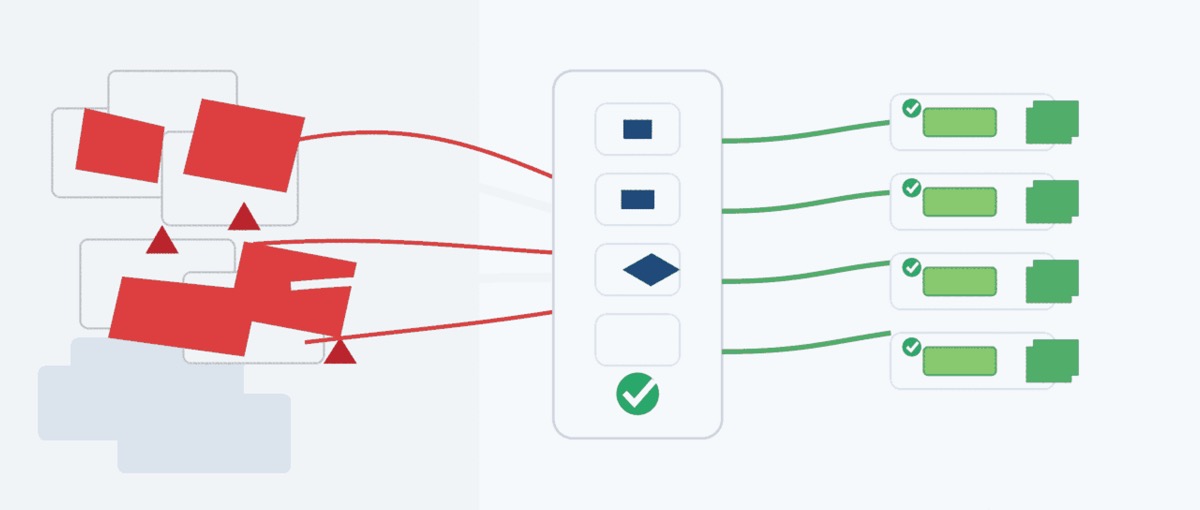
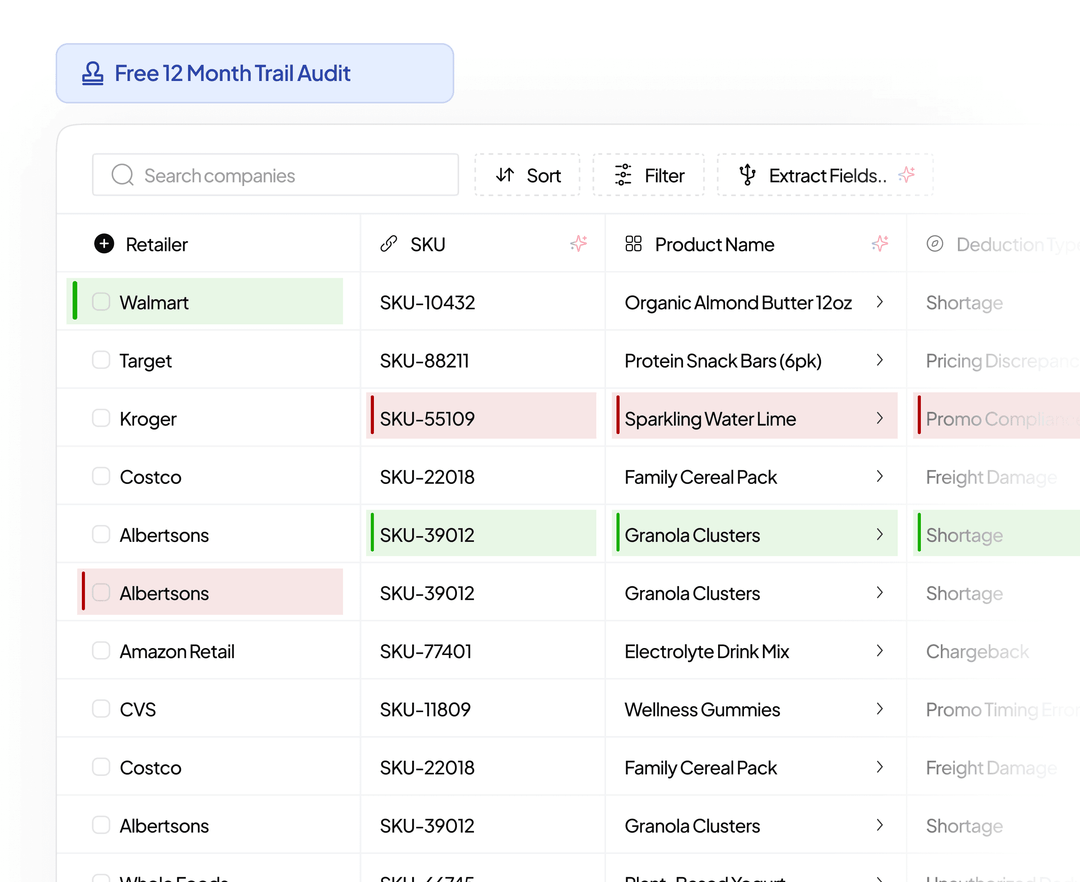
Image source: Glimpse official platform page. The image shows retailers, SKUs, product names, deduction types, and AI extraction/review status; it is official product material, not third-party operating evidence.
If you sell a consumer packaged goods brand through Walmart, Amazon, Target, UNFI, or KeHE, growth does not only mean more orders. It also means more short payments, deductions, promotional mismatches, logistics claims, invoice disputes, and documents sitting inside retail portals.
The painful part is that much of the money is not lost in one obvious event. It is shaved away little by little.
One retailer says a shipment was short. A distributor says promotional terms did not match. A portal adds a document that needs a bill of lading. An email attachment hides the reason for a deduction. Large amounts get chased. Small amounts are often written off because the human cost of investigating them is too high.
Glimpse is attacking that gap.
According to TechCrunch, Glimpse raised a $35 million Series A in March 2026 led by Andreessen Horowitz, bringing total funding to $52 million. More importantly, the company did not start in this exact direction. The founders began with another project in 2020 and pivoted in 2024 into retail deduction automation for CPG brands.
That makes Glimpse a useful “old tree, new flowers” case. The company entity is not brand new, but the AI commercialization breakout came from a product turn in the past 24 months.
It is not a finance copilot. It is a recovery pipeline.
Many finance AI products default to a natural-language reporting story: ask the numbers a question and get an answer. Glimpse is more direct. It asks whether money that has already been deducted can be recovered.
In CPG, retail deductions are amounts retailers or distributors subtract from payments. Some are legitimate, such as damaged goods, shortages, promotional agreements, compliance penalties, or logistics problems. Others are wrong: the brand shipped correctly, but the retailer processed it as a shortage or applied the wrong term.
The manual workflow is fragmented. Teams log into different retail portals, download deduction files, find invoices, bills of lading, proof of delivery, promotional agreements, and ERP records, then decide whether to dispute the deduction. Small brands rarely have enough staff. Large brands are still slowed by channel-specific rules.
Glimpse productizes the work as an executable chain. TechCrunch describes AI agents that log into retailer portals, collect documents, classify deductions, compare them against internal supply-chain records and promotional calendars, submit disputes, track progress, and sync recovered cash back into ERP systems.
That makes Glimpse more than “AI that reads documents.” The product is organized around one outcome object: money that was deducted.
Glimpse’s platform page separates the system into Deductions Management, Revenue Recovery, and Cash Application. First it identifies and manages the deduction. Then it recovers money. Then it handles the accounting step. That structure matters because the customer is not buying field extraction. The customer is buying the loop from problem discovery to cash return.
Why this workflow fits AI
Deduction management looks narrow, but it is unusually well suited to AI productization.
First, it has abundant unstructured and semi-structured material: PDFs, emails, EDI files, retail portals, invoices, bills of lading, proof of delivery, promotional calendars, and ERP records.
Second, it has explicit decision rules. Different retailers have different reason codes, deadlines, evidence requirements, and submission paths. The model cannot only “understand text.” It must know which evidence can support which dispute.
Third, it has a clear economic outcome. The system either recovers money, saves staff time, or reduces future deductions. Customers do not need to believe a vague productivity story. They can look at historical deductions and ask how much cash is still recoverable.
That is why Glimpse has more commercial tension than a generic back-office automation tool. It is not selling into an “efficiency budget.” It is selling profit protection and cash recovery.
The company website lists official platform metrics such as a 91% dispute win rate, more than $200 million processed, more than 100 hours saved per month, an 87% valid shortage-claim recovery rate, and an average 45-day recovery period. These figures come from Glimpse’s own materials and should be treated as company disclosures rather than independently audited data.
Even with that caveat, the direction is clear: AI changes which money is worth chasing.
In the manual era, teams set thresholds. Do not dispute deductions below $500, or below $200, or below $50, because every claim requires a person to inspect files, fill forms, submit evidence, and follow up. AI agents can lower the marginal handling cost. Small deductions that were previously uneconomic become actionable. Evidence chains that only large brands could maintain become accessible to smaller operators.
The real signal in the customer stories
Glimpse’s website includes multiple customer stories. These are official case studies, not independent audits, but they reveal why the product can sell.
In the Miss Jones Baking Co. story, Glimpse says the customer had been paying contractors $3,000 to $4,000 per month to handle deductions manually and only disputed claims above $500. After adopting Glimpse, the customer paid a $3,000 monthly subscription, recovered six figures, recovered one Walmart shortage claim of $22,943.83, and improved gross margin by 1.1 percentage points in one quarter.
The interesting part is not only the hours saved. It is that the threshold disappeared. Glimpse says it found $40,000 in invalid deductions below $50 across KeHE and UNFI in one year, plus $80,000 in invalid deductions below $200.
That is the AI product opportunity: not simply helping the same people do existing tasks faster, but making tasks that were previously too uneconomic become executable.
Another BERO customer story cites a 97% dispute win rate, 20 hours saved per month, and 2.5x ROI. Again, this is official customer material. But it shows the same logic. The leaner the CPG brand, the less it can afford to bury people inside low-value recovery work. AI turns that background mess into a continuous system.
How the business charges
Glimpse does not publish a standard price table. Its website asks users to book a 30-minute demo, offers a free deduction audit, and says custom pricing depends on retailers, invoice volume, and recovery opportunity.
That packaging is sensible.
If Glimpse charged by seat, buyers would compare it with ordinary SaaS. By starting with an audit of historical deductions, the sales conversation shifts to “how much recoverable money is sitting in your accounts?” That moves the discussion from software features to financial outcome.
TechCrunch reported that Glimpse serves more than 200 retail brands, including Suave and ChapStick. The article also says Glimpse keeps humans in the loop, especially around confirmation, dispute follow-up, and quality control for key classifications and extractions.
That is worth noting. Many AI companies rush to present “fully autonomous” as the goal. In high-risk finance workflows, the human expert layer can be a trust mechanism rather than a flaw. The customer is not trying to experience a pure model. The customer wants less leakage, lower error risk, and recovered cash. If the outcome works, human-in-the-loop packaging may be more purchasable than purity.
The moat is not OCR
If Glimpse is reduced to “AI reads PDFs,” the case becomes ordinary.
The real barriers sit in messier layers.
The first layer is channel connection. Walmart, Amazon, Target, UNFI, KeHE, QuickBooks, NetSuite, email, and Excel are not one data source. Connecting to them, pulling documents reliably, and tracking status is itself a workflow barrier.
The second layer is industry rule knowledge. Deduction reasons, promotional agreements, logistics evidence, dispute deadlines, portal actions, and reason codes differ by channel. A general model will not automatically know which evidence refutes which shortage.
The third layer is feedback data. Each dispute outcome teaches the system which evidence worked, which channel rejected a claim, and which small deductions are symptoms of a larger recurring issue.
The fourth layer is process lock-in. Once the finance team routes deduction intake, review queues, recovery status, and ERP sync through Glimpse, replacing it is not just a tooling change. It is a recovery-process rebuild.
That is why narrow can be powerful. The narrower the workflow, the more specific the rules, the more measurable the result, and the easier it is to turn AI from a demo into a system.
The larger builder lesson is not about CPG alone. Glimpse starts from a better question than “where can AI be used?” It asks: where is there clear leakage, clear evidence, clear action, and a clear buyer?
Many industries have similar corners: insurance denials, logistics claims, trade deductions, missed contract revenue, procurement rebates, ad-platform anomalies, channel reconciliation, and compliance penalty appeals. They are dirty, fragmented, cross-system, experience-heavy, and tied to money.
Those problems are not always glamorous. But commercialization does not reward glamour. It rewards attribution.
Glimpse’s answer is simple: before AI tries to make grand decisions, let it recover money companies have already written off. Once AI can prevent one more leak in the income statement, it stops being a productivity toy and becomes a business explanation.