
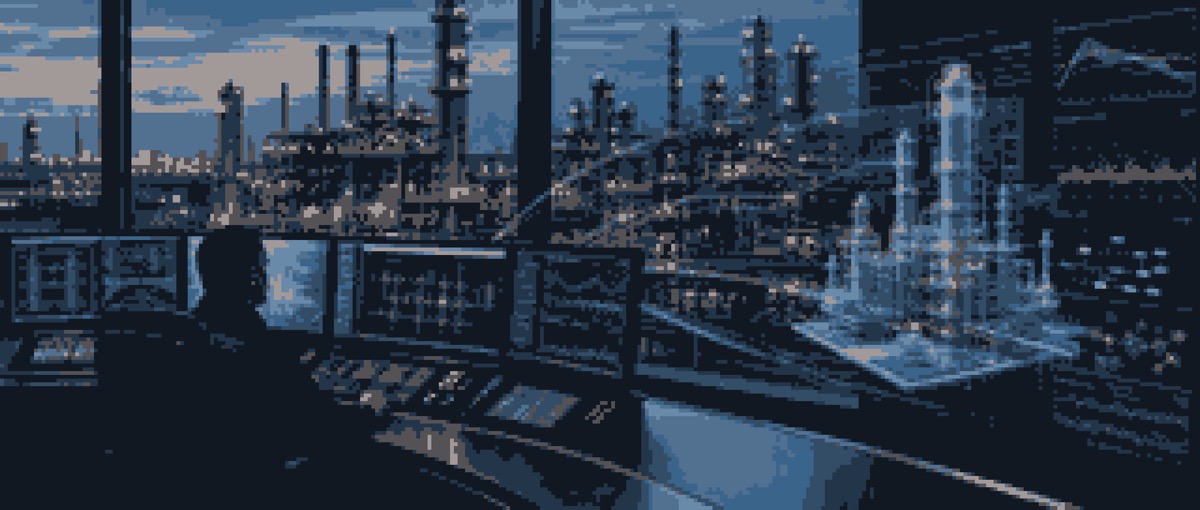
In a refinery control room, the most expensive thing is not the data on the screen. It is the question of who is willing to change a set point because of that data.
Temperature, pressure, flow rate, material quality, energy consumption, and equipment condition are all being measured every day. The problem is that those signals sit across control systems, historians, engineering drawings, standard operating procedures, and expert judgment. One bad recommendation can mean downtime, higher energy use, or a safety risk. In this kind of industry, the hardest part of selling AI is not “can it answer?” It is “who will trust it when the cost of being wrong is high?”
That is why Applied Computing is worth studying. It is not inserting ChatGPT into a refinery. It is building a more industrial product: Orbital, a foundation model for energy operations that combines sensor time series, engineering documents, chemistry and physics constraints, and operator language. More importantly, it is using a partner such as KBR to turn that capability into something the market can buy, deploy, and trust.
According to TechCrunch’s July 15, 2026 report, Applied Computing was founded in 2023 and raised a $20 million Series A led by engineering giant KBR, with participation from Databricks Ventures. The report says the company moved from stealth to double-digit millions of ARR in 18 months and is already used in oil, gas, refining, and petrochemical settings at large public energy companies. Those ARR, customer, and efficiency figures are company disclosures rather than audited operating data, but they are strong enough to show that industrial AI is no longer only a lab story.
The hard part is not “more data”
Many AI founders oversimplify vertical industries: the industry has data, models can read data, so the product should work.
Refineries do not work that way.
Applied Computing describes Orbital as a system that monitors thousands of sensors, predicts outcomes, finds optimal set points under multiple constraints, and warns about equipment problems in real time. The important point is that it does not rely only on statistical correlation. The company says the model is constrained by physics and chemistry in the process.
On its website, Applied Computing breaks Orbital into three layers. A Time Series Model reads raw data from DCS, historian, LIMS, and similar systems. A Physics-Based Model extracts constraints from manuals and technical literature. A Language Model reads P&IDs, SOPs, and work orders, then explains results in terms engineers can understand.
The product story is not “we use three models.” The product story is that Applied Computing has packaged the customer’s fear: hallucination, unexplainable output, recommendations outside safe operating boundaries, and decisions that cannot be audited.
In consumer AI, a wrong answer may only create a poor experience. In a refinery, a wrong suggestion can create real loss. Applied Computing’s entry point is to put AI freedom inside boundaries that an industrial site can accept. It is not selling “the model is smarter.” It is selling “the model will not behave as if physics is optional.”
That is an important lesson for AI product teams. In high-risk verticals, the value of AI is often less about generation and more about constraint. The company that helps AI avoid unacceptable mistakes has a better chance of entering the core workflow.
It compresses anomaly investigation into an operating system
One detail in the TechCrunch report is especially important. Applied Computing says Orbital can identify anomalies in minutes, investigate the cause, and simulate whether a fix would create problems elsewhere in the facility. The CEO also said this can compress investigations that once took days or weeks into seconds. That claim comes from the company and should not be treated as independently verified, but it explains the commercialization wedge.
Refineries are not buying “AI chat.” They are buying faster, steadier operational judgment.
In a plant, energy use, output, quality, and maintenance risk constantly interact. Engineers make multi-objective tradeoffs every day. If they increase a temperature, will yield improve? Will energy use rise? Is a component moving closer to failure? Will a downstream process be affected? Traditional software can model and optimize parts of that system, but deployment is slow, systems are fragmented, and expert configuration is heavy. General LLMs can explain documents, but they do not naturally understand live plant state or conservation constraints.
Orbital’s productization bundles those pieces: real-time plant state, engineering knowledge, physical constraints, natural-language explanation, and simulated operating recommendations.
That shifts it from a tool toward an operating layer. An engineer is not opening a separate AI window and asking a question. The system creates a faster judgment loop inside the operating workflow: detect the anomaly, explain the likely cause, evaluate the action, show the boundary, and preserve the evidence.
Applied Computing’s case-study page lists official metrics such as improved CO2 concentration prediction, improved simulated distillation energy efficiency, improved natural gas process purity, hydroprocessing savings, and faster asset failure prediction. These figures are company-published, not third-party audited. But as product evidence, they point to one commercial logic: customers do not pay for AI as a label. They pay for lower energy use, less downtime, higher output, and more controllable engineering judgment.
The channel matters more than the funding headline
The most important part of Applied Computing’s Series A is not the $20 million number. It is KBR’s role.
In a March 2026 announcement, KBR said it made a strategic investment in Applied Computing and received a board seat. The companies also signed a multi-year joint development agreement to combine Orbital with KBR’s process technology, capital-project expertise, and supply-chain experience. KBR described three paths: asset operations, capital projects, and derisking next-generation technology.
That is more important than an ordinary financing event.
Refineries are not markets that grow through ads, free trials, or Product Hunt launches. Their procurement chains are long, risk responsibility is heavy, and incumbent supplier relationships run deep. Even if a startup has a strong model, it is difficult to persuade an energy customer to connect core operations data, and harder still to enter live operating conditions.
KBR helps in three ways.
First, it supplies industry trust. Energy customers are not only evaluating an AI model. They are evaluating whether the system can be accepted by engineering contractors, operating teams, and management.
Second, it supplies scenario packaging. Orbital is not sold as an isolated model capability. It can be integrated into existing energy-project platforms such as INSITE 3.0, so the customer is buying a contextual solution.
Third, it supplies a data and deployment path. High-quality refinery data does not circulate publicly. A startup cannot crawl the web into a durable industrial moat. Real deployment creates the feedback, boundary conditions, and operating knowledge that matter.
In other words, Applied Computing’s distribution is not a sales problem that comes after the product. It is part of the product.
Old industry, new explosion point
Applied Computing sits on the edge of the “old tree, new flowers” category. Public information says it was founded in 2023, so by 2026 it is around the three-year mark. But the commercial breakout appears to have happened in the past 18 months, especially around the 2026 KBR strategic partnership and Series A.
This kind of company differs from many AI-native products. It is not rapidly capturing traffic through a new interface. It is finding the moment when AI can finally be packaged for an industry that has resisted software rewrites for decades.
Why now?
Applied Computing’s mission page argues that roughly 90% of energy-industry data goes unused, while industrial data combines slow and expensive physical simulation, complex engineering documents, and time series that must obey physical and chemical rules. The company says recent progress in multimodal models, time-series modeling, reasoning, and physics-based modeling makes unified system intelligence possible.
That is company narrative, not independent evidence. But it explains why this case matters. The AI startup window is not only “content is cheaper to generate.” It is also “expert judgment that was previously impossible to productize can now be packaged.”
In high-risk industries, customers may not first want an AI that replaces experts. They may first buy a system that lets experts make decisions faster, more steadily, and with more evidence. Applied Computing turns that system into Orbital, then uses an industry channel such as KBR to lower the trust threshold.
The builder lesson: sell the risk structure
Many AI products fail commercially not because the model is weak, but because the company has not answered the customer’s deeper question: why should I let this product into my workflow?
Applied Computing’s answer has four layers.
The first layer is physical constraint. AI recommendations cannot merely sound fluent. They must respect mass balance, energy balance, reaction dynamics, and equipment boundaries.
The second layer is explainable language. Engineers need to see the basis for a recommendation, not just receive a mysterious optimum.
The third layer is measurable business outcome. Energy use, output, failure prediction, downtime risk, and cost savings enter budgets more easily than “a better AI experience.”
The fourth layer is a trusted channel. KBR’s investment, board seat, and joint development agreement turn Applied Computing from “an AI startup” into part of an industry solution.
Together, those four layers are what the company is really selling.
The lesson is not simply “go build industrial AI.” The lesson is that when an AI product enters an industry where mistakes are not allowed to be large, the product should not only show what AI can do. It should design why customers can trust it, who will stand behind it, and how it fits into existing procurement and responsibility systems.
AI founders often say they want to enter core workflows. Applied Computing is a reminder that the entrance to a core workflow is guarded by a more practical question: can you productize the risk structure first?