
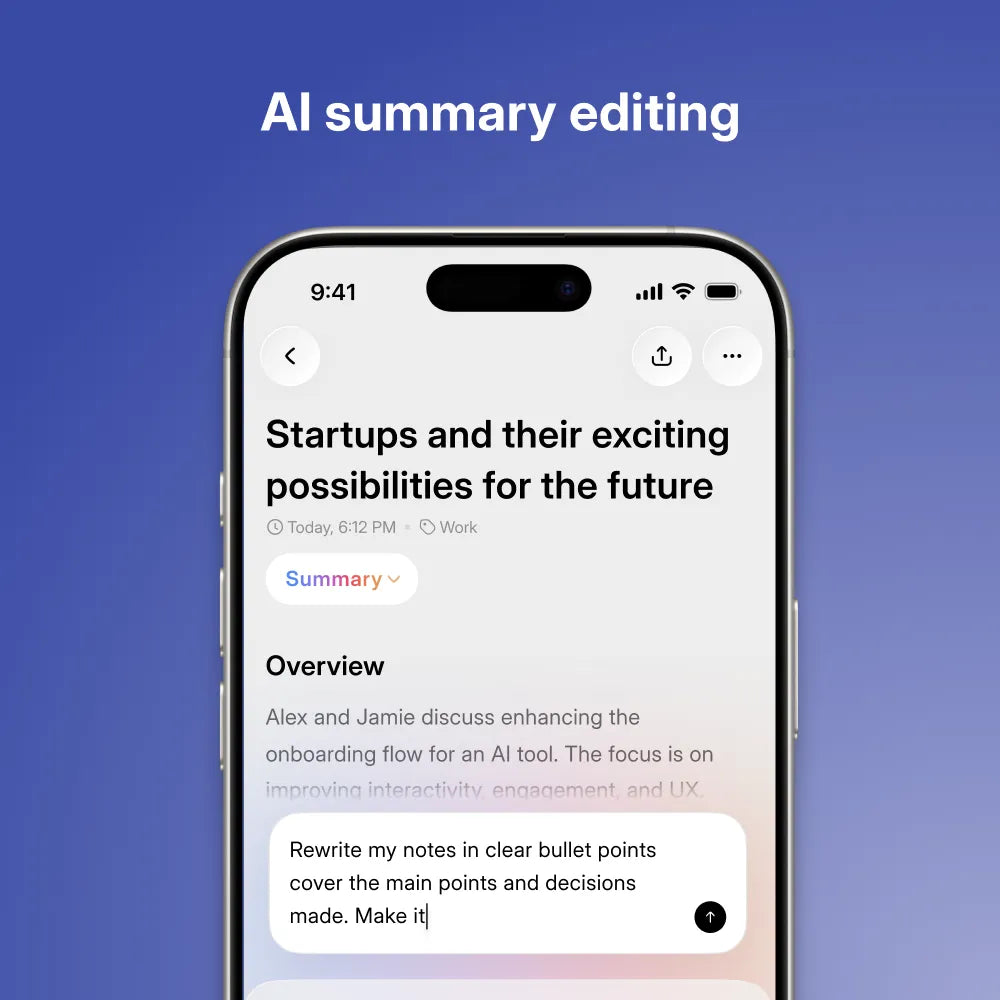
Source: Pocket official website. The image shows the product interface for editing an AI-generated summary. It is official product material, not third-party operating evidence.
The most valuable customer context often does not live inside Zoom.
It may appear during a lunch meeting, a quick phone call, a store visit, a consulting interview, or the sentence a doctor, salesperson, or founder remembers only after walking out of the room. Online meetings already have Fathom, Fireflies, Granola, and many similar products around them. Offline conversations still often stop inside short-term human memory.
Pocket enters that gap.
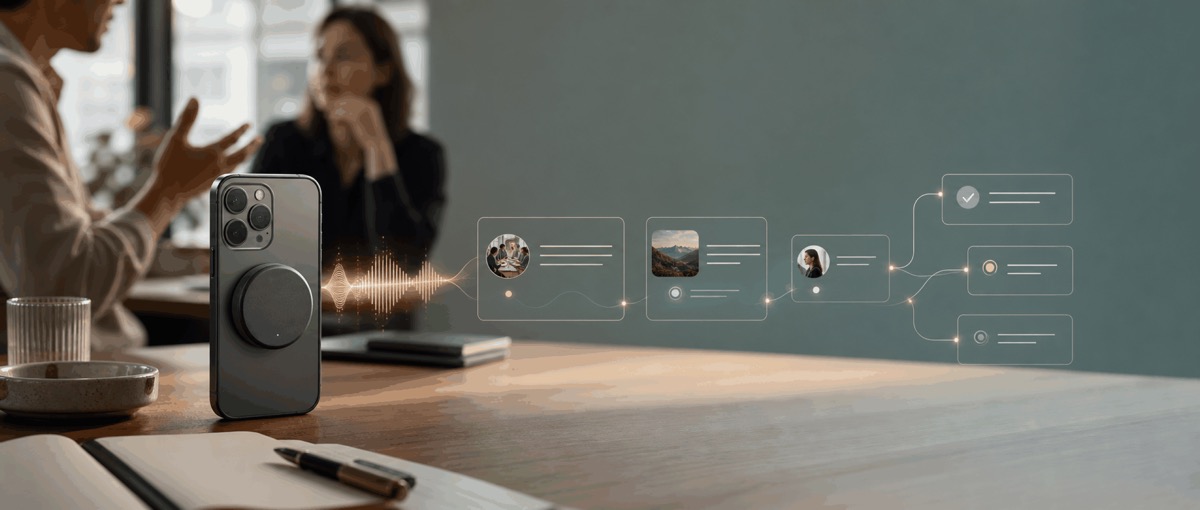
The company is not only building an AI recording app. It sells a small device that attaches to the back of a phone, then turns in-person meetings, calls, and daily conversations into transcripts, summaries, rewrites, and searchable memory inside an app. TechCrunch reported that Pocket raised $11 million and had sold roughly 130,000 devices. Its YC profile says the company was founded in 2024, making it a natively new AI product.
The commercialization path is more interesting than the device itself. Pocket’s pricing page lists the device at $129, includes unlimited transcription and basic AI in the free tier, prices Pro at $199 per year or $29 per month, and offers Enterprise through a custom plan. Those prices and features come from the company and are not independently audited, but they show a clear packaging logic: hardware sells the entry point, the free tier builds habit, and subscription plus enterprise features sell deeper workflow value.
Sacra’s research estimated Pocket at about $27 million in annualized revenue in February 2026, with roughly 50% monthly growth over the previous several months. That is an estimate, not audited financials. Even with a discount applied, it points to a useful trend: AI note-taking is not only a contest over transcription accuracy. It is a contest over who can capture more real context.
It Avoids the Most Crowded Entry Point
Most AI meeting tools share one assumption: valuable work conversations happen in calendars and meeting links.
That assumption covers only part of reality. Sales visits, in-person roadshows, consulting interviews, store service, clinical encounters, recruiting conversations, and phone calls can be more commercially important, but they are harder for software to enter automatically. Users also do not always want to open an app, position a phone, and check recording settings every time.
Pocket’s hardware wedge is not mainly about where the record button lives. It is about whether the user will keep capturing conversations. A physical device attached to a phone feels more like pressing a dedicated everyday tool than launching software. It reduces behavioral cost, not model cost.
That is the difference from pure software note takers. Software-first products usually begin with the online meeting workflow. Pocket begins with phone and offline conversation. The former joins an existing digital workflow. The latter fills a long-standing missing entry point.
Hardware Is a Commercial Boundary, Not a Gimmick
AI hardware is often challenged with a simple question: if a phone already has a microphone, why does the user need another device?
For Pocket, the answer is not that phones cannot record. The device changes what the customer thinks they are buying. They are not buying one transcript. They are buying a portable capture point. That creates several commercial advantages.
First, it gives the product one-time revenue. A $129 device creates a clearer acquisition threshold than a free app and filters early users toward people willing to pay to capture real conversations.
Second, it makes free transcription more rational. Many AI tools treat free usage as a direct acquisition subsidy. Pocket’s free tier comes after a hardware purchase. The customer has already paid for the entry point, so free transcription activates device usage rather than endlessly subsidizing anonymous traffic.
Third, it leaves room for Pro and Enterprise. Individual users may first want better summaries, rewrites, and search. Teams will eventually pay for permissions, sharing, compliance, integrations, and data-retention policies. In other words, Pocket is not monetizing “dollars per transcription minute.” It is monetizing where a real conversation goes after it is captured.
That path is sturdier than selling AI capability alone. Transcription will get cheaper. Summaries will become ordinary. But if a company accumulates historical meetings, customer leads, decision notes, phone context, and team knowledge, the value can move from one-time output into continuous memory.
It Sells Context, Not Notes
Calling Pocket an AI voice recorder understates the product.
A recorder ends at a file. An AI meeting bot often ends at minutes. Pocket’s more valuable destination is a cross-context personal memory layer: what a customer said, what objection appeared, what the next commitment was, where an idea first came up, and what a contact mentioned across the past three conversations.
That framing explains why it can move from personal productivity into enterprise use.
For individuals, the value is losing less information, writing fewer notes, and relying less on memory. For teams, the value becomes customer relationships, knowledge retention, training review, CRM updates, compliance trails, and management visibility. The first looks like a tool. The second looks like a system.
Many AI founders start from model capability: better summaries, more accurate search, more natural answers. Pocket is a reminder that AI commercialization often starts earlier, at the data entry point. The company that reliably captures context others cannot capture has an easier time packaging later AI functions into workflows.
The Risk Also Lives in the Entry Point
Pocket’s entry point is strong, but the closer a product gets to real conversations, the more concrete its risks become.
The first risk is privacy and consent. Call recording, offline recording, and one-party or two-party consent rules vary across jurisdictions. Healthcare, finance, law, and education add stricter data-governance expectations. If Pocket wants to enter enterprise and professional-services environments, it cannot only sell “record anytime.” It also has to sell clear compliance controls.
The second risk is converting hardware buyers into durable subscribers. Roughly 130,000 devices is a strong early signal, but the long-term business depends on device activation, recording frequency, Pro conversion, enterprise contracts, and retention. Sacra’s revenue estimate is useful, but it is still not company-audited financial data.
The third risk is platform pressure. Mobile operating systems, AirPods, meeting software, CRM systems, and note apps can all add AI recording features. Pocket has to prove that it is not just a recording entry point that a system feature can absorb. It has to become a memory layer across calls, in-person meetings, apps, and enterprise workflows.
What AI Founders Can Learn
Pocket’s most useful lesson is not that AI hardware is back.
The better formulation is this: when software entry points are crowded, hardware can become a context-capture strategy. It does not need to invent a new general-purpose computer. If it helps users consistently capture high-value information, it can open a new boundary for software monetization.
That is why Pocket is more interesting than many AI note-taking tools. It does not only compete on transcription, summaries, or model selection. It answers a deeper question first: which important information has not yet entered an AI system?
For founders, that question comes before “what can my agent do?”
Without context, an agent is only a smart system spinning in place. Once it has real context, summaries, search, CRM updates, follow-up emails, customer insights, and team knowledge can become a paid product line.
Pocket’s commercialization sample says: do not rush to make AI do everything for the user. First find the context entry point that others have not captured, even though the user creates it every day. Once that entry point works, workflows and revenue have somewhere to grow.