

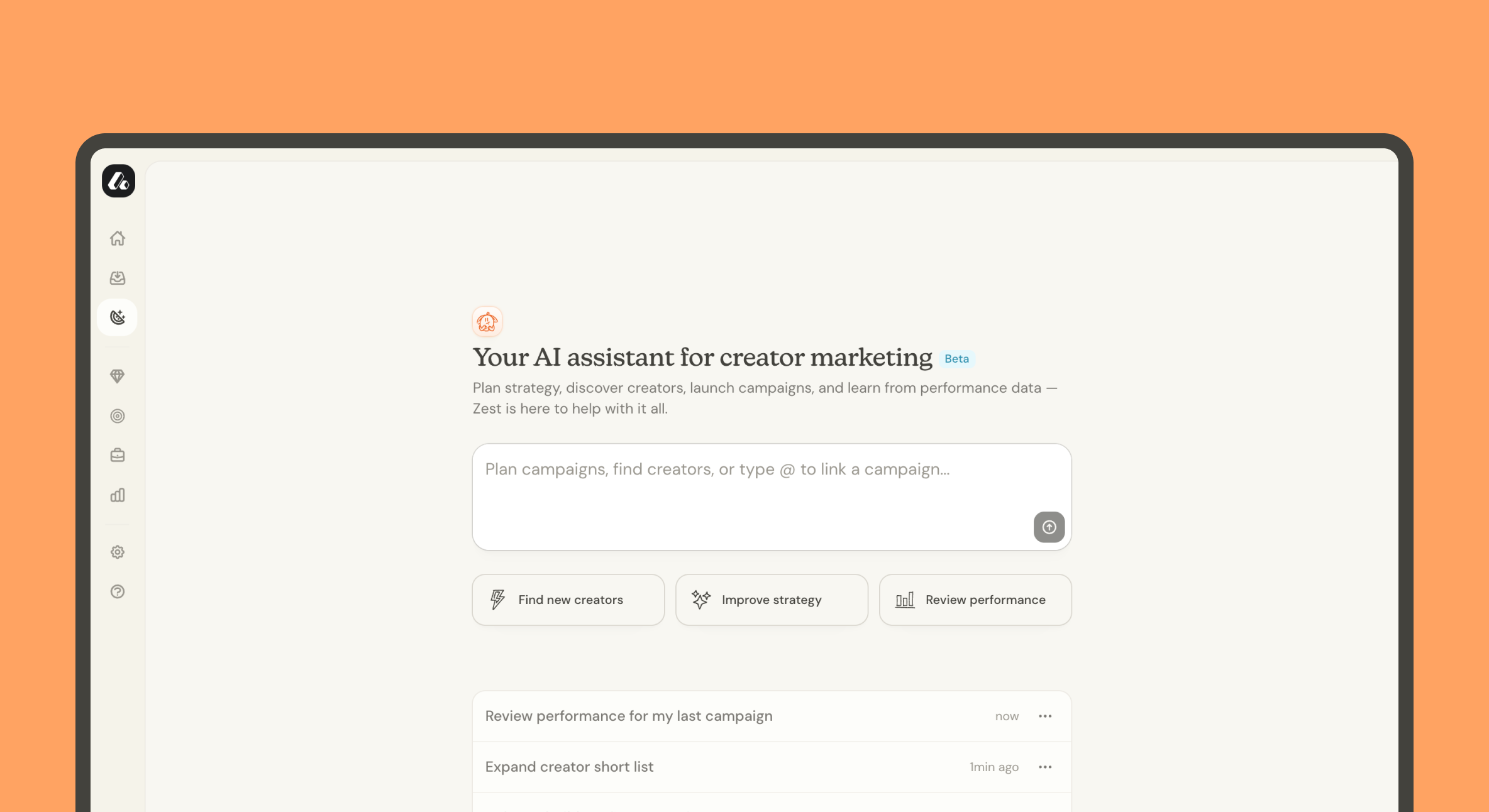
Source: Passionfroot official help center. The screenshot shows the Zest workflow for creator marketing. It is official product material, not third-party operating evidence.
Many AI startups run into the same awkward problem: the more professional the product, the less ordinary ads can explain it.
Search terms become expensive. Cold email starts to feel like noise. Broad social advertising struggles to communicate a complex product. The people who actually move buyers are often the creators who have built trust on YouTube, X, LinkedIn, newsletters, and professional communities.
Creator marketing works, but it is hard to scale. A marketing team has to find creators, compare prices, write briefs, send messages, manage contracts, make payments, chase deliverables, calculate CPM, and review ROI. One campaign is manageable. Ten parallel campaigns can become a messy combination of Slack, spreadsheets, DMs, and finance workflows.
That is the layer Passionfroot wants to own.
On July 22, 2026, Passionfroot announced a $15 million Series A led by Insight Partners. The company also disclosed 13x revenue growth over the previous year, profitability, a team of only 15 people, and B2B customers such as ElevenLabs, Figma, Replit, Framer, and Gamma. Those growth, profitability, and customer figures are company-reported and not independently audited.
Still, the company is worth studying for more than a funding round. It is turning a growth channel that used to depend on relationships, judgment, and spreadsheets into an AI-native operating system for creator-led GTM.
It Does Not Sell a Creator List
Calling Passionfroot a creator database misses the product.
The hard part of creator marketing is not only knowing who has an audience. The hard part is turning a possible partnership into an executable commercial process. Which audience fits the product? Should the campaign run on YouTube, LinkedIn, or newsletters? How should the budget be split? Is a creator’s price reasonable? Who sends the proposal? How does payment work? After delivery, how does the team know whether it bought real influence or only activity?
Passionfroot’s website describes the product as an AI agent for creator-led GTM: it discovers creators, runs campaigns, handles payments, and measures results. Its Zest help documentation says the agent can support campaign strategy, creator discovery, outreach, and performance reporting based on ICP, goals, budget, and platform preferences.
That means Passionfroot is not adding a chatbot to creator marketing. It is placing AI inside the operating nodes.
The user is not really asking, “find me ten influencers.” The realistic task is closer to: “We are launching an AI developer tool next month, have a $20,000 budget, want to reach RAG and agent developers, and need a platform mix, creator shortlist, pricing range, outreach drafts, and review metrics.”
That task fits an agent because it is not one generation step. It is a multi-step workflow that needs context, constraints, execution, and feedback.
The Comet Case Shows the Product Boundary
Passionfroot’s Comet customer story helps explain why this is a product rather than a utility.
Comet is an AI developer platform whose target users already spend time in technical communities, developer content, and AI creator networks. According to Passionfroot’s case study, Comet previously relied on Slack relationships, individual creator contracts, distributed payments, and manual screening. Campaigns could take weeks to launch.
After adopting Passionfroot, Comet centralized creator discovery, booking, wallet payments, and analytics. The case says Zest could quickly build campaign plans, refine budgets, and help the team secure internal budget. It also reports launch cycles compressed from weeks to days or within a week, with less than $10 CPM and more than 250,000 impressions.
Those results are still official customer-case claims, not independent audit data. But they reveal Passionfroot’s productization point. It is not helping the marketing team produce more content. It is reducing the friction between a campaign idea and a live partnership.
That distinction matters for AI founders.
Many AI marketing tools compete on generation: write emails, write ads, make images, write posts. Passionfroot’s wedge is closer to transaction infrastructure: who is worth partnering with, how money moves, how delivery is tracked, and how performance is reviewed. AI is not here to make the copy more decorative. It helps a trusted commercial collaboration happen faster.
Its Business Model Looks More Like Channel Take Rate
The pricing structure is also worth unpacking.
According to Passionfroot’s pricing help document, the core product is free for creators. If a creator brings their own brand partnership and runs it through the platform, Passionfroot charges a 5% fee paid by the brand. If a deal comes through the Passionfroot Partner Network or Discover, it charges a 15% sourcing fee deducted from creator earnings. Another help document says brands can use Starter, Scale, and Enterprise plans, though public prices are not listed.
The center of the model is not a SaaS seat. It is a transaction.
When a brand brings its own partnership, Passionfroot monetizes transaction and payment infrastructure. When the platform brings a brand to a creator, it monetizes sourcing. When a brand needs scaled discovery, campaigns, and collaboration, it can move into brand subscriptions or enterprise plans.
That structure matches the budget logic of creator marketing better than a generic monthly AI tool. Marketing teams pay to put budget to work, launch campaigns, and understand outcomes. Creators pay indirectly when the platform brings incremental revenue and makes payment easier.
So Passionfroot’s ambition is not simply software tooling. It is the transaction layer for B2B creator distribution.
If that layer works, AI can increase throughput: faster strategy, faster creator matching, faster budget estimates, faster proposals, and faster anomaly detection. AI does not replace the network. It makes each transaction in the network easier to operate.
Why This Is an Old Product With New Growth
Seedtable lists Passionfroot as founded in 2022 and records total funding of about $22.2 million after the Series A. By age, this is not a brand-new company founded in the last three years. It is more of an old-tree-new-growth case.
That makes it more useful.
In 2022, a creator-economy platform could be understood as a media kit, booking, and payment product. By 2026, both AI and B2B acquisition have changed. Search traffic is increasingly mediated by AI answers. Buyers rely more on trusted individual voices. Brands are starting to treat creators as a GTM channel rather than a PR side activity.
Passionfroot’s opportunity is to upgrade the original creator transaction network into a GTM workflow for the AI era.
It did not invent demand from nothing. It found an existing budget flow whose operation cost was too high. AI’s role is to turn that budget flow from manual craft into a repeatable process.
This kind of old-tree-new-growth case can commercialize better than a completely new concept. The customer budget already exists. The pain already exists. Both sides of the transaction already exist. The product’s job is to turn inefficient market behavior into a system software can carry.
What AI Founders Can Learn
The first lesson from Passionfroot is to ask not only what AI can generate, but which high-friction transaction AI can make faster.
AI-generated content is easy to see, but it may not be the strongest place to monetize. Generation is often only one step inside a broader process. The highest willingness to pay often sits where a workflow crosses roles, systems, budgets, and risk.
Creator marketing is exactly that. Lists, briefs, pricing, contracts, payments, and reporting are not individually hard. Connected together, they become heavy. Whoever shortens that chain gets closer to the budget.
The second lesson is that transaction networks and AI capability can reinforce each other.
If a platform accumulates creator prices, brand preferences, historic performance, payment records, and repeat relationships, Zest’s recommendations are not only model guesses. They become operating suggestions informed by network data. In the other direction, an agent lowers operating cost, which allows more campaigns to happen and creates more data.
That is a stronger position than building an “AI creator finder.”
The risks are clear. Will creators continue accepting a 15% sourcing fee? Will brands and creators bypass the platform once they know each other? Will AI outreach turn a trusted channel into another stream of low-quality mass messages? Those questions will decide whether Passionfroot can become channel infrastructure rather than a growth tool.
But it has already proven a useful point: the first profitable AI product in a workflow may not be the one that creates. It may be the one that turns a relationship-heavy, spreadsheet-heavy, patience-heavy commercial process into something executable, measurable, and repeatable.
When a channel is trusted but not scalable, AI’s most valuable job is to make it a system.