
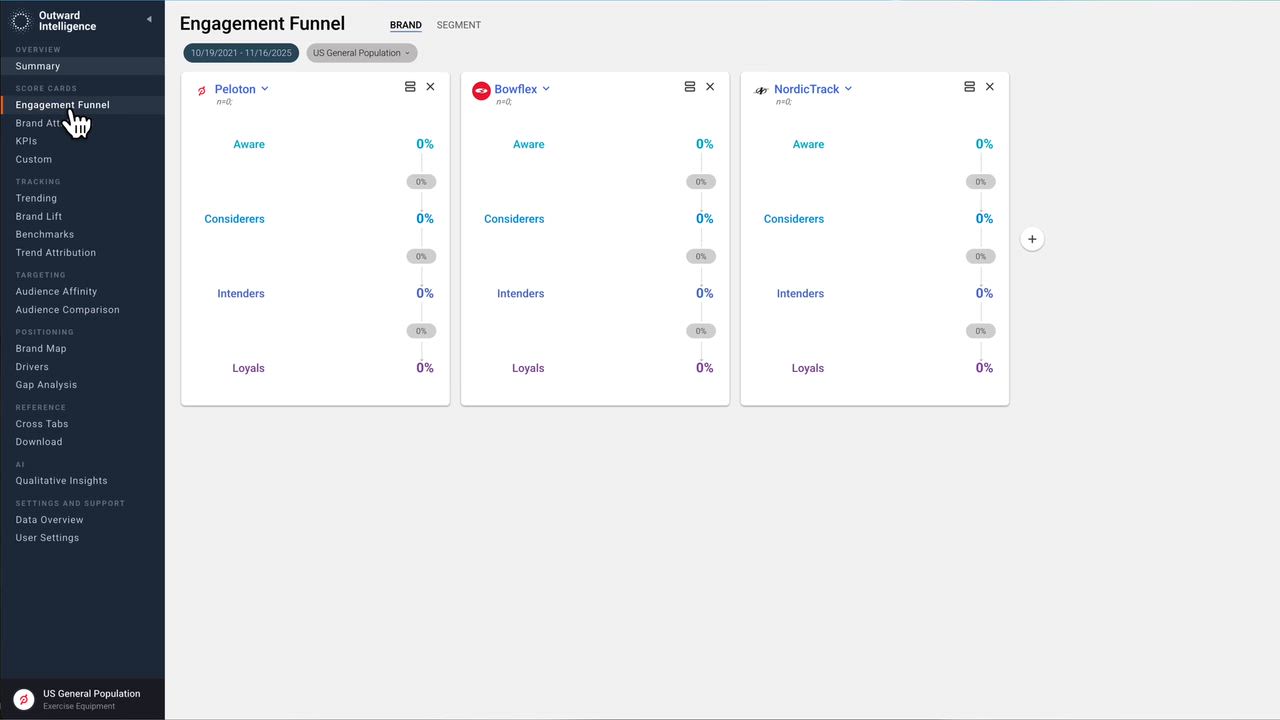
Source: Outward Intelligence official website. The image shows an engagement funnel dashboard inside a brand-tracking workspace. It is official promotional and product material, not third-party operating evidence.
When many AI founders look at services, their first instinct is to use AI to hire fewer people. That is not the most interesting lesson from Outward Intelligence.
Outward works in market research. The industry looks traditional: design surveys, find respondents, clean data, run cross-tabs, write reports, and explain findings to clients. Historically, it has been labor intensive. The more complex a project becomes, the more it depends on researchers, operations teams, and data teams handing work across layers.
Outward’s non-consensus move is that it does not present itself as an AI survey tool. It turns the back office of market research into an AI operating system. The founders also did not begin with venture capital. According to eWeek’s report based on Business Insider coverage, Business Insider verified seven-figure revenue in Outward’s 2025 tax filings. The same report says the founders claimed the company crossed $1 million in revenue eight months after commercialization and reached more than eight figures of ARR in 2026, but those latter claims were not verified in the same way.
That evidence is enough to make Outward worth studying. The strongest product lesson is that AI-native services may not sell “automation” as the main value. They can sell faster, cleaner, more explainable professional delivery.
It Sells Research Delivery Speed, Not Survey Writing
Outward’s website describes the company as an AI-powered quantitative research platform for brand tracking, creative and message testing, advertising and campaign tracking, and custom research.
On the surface, that sounds like another research platform. The key difference is in the delivery chain.
The hardest part of traditional market research is not writing a question. The real time sinks are sample quality, quota control, low-quality response removal, comparable waves of data, rapid explanation of what changed, and turning findings into material a client can use in a leadership meeting.
Outward breaks those steps into an AI plus expert operating flow. Its website describes AI support for survey authoring, test scripting, data collection, quota management, respondent screening, fraud detection, open-end review, real-time analytics, and insight generation. Human researchers still handle study design, interpretation, training, and client communication.
That is the productization point. AI is not standing at the front of the product to write a polished report. It sits in the back office where repeated, measurable, accumulative research work happens.
The First Signal Is Its Own Cost Structure
Outward is useful for founders because it is not the standard story of funding first and growth later.
eWeek reports that Outward was started in March 2023 by Amir Kanpurwala, Abhish Raghavan, and Brian Tatum, with backgrounds that include Google, Palantir, and The Harris Poll. This is not a team of outsiders using AI to enter research from a distance. It is a team with data, enterprise, and research-method experience going back into an industry where they understood the labor bottlenecks.
The report includes an important claim from the founders: AI allowed the company to delay hiring, remain profitable, and compete with much larger research firms. The exact contribution of AI to margin is not publicly audited. But the verified seven-figure revenue signal shows that this is not only an AI-service story with no customers.
The lesson is direct. If a service industry’s delivery cost comes from repeat work, quality checking, and report preparation, the first value of AI may not be a software subscription sold to outsiders. It may be a stronger service margin inside the company itself.
Use AI to rebuild delivery capability first, then package that stronger delivery for customers. That is why Outward looks more like an AI-native service company than a survey SaaS app.
Why It Does Not Rush Into Pure Self-Serve SaaS
Many AI products instinctively chase pure SaaS: self-serve signup, uploaded data, dashboards, and seat-based pricing.
Outward keeps a strong expert-service feel. Its website repeatedly emphasizes expert-led support, including researchers who design studies, interpret results, create toplines, and build slides. It does not simply drop customers into a tool. It tells them they are buying faster and more reliable research outcomes.
That may sound less like software, but it may be commercially smarter.
Market-research buyers do not always want to operate another tool themselves. Brand managers, consumer insights teams, and CMOs care about whether the data can be shown to a CEO or board, whether the sample is trustworthy, and whether the findings can explain changes in positioning, advertising, or budget.
Outward’s customer quotes reinforce this trust point. Jeni’s, Hims & Hers, and La-Z-Boy appear on the website. One quote emphasizes data quality strong enough to share with executive leadership; another frames Outward as a change to brand-health tracking. These are official website claims, not independent audits, but they clarify the buyer: organizations willing to pay for credible research delivery, not low-price individual users.
So Outward does not remove the expert from the product story. It moves experts to the place where customers see value and moves AI into the back office where customers do not want to wait.
The Real Mechanism Is Quality Control
AI research can make buyers nervous. If AI writes questions and analyzes answers, will it also hallucinate? Will bots contaminate the sample? Will the conclusion look polished but fail under scrutiny?
Outward’s product direction addresses that anxiety directly.
The company says it can reach more than 100 million respondents across more than 75 countries and uses AI for complex screening, quota management, sample balancing, and quality control. Its website also says AI cross-checks invalidate 35% of responses even from leading panels, and that the average time from approval to insights is under one week. These numbers are official claims and should not be treated as independently verified data.
As product positioning, though, they point to something important: do not only sell speed. Sell why the faster process is trustworthy.
For enterprise customers, speed without quality gates can increase risk. Outward turns quality control into product interface, workflow, and sales narrative. It is telling customers that it is not compressing research recklessly. It is checking every sample, wave, and conclusion earlier.
That is transferable to many vertical AI products. The more professional the industry, the less persuasive a simple automation-rate claim becomes. Buyers need the evidence chain, the quality-control points, and a clear view of where human judgment enters.
The Commercial Lesson: Sell Certainty First
Outward’s strongest lesson is not that market research can use AI. It is that market research is a good entry point for an AI-native service.
First, the category already has professional-service budgets. Companies already pay for research, brand tracking, ad effectiveness, and consumer insight.
Second, the delivery chain is structured. Survey design, sampling, quota management, cleaning, statistics, reporting, and client explanation all have rules and repeated actions that AI can support.
Third, output quality affects real business decisions. This is not only “saving a few hours.” It can influence product positioning, campaign budgets, brand health, customer retention, and executive decisions.
Fourth, human experts still have a clear role. AI provides speed, scale, and quality control. Humans provide method, judgment, and trust. That avoids a dangerous story common to AI service companies: promise to remove people, then fail to take responsibility for the result.
From that angle, Outward is not an AI survey-tool case. It is a case of AI rewriting the gross margin of professional services.
Two Reminders for AI Founders
First, do not underestimate the commercial value of an internal operating system.
Many AI startups immediately try to sell a tool to customers. But customers may not have the ability, time, or desire to run the tool well. Outward’s path is to refine its own delivery system first, then let customers buy the result. For consulting, research, customer support, legal, recruiting, finance, insurance, procurement, and other service categories, this path may reach revenue faster than pure SaaS.
Second, do not frame AI value only as fewer people.
“Hiring fewer people” is a founder-side view. Customers pay for shorter cycles, steadier quality, fuller evidence, and results they can use in decisions. By keeping expert teams in the story, Outward makes its AI narrative more credible: it is not asking customers to believe a machine understands everything automatically. It asks them to believe the delivery system is stronger.
The risks are clear. Outward’s eight-figure ARR, profitability, and AI cost-reduction claims are still mostly company or founder statements. As it enters larger enterprises, security review, procurement cycles, data responsibility, and confidence in research methodology will become harder gates. If the company cannot keep turning methodology, historical waves, and customer context into durable product assets, traditional research firms or pure software platforms can pressure it from both sides.
But as a case study, Outward gives a clear answer. AI product commercialization does not always begin with building a new tool. It can begin by rebuilding the back office of an old service.
The most valuable parts of services used to live inside human experience. AI founders should ask which parts of that experience can be systematized, which judgments must remain human, and which delivered outcomes customers will pay for immediately.
Whoever can separate those three things is not merely automating a workflow. They are rewriting an industry’s profit structure.