

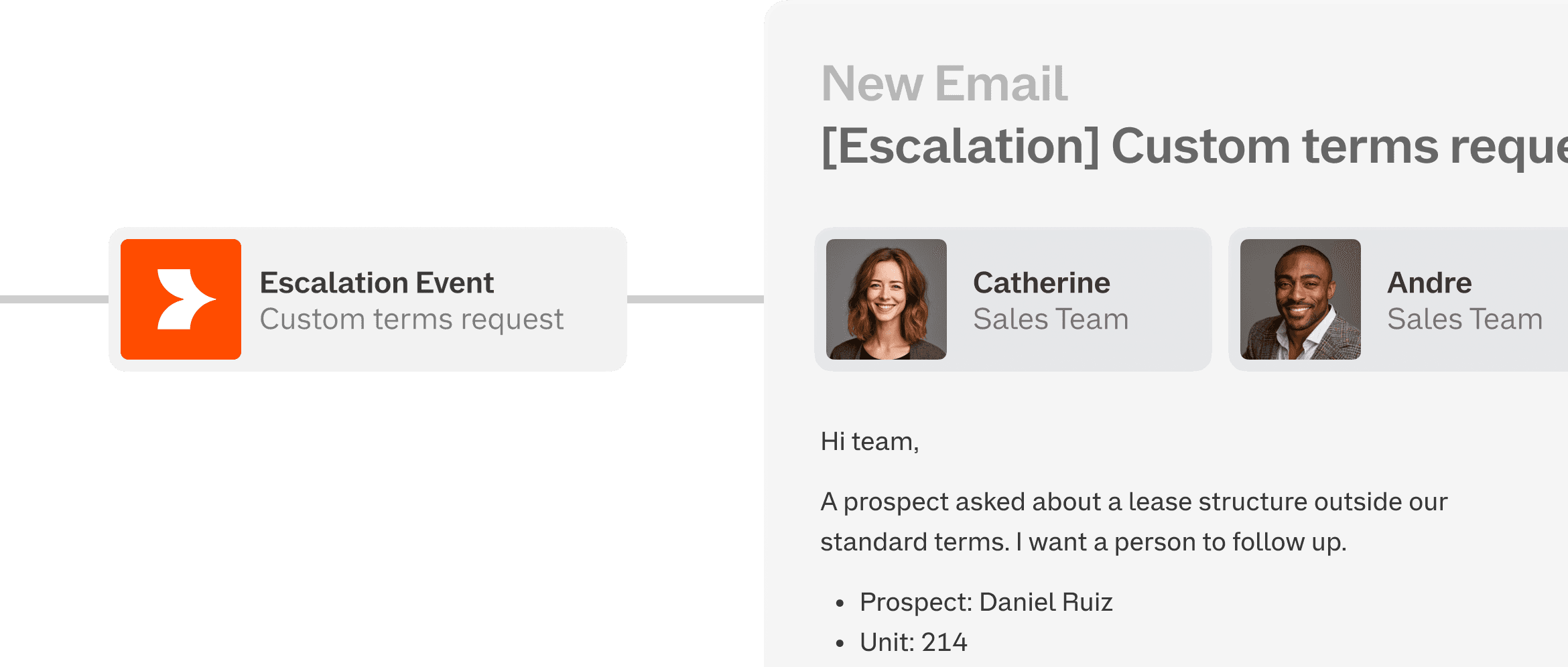
Source: Uniti AI website. The image shows an AI escalating a non-standard lease request to a human sales team with lead context. It is official product material, not third-party operating evidence.
At 11 p.m., a rental or storage inquiry enters the system. The property office is closed. Sales sees it the next morning. By the time someone calls back, the customer may already have booked a tour somewhere else.
In real estate operations, this loss is ordinary and expensive. It makes the value of an AI product unusually easy to calculate: how much faster did the team respond, how many customers booked, and how many leads were no longer missed?
Uniti AI starts from that gap. Its website says its sales agent makes first contact with a lead in an average of 27 seconds, and that customers have seen lead-to-tour conversion improve by as much as 3.4x. In the Inspire Communities case, the agent reportedly covers more than 400 communities and schedules 300 to 400 leads per week. These results come from company and customer case material, not independent audits.
The more interesting number appeared in July 2026. Uniti announced a $12 million Series A and disclosed that 94% of pilots convert into long-term contracts, while net revenue retention reached 306%. That means a cohort of existing customers was, in theory, worth more than three times as much one year later.
Why can a real-estate AI company less than three years old expand old contracts that aggressively?
Capture the 30 Seconds Closest to Revenue
Uniti did not begin by trying to replace the whole property-management system. It first took over the action where money is most easily lost: replying to new leads.
The workflow on its website is concrete. Leads can arrive through phone, text, email, web chat, or WhatsApp. The agent reads property and listing information, asks follow-up questions, qualifies intent, books a tour, and writes the record back to the customer’s existing PMS or CRM. If it encounters unusual lease terms, complaints, or other high-risk situations, it escalates the case to a human with context attached.
That wedge has two commercial advantages.
First, the result shows up quickly. Traditional enterprise software may take months to prove efficiency improvement. Lead response speed and appointment volume can be observed in days. Uniti’s Inspire Communities customer story says conversion changes appeared quickly after deployment. Its customer case page also lists examples such as 20% to 25% tour-conversion improvement for coworking customers and 37% night-time conversion improvement. These numbers are still official case claims and are not third-party audited.
Second, the buyer already knows what a missed lead is worth. Uniti’s website says one missed call once cost StorQuest $2,000 to $4,000. AI does not need to educate the customer on a grand thesis. It only needs to prove that it catches demand the customer was already losing.
That helps explain why the company reports a 94% pilot-to-long-term-contract conversion rate. The number needs independent verification, but the product logic is credible: a pilot can compare response, bookings, and conversions in real properties. The agent’s conversational ability is only the starting point.
The Key to 306% Is Multiple Expansion Paths
High net revenue retention usually comes from price increases, add-ons, or usage growth. Uniti hits all three.
The first axis is property count. An operator can test the product at a few sites, then copy the same workflow to dozens or hundreds of locations. Inspire expanded to more than 400 communities. Storage King USA says Uniti now handles 100% of inbound calls across all its locations. Each additional property becomes a natural deployment unit.
The second axis is lead volume. Uniti’s website FAQ says pricing combines a platform fee with variable fees tied to lead volume. As a customer increases marketing spend, expands its portfolio, or enters a busy season, usage and contract size can grow together. Its service terms also allow fees and overage charges based on the order form, which suggests that expansion is already embedded in the commercial structure.
The third axis is workflow. A new customer may start with sales and leasing agents. Later it can add support, maintenance, collections, renewal, payments, and review workflows. After Uniti integrates with more than 15 PMS and CRM systems, the same property data and communication channels can support additional tasks. The second agent may be cheaper to deploy than the first.
Property count, lead volume, and workflow expansion together make the headline 306% net revenue retention easier to understand.
It Does Not Ask Customers to Replace the Old System
Real estate software is fragmented across PMS, CRM, access control, payments, maintenance, and work-order tools. Replacing everything would mean data migration, staff training, and operational risk. The sales cycle would become much longer.
Uniti sits above those systems. The agent reads listing, customer, and billing information from the existing software, communicates through existing channels, and writes outcomes back. Customers are buying new execution capacity while keeping the systems of record that have already been running for years.
That architecture also makes expansion smoother. A property group does not need to rebuild its data foundation for each new agent. Once identity, listings, conversations, and permissions are connected, they can serve maintenance, collections, and payment workflows too.
As of July 2026, publicly named customers include Regus, StorQuest, RHP Properties, Storage King USA, and Fora. New York Business Journal confirmed the $12 million Series A. A republished funding announcement says one enterprise self-storage customer achieved 214% ROI. The financing fact has third-party reporting; the ROI, conversion, and retention figures remain company-reported and should be treated with that caveat.
The Number May Also Reflect Early-Stage Expansion Math
The 306% net revenue retention figure is rare and should be interpreted carefully.
Uniti was founded in late 2023, making it a natively new product. Early companies often start with small pilots, and the first customers can expand quickly from limited tests into full portfolios. That can make net revenue retention look especially high during a certain period. As new customers begin with larger contracts, the expansion percentage often normalizes.
The company also has not disclosed ARR, total customer count, gross margin, or the sample and period behind the 306% calculation. Real-estate agents also carry voice costs, implementation, integration, and customer-success work. Fast contract expansion does not automatically mean pure software margins.
But that does not weaken the most useful part of the case. Uniti connects three commercialization steps: it uses a narrow revenue-adjacent workflow to win the pilot, copies deployment across the customer’s existing property network, and expands contract size through lead volume and additional workflows.
The future revenue curve of an AI product is often shaped by its first pricing decision. Per-seat pricing depends on selling more seats. Token pricing makes customers focus on cost. Pricing near properties, transactions, orders, or other business units gives the product a chance to grow with the customer’s real operating scale.
What AI Founders Can Learn
The first lesson is to start near measurable lost revenue. “AI can talk to customers” is generic. “AI can answer the inquiry before the prospect books somewhere else” is a budget.
The second lesson is to avoid unnecessary replacement. Uniti does not need to become the PMS before it can create value. It sits where the old system is weak: real-time execution across channels. That lets customers try the product without tearing out core operational software.
The third lesson is to design the expansion path before the first pilot. If the pilot can only prove one small task, expansion will be hard. If the first task establishes identity, property context, communication channels, permissions, and system writeback, the product has a foundation for more workflows.
Uniti still needs more public proof. The strongest operating metrics are company-reported. Real estate portfolios vary widely. Voice quality, escalation accuracy, compliance with communication rules, and integration reliability will all matter as the product scales.
Still, the commercial lesson is clear. The best AI agent is not always the one that performs the most impressive isolated task. It may be the one that attaches itself to a business unit the customer already counts, then expands as that unit expands.
In Uniti’s case, every property can become another surface for the same AI operating layer.