

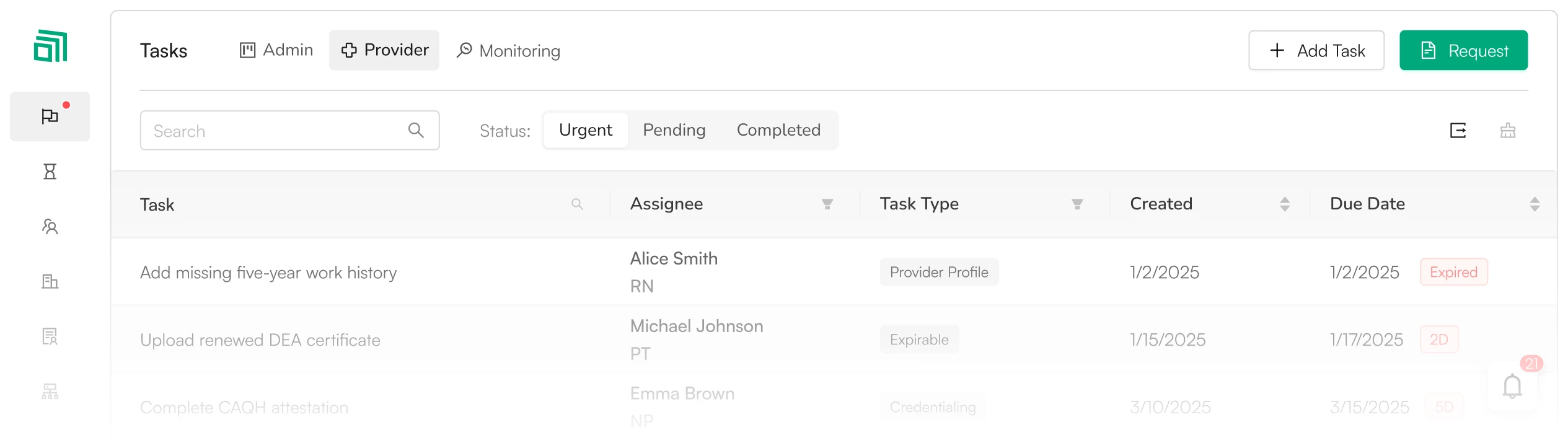
Source: Assured website. The image shows provider credentialing tasks, missing work history, an expired DEA certificate, and a pending CAQH attestation to explain how the product turns fragmented compliance work into trackable tasks; official product material is not third-party operating evidence.
When a healthcare organization hires a new doctor, that does not mean the doctor can create revenue tomorrow.
In the U.S. healthcare system, the doctor must first complete credentialing: education, license, work history, insurance, disciplinary records, and exclusion checks. The doctor must also enter payer networks before commercial insurers or government programs can be billed smoothly. One state, one payer, or one expired certificate can leave a provider sitting inside the system without being able to treat, bill, or generate revenue.
That is where Assured enters. It is not diagnostic AI and it is not a doctor assistant. It turns provider credentialing, licensing, payer enrollment, and network management into an AI execution system.
The entry point is not glamorous. It is valuable.
MedCity News reported on July 23, 2026 that Assured raised a $19 million Series A, bringing total funding to $25 million. Insight Partners led the round, with First Round Capital and Kindred Ventures continuing to participate. The report also says Assured launched in early 2024 and is already used by more than 100 healthcare organizations, including Houston Methodist and Tono Health.
Assured is a natively new product. Based on the publicly reported 2024 launch date, it is less than three years old as of July 23, 2026. Its breakout point is not “can AI understand medicine?” It is “can AI make doctors revenue-ready faster?”
The Overlooked Entry Point in Healthcare AI
Most conversations about healthcare AI begin with clinical decisions, note generation, imaging, or patient communication. Those areas matter, but they also carry higher clinical risk, more complex regulatory boundaries, and longer trust-building cycles.
Assured chose a more back-office, mechanical, and cash-flow-adjacent area: provider operations.
The website describes the problem plainly. Provider information is scattered across outdated systems, state and payer rules are complex and change frequently, teams lose more than 60 hours per month to manual administrative work, and credentialing delays can push billing back by more than 45 days. These numbers come from Assured’s website and are not independently audited, but they point to the buyer’s real pain: this is not just about filling fewer forms. It is about new doctors being unable to start generating revenue on time.
The pain has three useful properties.
First, it is a mandatory process. Healthcare organizations cannot skip credentialing and payer enrollment at scale without creating compliance, reimbursement, and audit risk.
Second, it is directly tied to revenue. The later a doctor enters the network, the slower patient scheduling and collection become. For digital health companies and large provider groups expanding across states, this is not only an administrative-efficiency issue. It is a growth-speed issue.
Third, it is repetitive but not fully standardized. Every state, license type, and payer has rule differences. A form-tracking tool can record status, but the hard work is dealing with portals, certificates, verification, follow-up, exception handling, and evidence.
That is where an AI agent has room: not replacing clinical judgment, but running a long, rule-heavy, auditable administrative pipeline for the operations team.
It Is Not a Form Tool. It Is a Billing-Eligibility Pipeline
The important part of Assured’s product is not the word automation. It is the way the company combines several fragmented workflows.
On its credentialing product page, Assured says the system can import data from sources such as CAQH, NPPES, DEA, and state medical boards, run automated primary source verification, and generate committee-ready credentialing files. It also emphasizes continuous monitoring for expiring credentials, Medicare, Medicaid, and OIG exclusion checks, with exceptions escalated back to the team.
That means the product is not only filling information once. It manages whether providers can remain inside a compliant network over time.
From a productization lens, Assured breaks a complex process into four layers.
The first layer is data capture. Provider records come from many systems and licensing sources, so relying only on manual user input is fragile.
The second layer is verification. Education, licenses, board certification, employment history, OIG, NPDB, and other records must map back to primary sources and leave evidence.
The third layer is package generation. A credentialing committee needs standardized, reviewable materials, not loose attachments scattered across email and spreadsheets.
The fourth layer is ongoing monitoring. Licenses expire, lists update, payer rules change, and the system needs to surface risk before the team is surprised.
Assured says it can compress traditional 60-day credentialing into 48 hours, handle more than 2,000 primary sources, support all 50 states, and get an organization live in 72 hours. These are company disclosures, not third-party audited facts. Even when discounted, the product logic holds: it turns “eligibility confirmation” from a project-style service into a scalable software workflow.
The Commercial Core Is Earlier Revenue
Assured does not publish pricing. Its site uses enterprise demo flows and structured data that points to contact-based enterprise pricing. That suggests a sales-led enterprise product rather than a low-price self-serve SaaS tool.
That makes sense. Credentialing, licensing, and payer enrollment involve compliance, revenue cycle, system integration, and organizational liability. They are unlikely to be solved by a $19 monthly tool.
More importantly, Assured is not selling only “administrative time saved.” It is selling earlier revenue readiness.
Customer testimonials on the website say Tono Health used Assured to manage licensing and payer enrollment for a dermatology network while expanding to 31 states. Birches Health says provider onboarding used to constrain growth and that it can now move from application to patient care in under a month while expanding to 40 states. These are official customer testimonials and are not independently audited, but they explain Assured’s expansion logic: the more states, providers, and payers a customer has, the more valuable the system becomes.
This matters for AI founders. Many products start with “what employees repeat every day.” The more easily funded entry point is often “what costs the customer money every day it is delayed.”
Assured captures the eligibility gate. If a doctor cannot enter the network, scheduling, care delivery, billing, and collection all slow down. If AI can speed up that gate, it does not only affect one operations employee’s hours. It affects the organization’s revenue-generating capacity.
Why This Agent Looks More Enterprise Than a Chatbot
Assured also shows that enterprise AI agents do not need to look like chatbots.
In high-responsibility industries, the buyer may not want an AI that “talks well.” They want an execution layer that completes a process, leaves evidence, escalates exceptions, and writes status back to systems.
That is the difference between Assured and ordinary form automation. It has to integrate with ATS, EMR, and Salesforce. It has to understand CAQH, NPPES, DEA, state medical boards, and payer rules. It has to leave auditable evidence in an NCQA CVO context. It has to handle different provider rosters and delegated credentialing rules.
Those capabilities do not sound like launch-event features, but they create switching cost.
If a customer places provider records, payer status, credential monitoring, exception handling, and review packets inside one system, Assured stops being a form-filling tool. It becomes an operating base for the provider network. From there, expansion into privileging, license renewal, network monitoring, and more payer workflows can increase contract value along provider count, state count, and process count.
MedCity News reported that Assured plans to launch a privileging product in the first quarter of next year to help hospitals verify references, qualifications, and the procedures a new doctor can perform. That expansion path is natural. Credentialing confirms whether a doctor is legitimate and trustworthy. Payer enrollment confirms whether the doctor can bill. Privileging confirms what the doctor can do inside a particular hospital. All three orbit the same question: how can a healthcare organization turn a provider into serviceable, billable, auditable capacity faster?
What AI Founders Can Learn
The lesson from Assured is not simply “build healthcare AI.” The lesson is to choose a strong commercial position.
First, look for the necessary condition before revenue occurs. Customers pay for outcomes, but many outcomes are blocked by an upstream eligibility step. Credentialing before billing, compliance before launch, customs clearance before delivery, evidence before a bid, and documents before a loan can all become earlier AI-agent markets.
Second, turn process evidence into a product. In healthcare, finance, insurance, legal, and construction, AI cannot only give an answer. It must show which sources were checked, why a decision was made, who handled the exception, and when the task was completed. Auditability is a product capability.
Third, do not rush to replace experts. Start by unblocking experts. Assured does not claim to replace doctors. It handles the back-office blockage that prevents doctors from working. That kind of AI can be easier for organizations to accept because it reduces idle professional capacity rather than replacing professional judgment.
Assured still has uncertainty. It has not publicly disclosed ARR, gross margin, renewal rate, contract size, or net revenue retention. The efficiency, savings, and ROI claims on its website are not third-party audited. The complexity of healthcare back-office workflows is both the opportunity and the delivery burden: payer portal changes, state rule changes, and messy customer data can make agent execution more expensive than it looks.
But the framework is clear. The most valuable AI product may not be the one that helps users “do work faster.” It may be the one that lets customers become eligible to earn revenue sooner.
Before the doctor can bill, AI can clear the credentials. That does not sound like a grand narrative, but it may be one of the most realistic commercialization paths for vertical AI.