
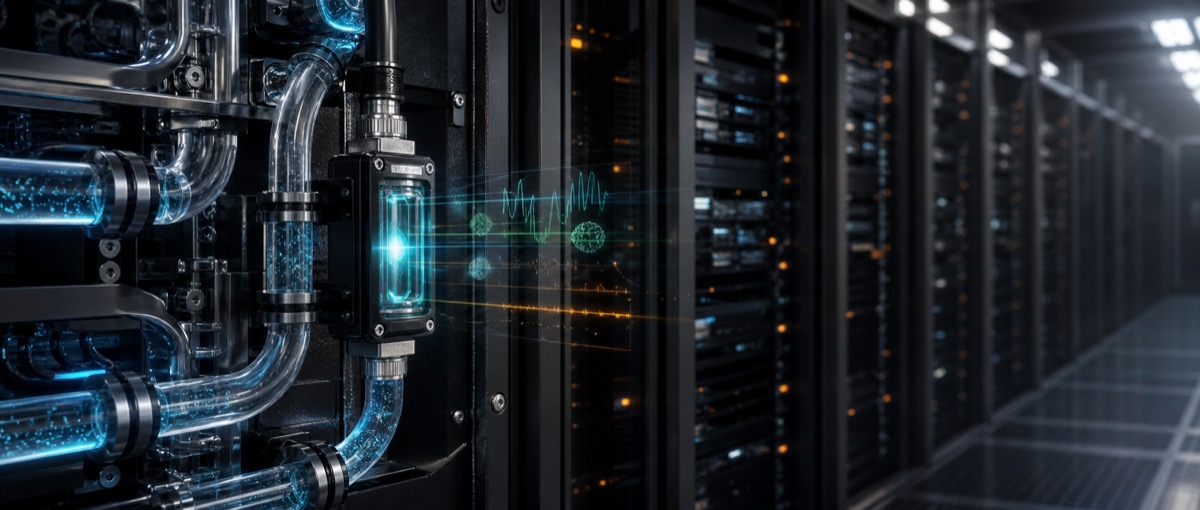
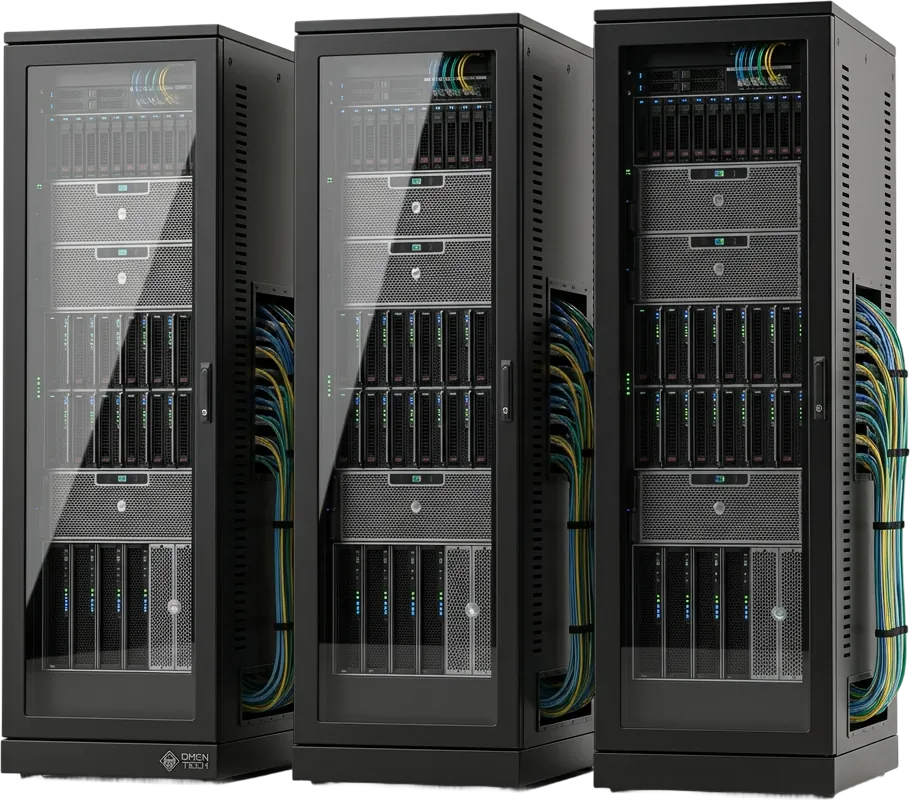
Source: public image from Omen AI. The image shows a data-center server and liquid-cooling environment, which helps explain the physical infrastructure context. It is not third-party evidence.
If you operate an expensive GPU cluster, one of the worst messages you can receive is not “the model underperformed.” It is “the cabinet needs to come offline because the coolant is showing a problem.”
That sounds like a maintenance detail, but it is becoming a new entry point in the AI infrastructure business. AI servers run hotter, air cooling is under pressure, and data centers are pushing more high-density GPU cabinets toward liquid cooling. Once liquid cooling becomes normal, coolant stops being a background consumable. It becomes one of the variables that decides whether compute can keep running.
Omen AI is focused on that variable. It is not building models or cloud capacity. It connects sensors to oil, coolant, or water systems and continuously reads metal content, biological contamination, wear patterns, and fluid degradation so data-center and industrial-equipment operators can see failure signals before machines break.
The company was founded in 2024. On June 30, 2026, Omen announced a $31 million Series A and $41.5 million in total funding. Business Insider also reported that Omen serves about 12 data-center customers and sells hardware as a subscription based on megawatt usage. The reported customer and sales details should be treated as media and company-disclosed signals, not independently audited operating data. Even with that caveat, the model is worth studying: Omen packages a narrow physical risk as a purchasable product that grows with the customer’s asset base.
The Most Expensive AI Assets Can Fail Because of Small Dirty Signals
AI infrastructure is usually described in three layers: chips, models, and cloud platforms. Omen reminds us there is a fourth layer: the maintenance systems that keep those assets available.
The traditional process is simple. Operators periodically draw oil or coolant samples, send them to a lab, wait days for results, and then decide whether to inspect, flush, repair, or replace components. That cadence can work for low-frequency maintenance. It is weaker for high-density GPU clusters where downtime can be expensive and where cooling systems are under constant load.
Liquid-cooling systems contain water, additives, metal parts, seals, pumps, and changing chemical conditions. To absorb more heat, operators may raise the water content in the coolant. More water can increase biological contamination risk. If contamination, metal wear, or seal degradation is discovered too late, the result can be blockage, reduced flow, downtime, and flushing work.
The Next Web frames the problem directly: the industry is putting increasingly expensive compute into liquid-cooled cabinets while many operators still lack continuous visibility into the coolant itself. Omen’s answer is to move chemistry signals from the lab into the field and turn them into a live data stream.
That is the productization point. Omen is not selling a one-time analysis. It is turning a formerly invisible physical signal into something that can be continuously monitored, trended, and connected to maintenance action.
The Product Is Not the Sensor. It Is the Disappearing Wait Time
Omen’s website shows two product shapes. One is a fixed sensor that connects non-invasively to fluid systems and continuously tracks metals, biological contamination, and wear trends. The other is a portable diagnostic device that technicians can bring to a site for immediate analysis.
At the hardware level, this looks like an industrial sensor company. In the AI data-center context, the value is not “one more dashboard.” The value is removing a dangerous waiting period.
The old chain is sample, ship, wait, read the report, and then decide whether to stop equipment. Omen compresses that into live readings, trend anomalies, and earlier intervention. For ordinary equipment, that may improve maintenance efficiency. For racks of high-value GPU cabinets, it can affect availability, customer SLAs, training schedules, and utilization.
Omen says its sensors are deployed with data-center customers managing 10 to 14 gigawatts of capacity and with North American industrial fleet customers. Its website also refers to customer-operated data-center assets worth roughly $200 billion, industrial fleet customer revenue of about $130 billion, and combined customer revenue above $150 billion. These figures are company disclosures, not independent verification. But they show the buying frame clearly: the customer is not an innovation team trying AI. The buyer is an operations team that cannot afford machine failure.
Why Megawatt Pricing Is Smarter Than Device Pricing
The most interesting commercial detail is that Omen ties coolant monitoring to data-center capacity.
If the company sold by device, customers would naturally treat it as a hardware purchase: what does the sensor cost, how many units do we need, and what is the maintenance fee? The price anchor would sit near hardware bill of materials and competing industrial sensors.
But Business Insider reported that Omen uses a subscription tied to megawatt usage. That changes the anchor. The customer is not paying for a small box. The customer is paying for visibility into a high-value slice of compute capacity. The more megawatts behind the deployment, the larger the GPU fleet, cooling system, power infrastructure, customer contract exposure, and downtime risk. Omen’s pricing can then grow with the risk surface.
That lesson applies beyond hardware. Many AI tools get trapped in “how much per seat” pricing and are forced to compete on features. Omen takes a different route: find the expensive asset on the customer’s balance sheet, then attach the product to that asset’s risk curve.
The sales argument becomes sharper. Omen is not saying “your team will be more productive.” It is saying “you have hundreds of millions of dollars of hardware and megawatts of compute running with little real-time signal into fluid health.” The first sounds like an efficiency tool. The second sounds like insurance and control.
This Is Not AI-Wrapped Hardware. It Is Hardware Becoming a Data Product
Omen’s AI story should not be read as a marketing label. The product logic is that sensors capture continuous signals, software recognizes anomalies and trends, and customers use those signals to change maintenance decisions.
The moat is not only the device. If Omen can accumulate pre-failure data across coolant formulas, GPU densities, pumps, seals, data-center designs, and industrial equipment, it is no longer selling one-off tests. It is selling judgment about what normal looks like and what is likely to become abnormal.
That resembles many vertical AI products. Early on, the company appears to automate a specific step. Over time, the durable value comes from workflow data. Legal AI accumulates matter and contract context. Healthcare admin AI accumulates insurance, referral, and billing context. Omen accumulates the relationship between fluid chemistry changes and equipment failure.
The output is also different from most AI applications. It is not a paragraph of text. It is an operational decision: whether a loop needs flushing, whether a pump is wearing, whether a cabinet can keep taking higher load. AI builders often obsess over generating content. The AI products that earn high prices often help customers make more expensive decisions.
Two Lessons for Builders
First, AI commercialization opportunities are not only above the model layer. They also exist at the failure boundaries of AI infrastructure.
As compute becomes more expensive, any product that reduces downtime, lowers maintenance uncertainty, or improves capacity utilization can find budget. These products may not look like traditional AI applications, but they benefit from the real pain created by AI capital expenditure.
Second, a narrow problem is not a small market if it sits next to a high-value asset.
Coolant monitoring sounds narrow. But it touches GPU clusters, data-center capacity, industrial equipment, and downtime loss. Omen’s case shows that a good vertical AI product does not need to begin by becoming more general. It can begin where customers are most afraid of failure.
The better question for an AI founder is not “can I add an agent?” It is: where is the most expensive, fragile, signal-poor part of the customer’s operation? If you can turn one invisible risk there into a monitored, auditable, purchasable product, you do not have to compete with every chatbot.