

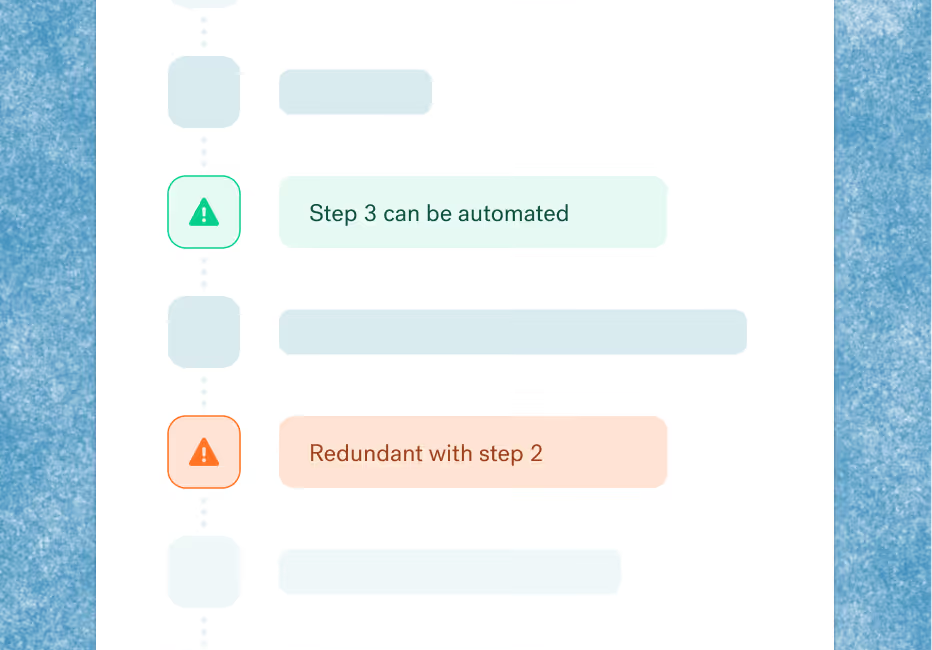
Image source: Scribe official product page. The image shows the system marking automation opportunities and repeated steps; it is not third-party evidence of operating metrics.
Behind $100 million ARR, Scribe has accumulated 15 million real workflows.
Many companies still start AI deployment by asking consultants to interview employees, or even by sitting beside workers with a timer to record how long a task takes.
That scene comes from Scribe founder Jennifer Smith’s description to TechCrunch. Models can write code, process documents, and call tools, yet enterprises often cannot answer a more basic question: which work should be handed to AI, and how is that work actually done?
Scribe is filling that gap. Forbes reported in May 2026 that the company had passed $100 million in annual recurring revenue, reached 6 million users, recorded and analyzed 15 million workflows, and covered 40,000 enterprise applications.
Those operating figures were disclosed by the company to media and are not independently audited. But they reveal a product path worth studying: Scribe did not first ask enterprises to build a grand AI knowledge project. It first let ordinary employees leave an AI-readable operating trace while doing work they already needed to do.
Start with one fewer explanation
Scribe was founded in 2019, which makes it a classic older product with a new AI ceiling. Its first problem was small: a user opens the browser extension, performs a task as usual, and the product turns clicks, inputs, and page changes into a step-by-step guide with screenshots.
That format is easier to search and edit than video. It also removes screenshotting, cropping, annotation, description writing, and formatting. Someone who knows a process only has to do it once, then share the link with a new colleague or customer.
The first user value was direct: “I do not have to explain this again.” That immediate payoff lowered the friction of documenting knowledge. It also made every guide naturally distributable. The creator solves a repeated explanation problem. The viewer discovers Scribe while using the guide. As more guides appear inside a team, managers have a clearer reason to buy it centrally.
In November 2025, TechCrunch reported that Scribe had more than 5 million users and 78,000 paying organizations, and that it had entered 94% of the Fortune 500. This is a familiar enterprise growth path, but still hard to reproduce: individual users adopt because the product is useful, and enterprises pay later because usage has already happened.
How a documentation tool grows a context layer
If Scribe only generated how-to guides, it would still be a productivity tool. What changes the business ceiling is the data structure behind those guides.
A workflow contains which applications were used, which steps happened in what order, where users repeatedly switched context, and which moments tended to produce errors. When thousands or millions of workflows are aggregated, an enterprise can answer operational questions from actual behavior: which process consumes the most time, which steps are repeated, where automation is suitable, and whether AI deployment created real return.
That is the logic behind Scribe Optimize. According to the official product description, it can automatically capture authorized workflows, generate process maps, identify bottlenecks and automation opportunities, and estimate ROI from frequency and time spent. Through MCP and APIs, those workflows can also become context for internal enterprise agents.
This moves Scribe from “record how people do work” toward “decide what should change next.” The 15 million workflows are therefore not only a content inventory. They are an asset at three levels:
- For employees, they are immediately reusable operating guides.
- For managers, they are process data for finding waste and prioritizing automation.
- For AI, they are rules, sequences, and exceptions needed to execute enterprise tasks.
It is not unusual for an AI company to say it has data. What is more distinctive about Scribe is that the data is produced by an action the user already wants to take, and every recording first gives that user a visible result. The data asset and the product value have lived on the same path from day one.
From a $13 seat to seven-figure contracts
Scribe’s pricing turns that path into a commercial model.
The pricing page offers a free Basic plan, Pro Personal at $25 per seat per month when billed annually, Pro Team at $13 per seat per month with a five-seat minimum, and custom Enterprise plans with automated redaction, permissions, identity controls, data governance, and multi-team management.
Forbes reported that customer payments range from roughly $20 subscriptions to five-, six-, and seven-figure enterprise contracts. The front end is a lightweight product anyone can try. The back end sells security, governance, organization-level process insight, and AI transformation capability. As the product sees more work, the budget owner can move from an individual user to team leadership, IT, and enterprise transformation groups.
Customer outcomes explain why accounts can expand. Scribe’s official New York Life case says the customer expanded from a 40-person pilot to more than 80 teams, with surveyed creators reporting an average 41.6 hours saved per month. A school district IT case says the time to make a single guide dropped from about 30 minutes to 10 minutes. These are official customer-case figures, not independently audited results, but they map to costs enterprises understand: training, support, documentation maintenance, and knowledge loss.
The moat depends on keeping context fresh
Scribe’s moat is easy to misread as “a large number of screen recordings.” Volume alone is not enough. The harder-to-copy part is whether structured workflows can stay accurate, remain permissioned, and keep updating after execution results come back.
The team’s public ScribeAgent research used production workflow data to train a web agent and reported a 7.3% task-success improvement over the previous best text agent on WebArena. It is a preprint involving company researchers, so it should not be treated as an independent product benchmark. Still, it points in a useful direction: real workflow data may improve an agent’s understanding of long tasks and concrete operations.
The risk comes from the same place. Capturing employee behavior raises privacy, permission, and internal trust questions. Interface changes can make old workflows stale. Microsoft, ServiceNow, UiPath, and process-mining vendors also own adjacent data. If Scribe can only record workflows, but cannot keep them fresh or prove AI execution results, its context layer can decay into a larger documentation library.
That means the 15 million workflows are valuable only if they keep participating in work: viewed, corrected, analyzed, called by agents, and improved by execution feedback.
Two product moves to take away
Give users an immediately useful result before accumulating the long-term asset. Scribe did not ask employees to fill out forms for the company’s future AI strategy. A user completes one task and receives a shareable guide. Structured data is the byproduct of that immediate value. Many AI products should re-examine their data flywheel through this lens: why would a user contribute this context today, not only why will the company need it tomorrow?
Let individual sharing and enterprise purchasing happen along one path. The more useful a guide is, the more it gets shared. The broader usage becomes inside an organization, the clearer the management, security, and analytics needs become. Scribe did not build one system for product growth and another disconnected system for enterprise sales. Free usage becomes evidence for a larger contract.
Scribe crossed $100 million ARR on the surface because of the AI wave. Underneath, it was built on an accumulation that started six years earlier: first turn the steps in a person’s head into a shareable product, then turn those steps into context machines can use.
As model capability becomes easier to obtain, the scarce enterprise asset moves inward. Whoever can see how work happens has a stronger chance of deciding where AI enters and how much value can be retained.