
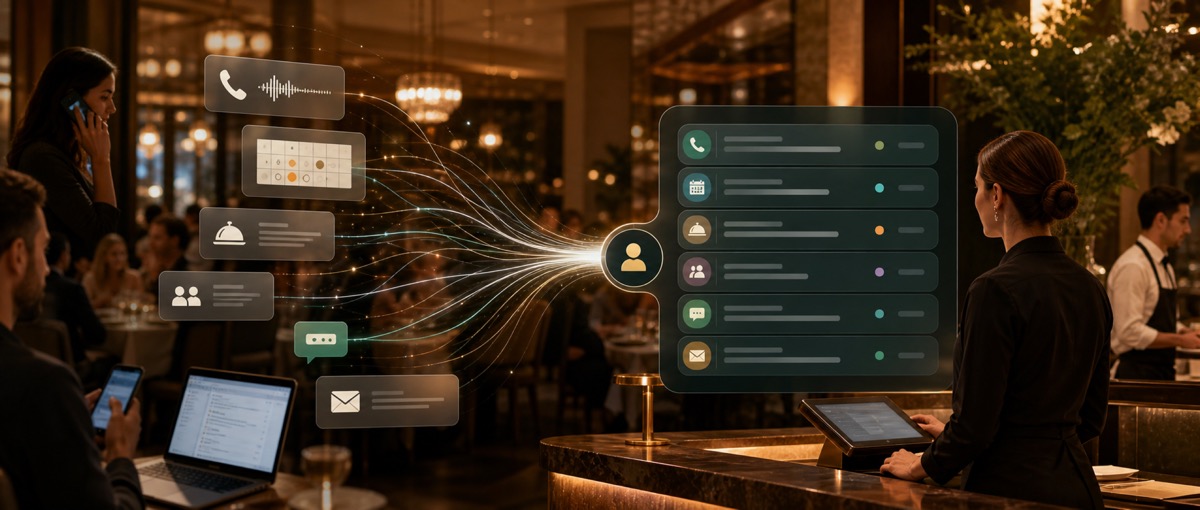
 Source: public media from Hostie’s official blog. The image explains the front-of-house restaurant setting; it is not third-party evidence for operating metrics.
The first place restaurant AI may make money is not menu generation, kitchen scheduling, or replacing servers with chat. It may be a simpler entry point: when the phone rings, does anyone answer?
Hostie is built around that entry point. It gives restaurants an AI virtual front desk that handles calls, texts, emails, reservations, takeout, common questions, and private-event inquiries. On the surface, this is a voice AI product. More deeply, it sells the idea that restaurant demand should not leak away.
The case is worth studying because the signals are concrete. Restaurant Technology News reported in July 2026 that Hostie raised a $12 million Series A, bringing total funding to $16 million. The same report said Hostie’s revenue grew 10x over the prior year, that it serves hundreds of restaurants, has handled more than two million guest conversations and 24 million messages, has booked more than 400,000 covers, and has supported more than 50,000 private-event inquiries.
Those operating figures are company-disclosed, not independently audited. They still point to an important pattern: Hostie is not selling a clever AI phone demo. It is entering a daily restaurant workflow that directly affects revenue.
It Captures the Restaurant Revenue Funnel at Its Busiest Moment
The front-desk tension inside a restaurant is concrete. The more guests are already in the room and the busier the kitchen and floor become, the less capacity staff have to answer the phone. But the person calling may want a reservation, takeout order, time change, parking information, allergen information, or a private dining event for dozens of guests.
Hostie’s origin story comes from this setting. The company says co-founder Randall Hom was operating the San Francisco restaurant Back to Back when calls, texts, and emails kept pulling him away from the floor. He then built Hostie with AI engineer Brendan Wood. LinkedIn lists Hostie as founded in 2024, which makes it a native recent AI product.
This entry point is strong for three reasons.
First, the pain does not require education. Restaurant owners do not need to understand agents, LLMs, or automation frameworks. They understand that a missed phone call can mean a missed table.
Second, the value is not only saving a few minutes. The value is capturing demand that would otherwise disappear. Reservations, large parties, takeout, and private events are concrete revenue opportunities, not abstract efficiency.
Third, the workflow has a natural vertical boundary. A restaurant front desk is not generic support. It needs to know hours, menu details, seating rules, reservation systems, allergen language, private-event forms, brand tone, and when to hand off to a human. The more vertical the context, the less the product looks like a generic bot.
Hostie Is Building a Guest-Communication Operating Layer
Hostie’s website describes a platform that brings calls, texts, and emails into one system. It supports reservations, takeout, private-event inquiries, real-time transcripts, an operator app, and multilingual communication. Its pricing page shows Essential starting at $199 per location per month, Premium at $399 per location per month, Hospitality Plus at $599 per location per month, and enterprise plans through sales.
That pricing structure matters. Hostie does not charge by employee seat. It charges by location. For a restaurant, the natural budget unit is the location: how many calls did this store stop missing, how many reservations did it recover, how many event leads did it convert, and how much staff attention did it preserve?
The product tiers also create a natural expansion path.
Essential solves the basic problem: answer, record, and notify. Premium adds full reservation integrations, takeout ordering, more customization, and 20 languages. Hospitality Plus adds cross-location recommendations, conversation scoring, private-event integrations, and SMS marketing.
This is not just a phone bot with a higher plan. The path starts by catching incoming calls, then gradually takes over the restaurant’s guest-communication surface, expanding into reservations, events, marketing, and operating data.
The Strongest Logic: Turn Interruptions Into Leads
Many AI tools sell “saving time.” Hostie’s smarter move is translating time savings into restaurant revenue language.
Restaurant Technology News listed customers including Flour + Water Hospitality Group, Riviera Dining Group, Bacchus Management Group, Cactus Club Cafe, Cunningham Restaurant Group, Merchants Hospitality, State Bird Provisions, Wayfare Tavern, Mirra, and The Progress. That customer list suggests Hostie is not limited to very small restaurants. It is also entering groups with multiple locations, multiple brands, and meaningful private-event needs.
Official customer stories reinforce the same logic. Hostie’s Stinking Rose Group case says the group handled 24,000 calls, increased over-the-phone covers by 117%, freed 403 hours in six months, booked 4,700 reservations, and had 80% of calls resolved without human handoff. A Slanted Door Group case says the group increased over-the-phone covers by 56%.
Those results are official case-study data and should be treated as company-supplied, not independently audited. But for product learning, they reveal Hostie’s narrative: the important question is not whether the AI sounds human. The important question is whether the restaurant recovered guests, tables, and event demand it would otherwise have missed.
For founders, this translation matters. If an AI product sells only efficiency, it can be pushed into a tool budget. If that efficiency maps to revenue leads, closed opportunities, loss reduction, or compliance evidence, the budget becomes clearer.
Why Restaurants Are a Good Vertical for AI
Restaurants can look low-tech from the outside, but the workflow is fragmented. Every location has different menus, table configurations, reservation policies, allergen scripts, private-room rules, event processes, takeout policies, and service tone. A generic customer-support bot struggles with these details.
Hostie’s opportunity is that it does not need to invent new consumer behavior. Guests already call, text, ask whether they can book a table, ask whether dogs are allowed, ask about gluten-free options, or ask how to host a birthday dinner for 50 people. The product’s value comes from unifying those entry points while letting the restaurant team remain in control.
That means Hostie’s moat is probably not “a better voice model” alone. It is four more operational things.
First, restaurant context. A high-end dining room and a neighborhood pizza shop should not speak the same way.
Second, integrations. Reservations, POS, events, SMS, email, and team notifications all need to connect.
Third, human handoff. AI should not force every answer. It needs to know when an issue belongs with a person.
Fourth, guest data. Every call, change, cancellation, question, and event lead can become an operating asset for the restaurant.
That is why Hostie looks more like an operating layer than an answering machine. It starts with the phone, but the end state is a guest communication OS.
Lessons for AI Builders
First, do not start with the AI capability. Start with the revenue leak.
Hostie does not need to teach restaurant owners what a voice agent is. It starts with a fact every restaurant understands: if nobody answers, money may disappear. The best vertical AI entry points are often not the most technically impressive points. They are the points where the customer already feels loss.
Second, begin with a narrow entry point, then expand into an operating layer.
If Hostie only answered calls, it would quickly face generic competition. By combining calls, texts, emails, reservations, takeout, and private-event inquiries, it moves from point tool to guest entry point. Many AI products should follow this path: solve one painful, frequent problem first, then expand along the user’s actual workflow.
Third, price by the customer’s business unit.
Restaurants do not naturally budget around “AI seats.” They think in locations, shifts, tables, covers, events, and staff time. Hostie’s per-location pricing places the product inside a unit restaurants already understand. In vertical AI, the pricing unit is part of the positioning.
Fourth, in service-heavy industries, do not make “replace people” the only story.
Hostie’s public story emphasizes supporting restaurant teams, not replacing hospitality staff. That is not timid. It is commercially accurate. Restaurants want staff to spend less time on repetitive interruptions and more time with guests already in the room.
What Still Needs Watching
Hostie has real risks. First, most public growth and customer results come from company disclosures. Second, restaurant voice and front-desk automation already have competitors such as Slang, SoundHound, Popmenu, and booking or POS ecosystem players. Third, restaurant trust is fragile: wrong reservations, incorrect answers, awkward tone, or poor handoff can all damage the guest experience.
That is why the case is useful. It shows that AI commercialization does not always start in the biggest possible market. A restaurant phone call can be a deep enough entry point.
The lesson is not simply “let AI answer the phone.” It is that Hostie reconstructs the demand behind the call into a revenue workflow: capture the question, identify intent, write to the system, route to a person when needed, store the data, and sell the whole layer per location.
That is what strong vertical AI products often look like. They do not prove how smart the model is. They make sure a business stops losing work it already earned.