

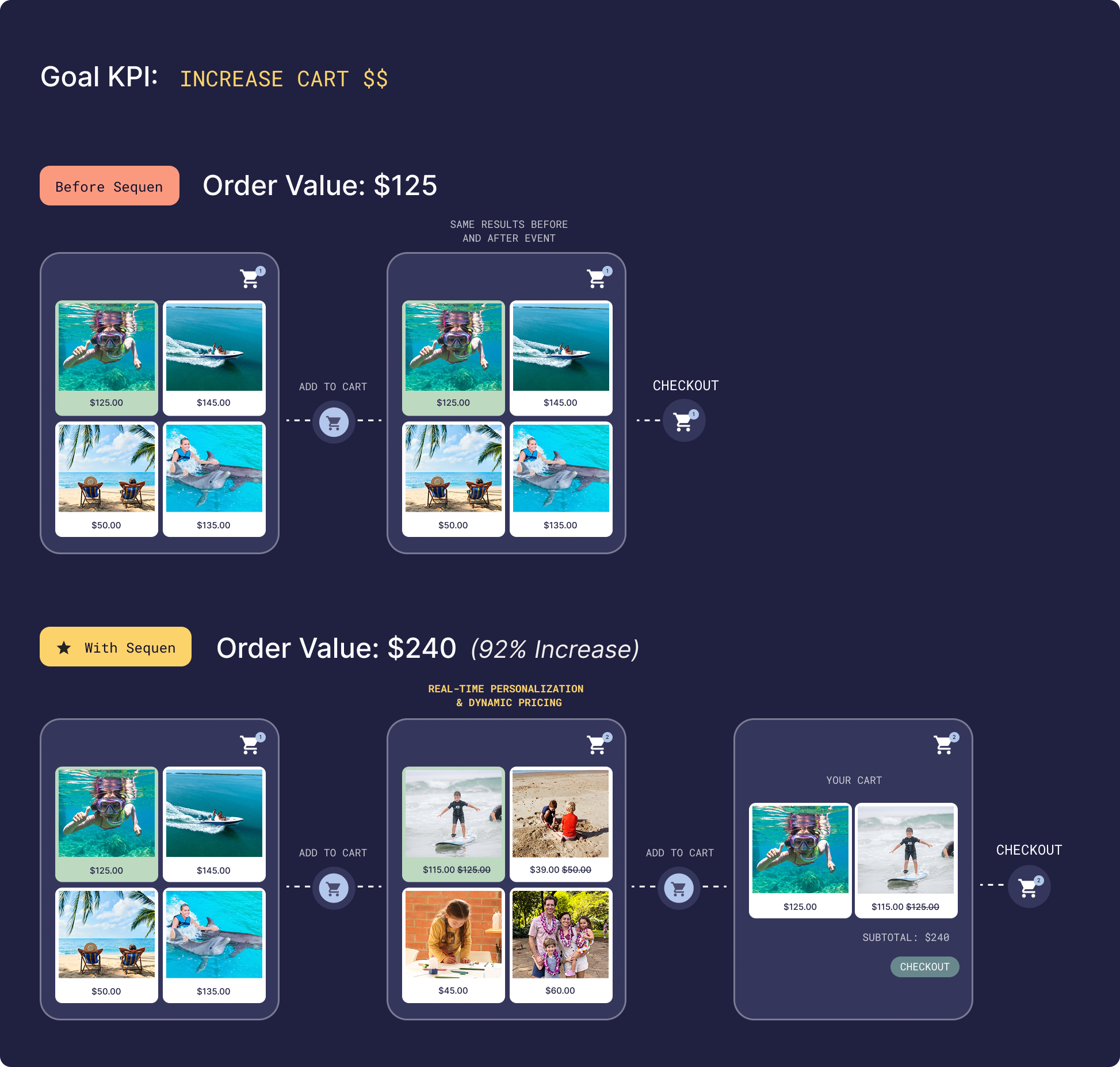
 Source: Sequen product page. The order-value improvement shown is an official mechanism illustration, not third-party verified data.
Many companies still understand personalization as “you may also like.” Sequen makes a more aggressive claim: recommendations, search, ads, and chat entry points are not merely display surfaces. They are revenue surfaces that can be optimized in real time.
The company is worth studying because it packages a capability once associated mainly with TikTok, Spotify, YouTube, and other super-platforms into an API and Ranking Platform that enterprises can buy.
According to TechCrunch, Sequen raised a $16 million Series A in March 2026, bringing total funding to $22 million. The report also said the company processed about 10 billion monthly requests within less than 18 months, signed seven-figure contracts among its first five customers, and entered several Fortune 500 companies. Those contract, request, and customer-effect metrics come from company disclosure or media reporting, not independent audit.
The important insight is not the funding. It is the layer Sequen chose: not generating more content, but deciding what the user should see next.
From User Profiles to Session Events
Traditional personalization systems often depend on “who the user is”: age, city, previous purchases, loyalty tier, and browsing history. The problem is that intent changes inside the current session.
A user opening an ecommerce app may not simply be “outdoor-oriented.” They may be buying scuba equipment for a child right now. A travel user may not simply be “high value.” They may have just clicked family trips, short-haul flights, and weekend hotels.
Static profiles describe the past. They may miss current intent.
Sequen’s narrative starts there. Its platform page frames the idea as “Events, Not Attributes”: real-time clicks, scrolls, dwell time, searches, cart additions, and purchases can describe what the user wants now better than static attributes.
So Sequen is not giving enterprises a recommendation widget. It is giving them a real-time reranking system. Each session’s behavior enters the model, and the model decides how search results, recommendation lists, ad units, or chat suggestions should be ordered next.
That sounds like recommendation software, but the business meaning is larger. If a product can change ranking, it can change the path to revenue.
It Sells Objective Functions, Not Relevance
Sequen’s smartest product move is translating “better recommendations” into business objectives.
The product page says customers can optimize for AOV, ACV, conversion, LTV, ARPU, engagement, clicks, time spent, or combinations of KPIs. In other words, Sequen is not only answering “which item is most relevant?” It is answering “what should we show next to improve the business outcome the customer selected?”
That difference determines commercial value.
If the product sells relevance, the buyer may be a data or search team, and the budget can look like tooling or infrastructure. If it sells order value, net revenue, conversion, and retention, the buyer can include growth, product, monetization, and management. Once AI enters outcome metrics, it is no longer only an efficiency tool.
TechCrunch cited two example claims: one large furniture company saw a 7% revenue lift after switching to Sequen, and Fetch Rewards saw a 20% net-revenue lift in less than 11 days. Those figures come from company disclosure and are not independent facts. But they explain why customers can sign large contracts. Sequen is trying to connect model effects directly to revenue lift.
TikTok-Style Capability as Enterprise API
Sequen also avoids presenting itself as a massive ML project that the enterprise must rebuild internally.
The product page says it provides a low-latency API for query understanding, ranking, and personalization, and says customers can integrate in about six weeks. The platform page emphasizes in-session personalization, sub-20ms experience, Sequen Ranking Clusters, Ranktune, and Rumi analytics.
This packaging is important.
Large consumer apps know recommendation systems matter. The hard part is engineering: event collection, feature storage, real-time inference, ranking services, experiment measurement, latency control, sparse data, delayed feedback, and multi-objective optimization. If any one layer fails, the recommendation system remains an internal research project.
Sequen compresses that complexity into a few things enterprises can buy:
- low-latency API, so it can sit inside high-frequency search and recommendation surfaces;
- RPS tiers, so pricing can scale with traffic;
- dedicated Ranking Clusters, so customers can believe in performance and isolation;
- Ranktune, so existing AI/ML teams keep control;
- Rumi analytics, so product and growth teams can see model suggestions and trends.
That is how AI infrastructure becomes commercial product. It does not only deliver a model. It delivers a work system enterprises can procure, integrate, scale, and interpret.
Why Seven-Figure Contracts Are Plausible
TechCrunch reported that Sequen prices by requests per second, with tiers such as 500 RPS and 1,000 RPS, and that its first five customer contracts reached seven figures. That pricing approach is worth studying.
The company does not price by seat. Search and recommendation reranking are not software humans sit in all day. They are machine layers embedded in user traffic. Value comes from every request, every ranking decision, and every conversion opportunity.
This category naturally fits throughput and business-value pricing. The more traffic a customer has, the more requests the system processes, the larger the possible revenue impact, and the higher the customer’s willingness to pay.
More importantly, Sequen enters the enterprise’s sensitive revenue surfaces: homepage feed, search results, recommendation list, ad slot, and next-step suggestion before cart or checkout. A few points of improvement in these places can translate to a large absolute revenue impact. A back-office efficiency tool saving a few person-days rarely supports the same contract value.
That is Sequen’s first lesson for AI founders: if the goal is high price, do not ask only whose time AI saves. Ask whether AI can enter a high-frequency, high-revenue, high-leverage decision point.
The Moat Is Not a Model Name. It Is a Feedback Loop
Sequen talks about Large Event Models and reinforcement learning. Commercially, the model label matters less than the feedback loop.
Users see something, click, dwell, add to cart, buy, return, or leave. Those events flow back into the system. The closer the model is to real business action, the faster and more measurable the feedback loop becomes.
That differs from many generative AI tools. Writing an article, generating an image, or summarizing a meeting often produces subjective, delayed, weakly quantified feedback. Recommendation and ranking naturally have metrics: CTR, AOV, CVR, ARPU, LTV, time spent, and repeat purchase.
Sequen’s value is therefore not a one-time output. It is continuous optimization of a business path. If it can reliably create lift, customers naturally expand it to more pages and entry points.
That is also where lock-in can emerge. Once a ranking layer is integrated with event streams, objective functions, and experiment systems, replacement is not just switching APIs. It means revalidating a revenue path.
The Risk: Revenue Lift Is Hard to Prove
Sequen’s story has obvious risks.
First, revenue lift is difficult to attribute. Search ranking, promotions, inventory, traffic mix, seasonality, and user lifecycle all affect results. Without public long-term A/B reports, outside readers should treat customer effects as company disclosure rather than independent proof.
Second, real-time personalization touches privacy and experience boundaries. Sequen emphasizes post-cookie and privacy-first positioning, but the closer a product gets to user behavior, the more enterprises need to explain how data is collected, stored, modeled, and used.
Third, internal AI/ML teams can be both buyer and substitute. Sequen must prove not only that it can do the work, but that doing it internally would be slower, more expensive, and less stable.
Those risks do not weaken the lesson. They sharpen it: the closer an AI product sits to revenue, the more it must withstand experiments, compliance scrutiny, and engineering reliability checks.
What AI Founders Should Learn
Sequen is not a product every founder can copy. Most startups will not start by building enterprise recommendation infrastructure.
But its commercialization logic is reusable.
First, find high-frequency decision points. Every page open, search, browse action, cart add, and pre-purchase moment contains a “what should we show next?” decision. AI that can own that decision can be more valuable than AI that analyzes what happened afterward.
Second, translate model capability into business objectives. Customers do not want to buy better embeddings. They want higher AOV, higher conversion, higher retention, and less wasted acquisition spend.
Third, make AI an integrable system, not a demo. Enterprises pay for low latency, reliability, isolation, control, and interpretable dashboards.
Fourth, enter existing budgets. Sequen sells to growth, search, recommendation, advertising, and AI infrastructure budgets that consumer companies already fund. It does not create an unfamiliar AI budget from scratch.
The next phase of AI products may not be “generate more things.” It may be “decide the next step better.” Sequen’s lesson is here: whoever controls ranking controls the entry point to business outcomes.