

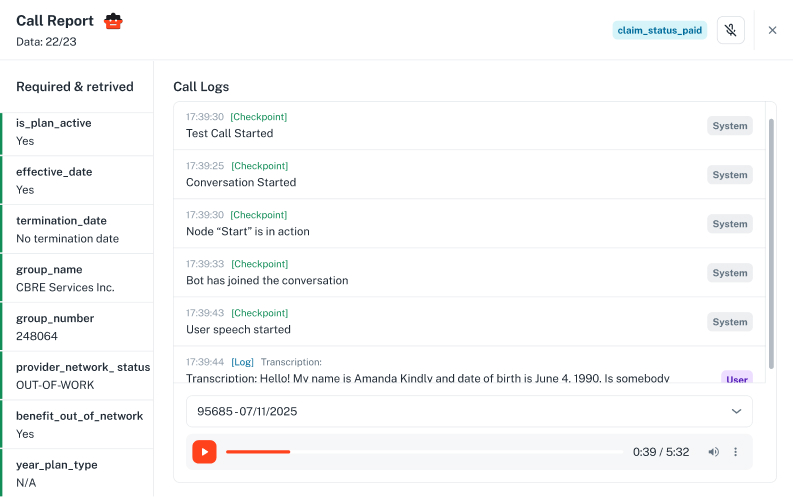
 Source: public product image from Prosper AI showing call logs, transcript snippets, and status records. Official product media, not third-party evidence.
The first places where healthcare AI makes money may not be diagnosis, and may not be a smarter patient chatbot.
A more practical entry point is the clinic phone.
Prosper AI is a case in that category. MobiHealthNews reported that the company was founded in 2023 and raised a $30 million Series A in June 2026 led by a16z. It is not a generic voice-support product. It lets AI agents handle the most repetitive healthcare phone work: scheduling, benefit checks, prior authorization, claims status, billing, refill reminders, and patient intake.
If the case is reduced to “AI answers calls,” the market looks crowded. Prosper AI is worth studying because it treats the phone as a revenue workflow, not a front-desk tool.
The Phone Is Not a Front-Desk Problem. It Is a Revenue Problem
In a healthcare organization, a phone call is rarely just a question.
It may determine whether a patient gets scheduled, whether insurance coverage is confirmed, whether prior authorization moves forward, whether a bill is explained, and whether the provider ultimately collects payment.
That is why Prosper AI does not stop at 24/7 answering. Its website separates capabilities into patient calls and payor calls. On the patient side, agents handle scheduling, intake, billing questions, and similar work. On the payor side, agents call insurance companies on behalf of healthcare organizations, navigate IVR, wait for human representatives, collect eligibility or claim information, and write results back into systems.
This work is not glamorous. The commercial value is hard.
Forbes wrote in June 2026 that Prosper AI added more than 40 healthcare organizations in the prior six months, increased revenue fivefold, and could fully handle 50% of patient calls. Those operating metrics come from company and founder disclosure, not third-party audit.
Even so, they point in a clear direction: healthcare organizations pay for fewer missed calls, less manual work, more scheduled visits, and more completed reimbursement steps, not simply for a voice model.
It Sells Patient-Journey Control, Not Voice
Prosper AI’s productization is important because it includes the actions after the call.
When a patient calls, the agent is not only answering. It may read and write EHR data, check appointment availability, confirm insurance, call an insurer when needed, process billing or payment questions, and escalate exceptions to humans.
That is closer to a patient-journey control layer than an AI front desk.
The How it works page states that Prosper AI can automate scheduling, benefit checks, prior authorization, claims status, billing, refill reminders, and patient intake. It says implementation can begin from spreadsheets or SFTP in one to two days, while full API/EHR integrations take weeks. Pricing is based on platform usage, with custom pricing for high-volume customers and partners.
These are official website claims and should be treated accordingly. But they explain why the product is more than a demo:
- It has prebuilt healthcare workflow blueprints rather than forcing every customer to start from a blank prompt.
- It connects with more than 80 EHR, clearinghouse, CRM, and practice-management systems.
- It includes transcripts, confidence scores, human handoff, QA, and audit records.
- It packages usage and enterprise partnership pricing instead of selling a fixed chatbot seat.
This layer around the model is what AI founders should study.
In constrained industries, customers do not buy AI because it understands one sentence. They buy it if, after that sentence, the system writes the right data to the right place, detects failures, and leaves a trace.
Why the Growth Signals Make Sense
Prosper AI’s growth signals fall into three groups.
First, the financing signal. MobiHealthNews confirmed the $30 million Series A. The company announcement says the round was led by a16z, with Base10, Emergence Capital, YC, and Company Ventures participating.
Second, customer and coverage signals. The company announcement says Prosper AI covers more than 150,000 providers and underpins more than $1.3 billion in patient care. The Forbes story references a $7 billion patient-care figure. Those two numbers appear to reflect different times or scopes of company disclosure rather than audited financial data.
Third, value signals. The website claims 50%+ cost reduction, 20%+ revenue lift, and 99%+ QA accuracy from AI voice agents. Customer testimonials also reference 50% or 60%+ call automation. These are website case claims, not independent audit.
Even after discounting those figures, Prosper AI’s commercialization logic is strong. It found a workflow inside a healthcare cost center that connects directly to revenue.
It is not saying, “we can chat.” It is saying:
do not miss the call;
do not make the patient wait;
do not let insurance block the process;
do not let billing drag;
do not make staff re-enter the same data across systems.
That is why vertical AI can charge more easily than general AI. It is not necessarily smarter. It sits closer to whether money is collected.
Three Lessons for Founders
First, find workflows that must be completed, not features that are merely pleasant to experience.
Many AI demos feel smooth but become vague when the buyer asks why to pay. Prosper AI addresses calls and insurance work that clinics must handle every day. If the work is not done, scheduling, cash flow, and patient experience suffer. That kind of process enters budget more easily than an experience enhancement.
Second, productize the result, not the conversation.
If the product only sells “AI can call,” the buyer will compare it with other voice agents on price. Prosper AI defines outcomes as completed scheduling, confirmed benefits, billing explanation, payment movement, exception handoff, and QA records. To the buyer, that is closer to an operating system.
Third, vertical AI moats often live in the unglamorous details.
EHR integrations, SFTP imports, permissions, PHI protection, SOC 2, HIPAA, call audit, confidence scoring, human handoff, customer success, and SLA are not as exciting as a model demo. They decide whether AI can actually be deployed.
Founders often underestimate that.
As model capability becomes more available, differentiation moves toward industry workflow, system connection, and delivery capability. Prosper AI’s lesson is not “build healthcare phones.” It is this: in a high-frequency, poor-experience, tightly constrained process that directly affects revenue, AI can become a traceable, billable, reusable execution layer.
Risks to Watch
Prosper AI still faces real risk.
Healthcare has low tolerance for failure. A mishandled call can affect not only customer experience, but insurance coverage, billing, privacy, and patient trust.
The evidence boundary also matters. Financing, customer count, provider coverage, revenue growth, cost savings, and QA accuracy currently come heavily from company disclosure or website cases, with little third-party audit. They are useful signals, not fully independent facts.
Large EHR, RCM, and healthcare contact-center platforms may also embed similar capabilities. Prosper AI cannot rely only on early voice-agent advantage. It must prove that its cross-system, cross-payor, cross-department execution layer is deep enough.
That is why the company is worth watching.
If Prosper AI expands from “answering calls” to a patient-access and revenue-cycle operating system, the story becomes larger than healthcare AI. It becomes a general AI commercialization rule: the first money is often not in the place with the most knowledge. It is in the fragmented workflow where responsibility is heavy and every step can affect revenue.