
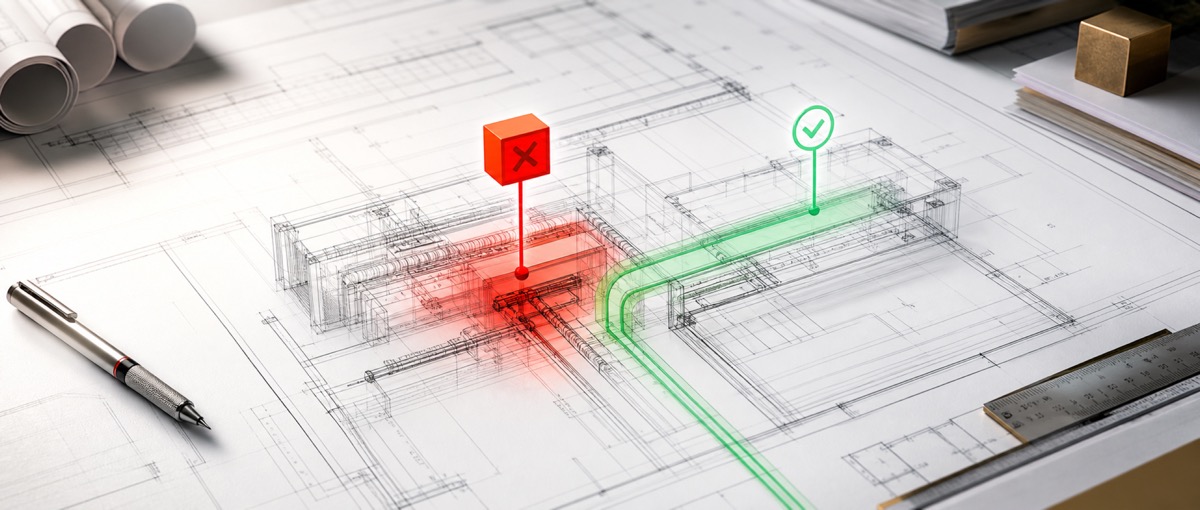
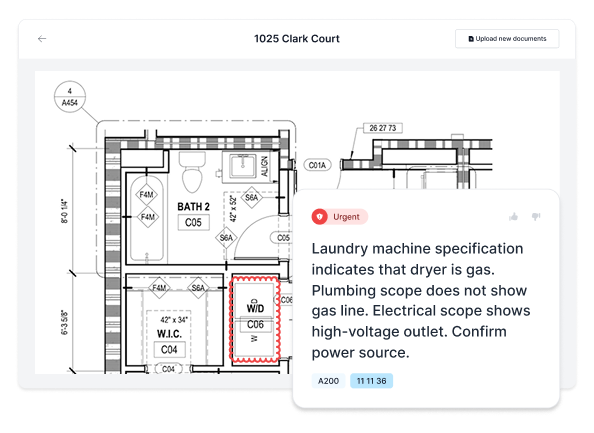
 Source: public product image from LightTable showing issue location and an urgent review recommendation. Official promotional media, not third-party evidence.
If LightTable is understood only as “AI that helps construction companies review drawings,” the case becomes too narrow.
The more accurate framing is that LightTable moves one of the most expensive classes of construction mistakes into the preconstruction stage. It does not start with generating drawings, replacing architects, or rebuilding BIM. It starts with a result buyers immediately understand: finding problems before construction is far cheaper than discovering them after work begins.
Several signals make the company worth studying:
- In May 2026, LightTable announced a $22 million Series A.
- The company says its product is used by developers and general contractors including Suffolk, Mill Creek Residential, and Swire.
- It says it has reviewed more than 20 million square feet of construction documents, covering $3.5 billion of project cost, and compressed traditional three-to-six-week reviews into three to five days.
- LightTable’s website also says the company has raised about $30 million and reviewed more than 261,000 documents.
Those operating metrics come from the company website or funding announcement and are not independently audited. Even with that caveat, the case shows a useful vertical AI entry point: do not rush to sell intelligence. Sell fewer expensive mistakes.
The Best Construction AI Entry Point May Not Be on the Jobsite
In construction technology, the visible stories are robots, autonomous excavators, drone inspection, and 3D scanning.
LightTable chose a quieter but budget-adjacent place: preconstruction.
Before actual work begins, developers, owners, general contractors, architects, structural engineers, MEP teams, and civil teams coordinate around drawings, specs, contracts, and budget documents. Those files are deeply interconnected. A piece of equipment in one drawing, a pipe route in an MEP plan, or a material requirement in a specification can become an RFI, change order, rework, or delay once the project reaches the field.
LightTable investor Innovation Endeavors explains the pain directly in an investment note: the U.S. construction industry spends about $8 billion annually on peer review, while much rework and delay comes from document coordination issues in preconstruction. That is an investor viewpoint, not neutral research, but it explains why LightTable starts with drawing review.
The commercialization lesson is clear. LightTable is not trying to make AI design a building. It first makes AI a multiplier for expert review.
That is easier for customers to accept than replacing experts outright. The customer is not buying a black-box conclusion. The customer is buying a faster workflow for finding risk.
It Turns Expert Service Into Product Modules
LightTable’s product pages do not show a chat box. They break preconstruction review into modules:
- QA/QC review: find conflicts across architectural, structural, MEP, civil, and other disciplines, then prioritize by cost impact.
- Checklist review: turn a project team’s historical expertise and checklists into reusable review workflows.
- Ball in court: assign issues to owners so findings do not sit unresolved.
- Expert double check: add expert review on top of AI detection.
- Value engineering: identify cost optimizations that do not sacrifice quality or schedule.
- Risk analysis and track changes: connect GMP, contracts, drawing revisions, and risk exposure.
This design matters.
Many AI products only provide answers. Enterprise customers often need work items. LightTable turns AI output into issue location, priority, ownership, evidence screenshots, and review flow. That means it is not selling “AI recognition capability.” It is selling a loss-prevention pipeline that can enter project management.
That is why it looks more like the entry point to a preconstruction operating system than a point drawing-review tool.
Why Buyers Can Pay for It
LightTable’s buyer is not an individual designer. It is the developer, owner, or general contractor that carries project budget and schedule risk.
This buyer’s logic is practical. If a tool can detect rework-causing mistakes earlier, it does not need a complicated AI story. It needs to prove it can reduce risk.
In its funding announcement, the company says LightTable can capture 70% of design errors that would lead to change orders, compared with about 30% for manual review, and can reduce review time from three to six weeks to three to five days. Those figures are company disclosure, not audited data. But they show the sales language:
Not “we make you smarter.” Instead: “we help you miss fewer mistakes that will become expensive.”
That is easier to sell than many general agent products because ROI does not need much translation:
- One avoided rework event saves cost.
- One fewer RFI reduces delay.
- Earlier design-conflict discovery leaves more time to fix decisions.
- Reusable review workflows let expert knowledge scale beyond a few senior people.
Industry publication Exchange Construction noted in an AI preconstruction funding analysis that AI preconstruction is moving from pitch decks into a funded, paid-contractor software category, while warning that false positives and false negatives are the key risk. Whether customers still trust the flags after three months is what matters.
That line is important. LightTable will not become a large company because the demo looks intelligent. It becomes valuable only if project teams continue to trust its high-priority findings.
The Transferable Lesson: Sell the Loss Function First
For AI founders, LightTable’s biggest lesson is not “construction can use AI.”
The deeper lesson is that traditional industries often have the best entry points where customers are already paying to avoid a specific loss function.
LightTable’s loss function is clear:
- drawing errors become rework;
- document conflicts become RFIs;
- missed specs become change orders;
- slow review compresses decision time;
- expert knowledge that cannot be reused limits project scale.
The product is not a new toy. It turns a risk customers already fear into something visible, ranked, traceable, and reviewable.
Products like this have several traits.
First, budget already exists. Developers and general contractors already spend on review, rework, consulting, delay mitigation, and risk control.
Second, AI does not need to replace the entire expert role immediately. It only needs to improve finding issues, ranking them, locating evidence, and producing reports.
Third, expansion paths are natural. A QA/QC entry point can later expand into value engineering, cost estimation, version change tracking, contract risk, and supplier coordination.
Fourth, the data loop is deeply vertical. Each project’s drawings, expert confirmations, issue priorities, and later rework outcomes can become feedback for the next review. That industry knowledge is not easy for a general model upgrade to replicate.
What It Still Has Not Proven
LightTable still has several questions to answer.
The core metrics on the website and in funding materials are not third-party audited. The 70% error-capture claim, three-to-five-day review cycle, 20 million square feet, and $3.5 billion project cost should be treated as company disclosure.
Construction projects also vary widely. Standard housing, commercial mixed-use, hospitals, data centers, and complex public works have different drawing relationships and risk priorities. LightTable still needs to prove whether it can maintain low false-positive and false-negative rates across more nonstandard settings.
The final question is whether expert review becomes moat or service cost. If every project requires heavy human expert work, margins and scale may be limited. If expert feedback compounds into better product capability, the company can move from service-heavy AI toward software-like AI.
Four Reusable Questions for Founders
LightTable is not a template every AI company can copy. But it gives founders four useful questions:
- Does the product create more output, or reduce expensive errors?
- Is the customer already paying for the cost of those errors today?
- Can the AI output become an executable work item, not just an answer?
- Can expert review become system knowledge instead of only delivery labor?
If those questions have strong answers, a narrow vertical market can commercialize earlier than a grand general agent.
LightTable’s non-obvious position is this: it does not stand on the noisy construction site. It stands over the drawings before work begins and tells the customer which mistakes will become expensive later.
In AI commercialization, that is often the best place to stand.