

 Source: ConverzAI Virtual Recruiter product page. Official promotional media, not third-party evidence.
AI recruiting tools are common. ConverzAI is worth studying because it does not package itself as a smarter interview chatbot. It packages the staffing-company recruiting funnel as a Virtual Recruiter that can deliver outcomes.
That distinction matters.
For staffing firms, recruiting is not an HR productivity problem. It is a revenue problem. If candidates are not reached quickly, information is not collected, ATS records are not updated, and interviews are not scheduled, the loss is not a few minutes. It is a lost placement.
GeekWire reported that ConverzAI was founded in 2019 and raised a $16 million Series A in February 2025 led by Menlo Ventures. Given that founding date, it is not a brand-new AI-native company under three years old. It is a good example of an older automation opportunity being re-productized in the AI agent wave into something that looks like a virtual worker.
It Sells a Virtual Recruiter, Not AI Screening
Many AI recruiting products start with automatic questions, resume summaries, or interview scheduling. ConverzAI’s packaging is more concrete. It sells a role the customer already understands: Virtual Recruiter.
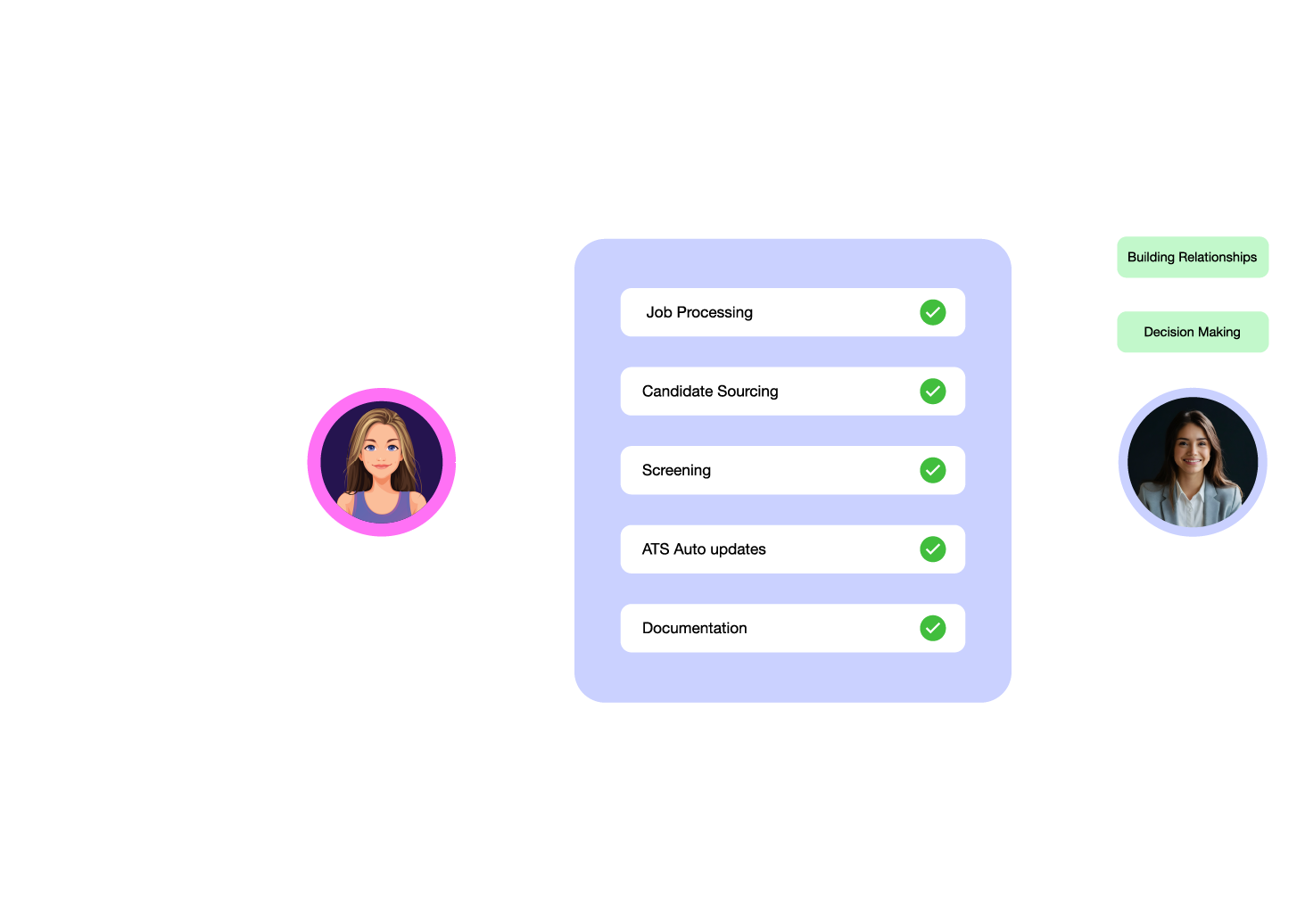
The product page breaks that role into specific actions:
- communicate with candidates across voice, SMS, and email;
- source autonomously from databases, job boards, company websites, and recruiter hotlists;
- generate screening questions from job skills, role types, and salary information;
- follow up, collect documents, and coordinate next steps;
- sync statuses, notes, and summaries back to the ATS;
- track funnel performance, follow-up speed, and processing efficiency through dashboards.
This is not a single AI feature. It is a recruiting workstream. The product insight is to compress “where the candidate came from, what to ask, when to follow up, whether the candidate qualifies, what happens next, and how the ATS records it” into one manageable execution unit.
That is why the product can be more legible to a business owner than a generic chatbot. The buyer is not purchasing “AI capability.” The buyer is purchasing a virtual recruiter that can move candidates through the funnel.
The Sharpest Commercial Move Is Outcome Pricing
ConverzAI’s site contains a signal founders should notice: the Virtual Recruiter page describes outcome-based pricing and says customers pay only for placements.
The exact unit price, take rate, and contract structure are not public, so outside observers cannot infer gross margin or average contract value. But “pay only for placements” already shows the company is trying to avoid a common SaaS problem. The customer does not want to justify budget for another tool. The customer is willing to pay for a revenue result that has already happened.
For staffing companies, placement is the business language. AI hours saved require translation. AI-driven placements enter the income statement directly.
This pricing choice also constrains the product. If the product only sends automatic replies, it cannot credibly own placement outcomes. It has to control more of the chain: candidate outreach, job matching, screening quality, scheduling speed, ATS data, and follow-up. In other words, outcome pricing is not merely copy. It forces the product to move from function to system.
Customer Cases Talk About Revenue, Not Only Efficiency
ConverzAI’s website displays several customer results. The boundary is important: these figures come from official website and customer-case material, not independent audit.
Even so, the chosen metrics reveal what the company wants the market to remember.
Its homepage highlights broad claims such as 3x more placements, 90% faster submissions, 99% engaged candidates, and 85% less manual work. The customer stories are even more revealing:
- TalentBurst says the agentic AI platform screened 5,000 candidates in three days, produced 40% more placements, and created 14% hands-free placements.
- TalentBridge says average time-to-fill for key functions and IT roles fell from 24 hours to four hours, 60,000 candidates were screened over 90 days, and AI produced 183% more placements.
- Integrity Staffing says candidates were assigned within one hour of applying, and after three years of full-scale agentic AI use, the business grew 80% without adding headcount and produced 10x ROI.
- Malone Workforce Solutions says the system produced 262 placements and $2.7 million in revenue impact over three months.
Those claims should not be treated as audited financial facts or controlled experiments. Job types, geographies, market conditions, and baseline efficiency differ.
But as commercialization narrative, ConverzAI is disciplined. It does not say only “save time.” It keeps tying AI to placements, time-to-fill, revenue impact, and ROI. It translates AI value into the metrics staffing firms already manage every day.
Why Staffing Is a Natural Agent Market
The reason this can work is not that recruiting buyers uniquely love AI. Staffing has several properties that suit agent commercialization.
First, the process is high-frequency and repetitive. Candidate outreach, initial screening, reminders, document collection, and status updates happen every day, with many templates, rules, and obvious next steps.
Second, delay has real cost. Candidates go cold. Jobs get filled by competitors. Clients lose confidence. Speed is not a nice experience improvement. It is a revenue variable.
Third, outcomes are comparatively clear. Placement, time-to-fill, submission speed, and candidate engagement can all appear in an operations dashboard.
Fourth, the system boundary is clear enough. A Virtual Recruiter does not need to manage the entire HR strategy. It first owns the repetitive execution layer inside the staffing funnel. The clearer that boundary is, the easier the agent is to launch, evaluate, and price.
The lesson for AI founders is not only “can AI do this task?” The more important question is “can the customer buy the result of this task?” ConverzAI chose a business step where the revenue result is clear.
The Moat Is Execution Memory
ConverzAI does not position itself as a foundation-model company. Its potential moat looks more like the moat of a vertical execution system.
Once a staffing customer accumulates candidate interaction history, role types, branch habits, ATS fields, screening templates, compliance requirements, and customer success patterns inside the platform, replacement cost is no longer just “switch AI tools.” The buyer would need to rebuild a recruiting execution memory.
That is an interpretation, not a proven fact. Outside observers cannot see ConverzAI’s retention, gross margin, model cost, average contract size, or take rate. But the product structure suggests the core competition is unlikely to be whether the AI voice sounds realistic. It is whether the product can keep the candidate funnel clean and make the customer believe the results are attributable.
That is the common challenge for vertical agents: demos are easier than stable delivery, automation is easier than taking responsibility for outcomes, and integrating one tool is easier than maintaining execution state across systems.
Risks to Watch
Recruiting is sensitive. AI involvement introduces more than efficiency upside.
Will candidates accept AI communication? Could automated screening amplify bias? How will disclosure, audit, and compliance rules for automated hiring tools evolve across states and industries? If the labor market cools, will placement-based pricing still convert well? ConverzAI and similar products will need to answer those questions over time.
The website’s customer-result claims also require caution. They are useful for understanding positioning and customer narrative, but they are not independently verified universal outcomes. Readers should not copy the numbers. They should study the commercial structure behind them.
Four Lessons for Founders
First, name the AI product as a role the customer already understands. Virtual Recruiter is easier to put into a budget conversation than a long phrase like “AI candidate engagement automation platform.”
Second, find a scenario where outcomes are easier to charge for than efficiency. Staffing firms already measure business by placements, so ConverzAI binds AI value to that metric.
Third, outcome pricing requires more than a point feature. Results come from chain control: sourcing, screening, scheduling, ATS updates, tracking, and review.
Fourth, use operating language in customer cases, but label the evidence boundary. Official ROI and revenue-impact figures can inform analysis, but they are not audited facts.
ConverzAI’s core lesson is not “AI can recruit.” It is that vertical agents often make money first not by talking for humans, but by moving a revenue-consequential process to completion.
When AI products move from saving time to taking responsibility for outcomes, commercialization becomes a different game.