

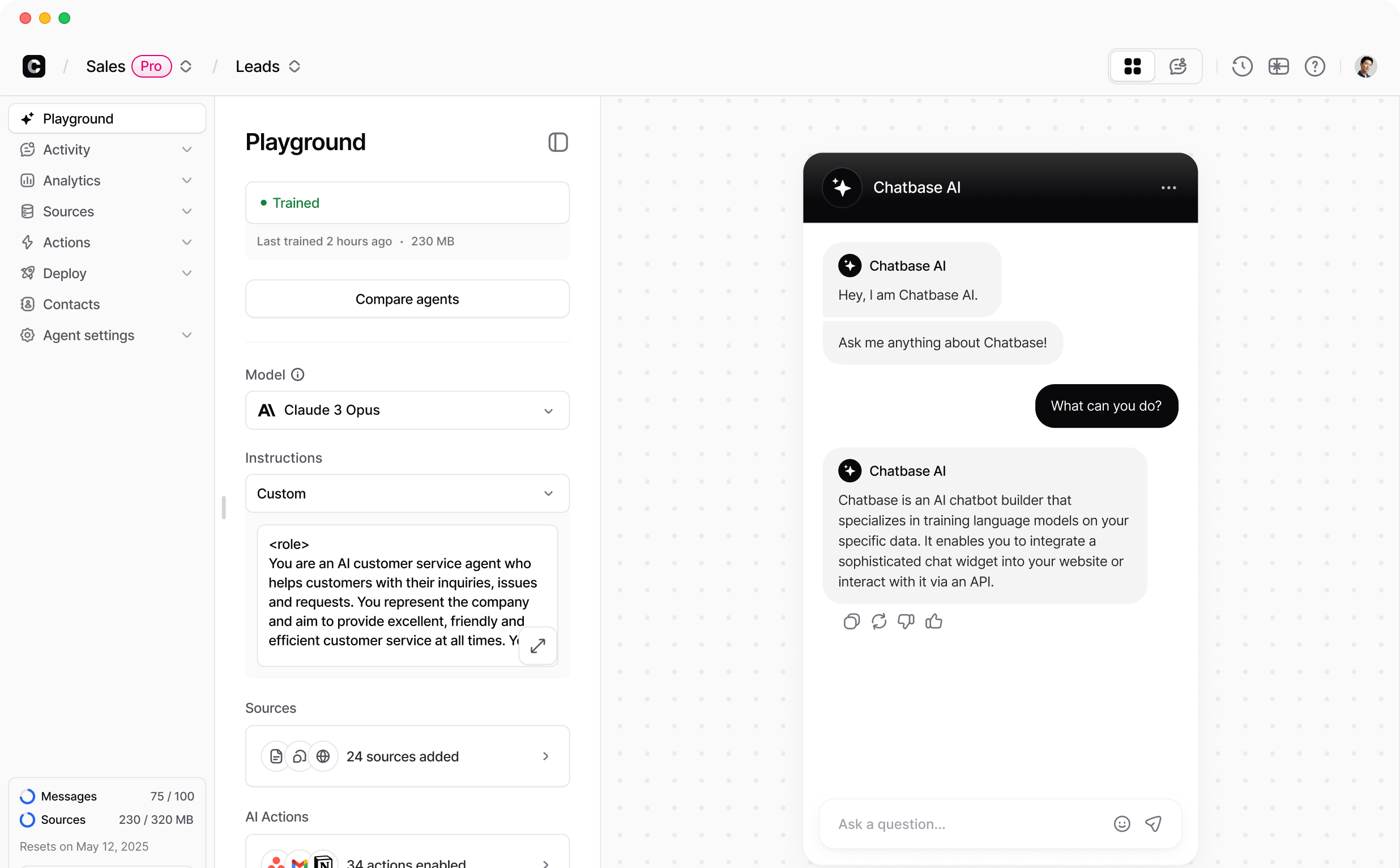
 Source: public product image from Chatbase. It shows Playground, model selection, agent instructions, training status, data sources, and a conversation testing window. This is official product media, not third-party audited evidence.
AI customer support is no longer a new story. The more useful question is why some products remain “it can answer questions” demos while others become recurring revenue.
Chatbase’s answer is direct: do not sell only a chat box. Package agent training, deployment, integrations, usage, expansion, risk control, and enterprise buying into one system. A Stripe customer story says Chatbase reached $10 million ARR in March 2026 with a 26-person team and no external funding. The same story says Stripe helped it recover $870,000 in revenue over three years and reduce fraudulent transactions by 37%.
Those numbers matter together.
It Does Not Put AI Into Support. It Puts Support Agents Into a Revenue Model
Chatbase’s website positions the company as a platform for building and deploying AI support agents for customer service and support. The product loop is mature enough to be legible: train the agent, configure actions, connect systems, deploy across channels, escalate complex issues to humans, and use analytics to keep improving.
That means Chatbase is not selling “a model that can talk.” It is selling the ability for a company to hand a customer-support workflow to an agent and let it run in production.
The difference is substantial. A generic AI chat tool is usually judged by answer quality. Chatbase needs to enter the business context: order lookup, subscription changes, ticket escalation, CRM or helpdesk integration, WhatsApp, Messenger, Slack, and other channels. The closer the agent gets to real workflows, the harder it is for a customer to replace it with a cheaper model alone.
The Chatbase pricing page makes that product logic visible. Free, Hobby, Standard, Pro, and Enterprise plans run from $0 to annual Pro pricing at $400 per month, with enterprise quotes above that. The tiers are not merely about whether the customer can chat. They segment message credits, number of agents, AI Actions, training content size, seats, voice, telephony, API access, personalization, auto-retraining, and advanced integrations.
This is one of the most overlooked pieces of AI agent commercialization: features do not matter because they are numerous. They matter when they can become a pricing ladder.
Self-Serve Solves Acquisition. Expansion Solves Growth
Chatbase’s starting point has very low friction. The Stripe case says founder Yasser Elsaid received his first paying customer 30 minutes after releasing the first demo. The early promise was simple: upload material and train an agent that can answer business questions.
But the company did not stop at a cheap subscription. The pricing page breaks expansion into understandable charging points:
| Charging point | Commercial meaning |
|---|---|
| message credits | Usage, cost, and customer value move together |
| extra agents | One account can expand from one support agent to multiple business agents |
| AI Actions | The product moves from answering to executing |
| integrations/API | The agent enters the customer’s existing systems |
| white-labeling | Agencies and service providers can resell the product |
| Enterprise | Permissions, SSO, audit logs, SLA, and success management enter procurement |
These charging points all connect to real usage depth, not just model calls.
For AI founders, this is a practical clue. Customers may pay a little for model access, but they pay more reliably for an agent that has become embedded in their operations. The unit of pricing should follow the value the buyer feels: more handled messages, more deployed agents, more connected systems, more covered teams, and stronger compliance requirements.
The Real Moat Is Outside the Model
A Supabase customer story says Chatbase had more than 8,000 paying customers in early 2026, over $10 million ARR, and an 18-person team including 11 engineers. It also says Chatbase supports tens of thousands of customer-facing AI support agents in production. These are vendor customer-case figures, not audited company financials, but they show an important pattern: production AI agent complexity appears mostly outside the model.
Why?
Once a customer-support agent goes live, the question is no longer whether it sounds human. It must know who the customer is, read the right data, call tools inside permission boundaries, escalate failures to humans, preserve conversation records, expose quality issues to operations teams, and remain stable when traffic grows.
That is what makes Chatbase worth studying. Its moat may not be a single irreplaceable model. It is the packaging of knowledge bases, workflows, channels, payments, fraud prevention, reporting, and enterprise needs into one purchase path. When a customer migrates away, they are not only moving prompts. They are moving training content, integrations, logs, actions, team habits, and billing configuration.
That kind of moat is not glamorous, but it is commercial.
A Low-Price Entry Does Not Mean a Low-Value Product
Many AI founders confuse self-serve purchasing with low-value software. Chatbase’s path is different: use self-serve to reduce trial friction, then use enterprise capabilities to support more complex customers.
The Stripe case explicitly says Chatbase uses a dual go-to-market motion: high-volume self-serve on one side, and a sales-led path with personalized onboarding on the other. That explains why it can serve SMBs and larger enterprises at the same time.
The self-serve entry proves demand. The enterprise path expands ACV. The key is that the product must naturally grow from one person’s experiment into a team dependency.
Chatbase builds that ladder into product and pricing: free trial, low-price plans, usage packs, extra agents, white-labeling, enterprise permissions, audit logs, and SLA. Users do not need to believe a grand platform vision on day one. They only need to let one agent answer questions. Once the agent starts carrying more business work, the reason to upgrade becomes obvious.
What AI Founders Should Learn
First, agent products should not optimize only for a surprising demo. Commercialization happens after the demo: who configures it, who pays for it, how renewal works, how expansion works, what happens when it fails, and what enterprise procurement needs to approve.
Second, pricing should bind to usage depth early. Chatbase turns message volume, number of agents, actions, channels, and enterprise capabilities into paid modules. That is easier to explain than “one monthly fee with unlimited use.”
Third, infrastructure becomes product capability. Payments, failed renewal recovery, fraud controls, revenue recognition, and reporting may look like back-office work. For a high-volume self-serve AI product, they directly affect revenue quality.
Fourth, the model is not the only moat. Once a support agent enters production, the buyer is paying for reliability, integrations, permissions, data, observability, and workflow continuity. The company that packages those hard parts simply is closer to durable revenue.
So Chatbase is not merely another AI support tool that succeeded. It shows a reusable path from agent demo to company revenue:
Let customers buy a useful result quickly, then let that result expand through usage, actions, channels, teams, and enterprise trust.