
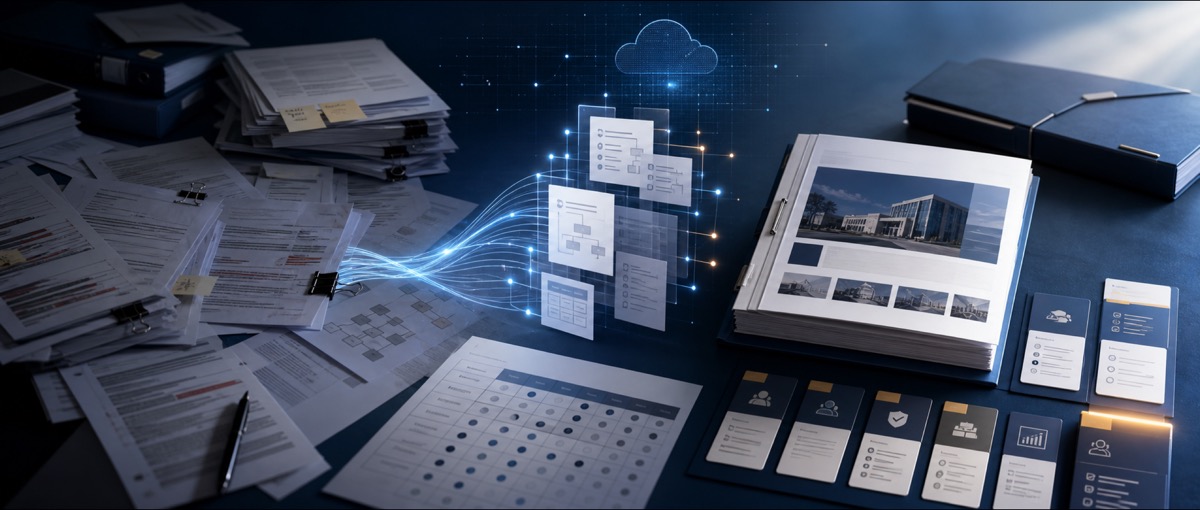
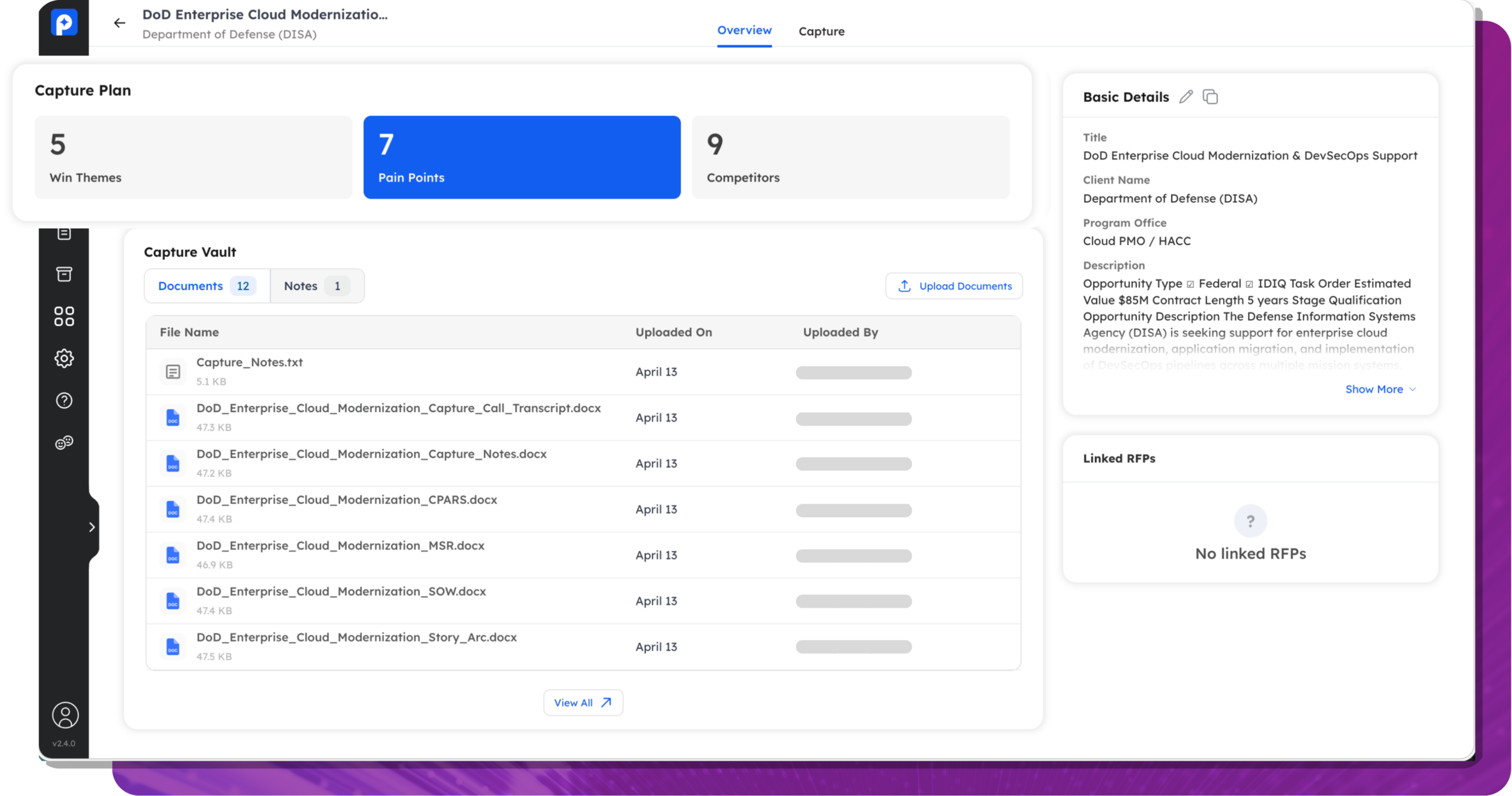
 Source: public product image from pWin.ai. Official promotional media, not third-party evidence.
Many AI writing products default to the same promise: make a piece of writing faster. pWin.ai is more interesting because it does not enter ordinary writing. It enters one of the most expensive, time-sensitive, and failure-intolerant writing workflows in business: RFI, RFP, and proposal work for government contractors.
In this market, the core value is not prose. It is discipline.
A GovCon team trying to win a federal contract has to manage customer pain points, capture strategy, competitors, past performance, CPARS, capability statements, compliance matrices, Pink Team reviews, Red Team reviews, and the final submission. If any one of those pieces breaks, fluent AI generation may only produce an unusable draft faster.
pWin.ai is built around that constraint. It is not just putting ChatGPT inside the proposal process. It packages GovCon proposal methodology, historical knowledge, security requirements, and human review checkpoints into a workspace.
Several signals explain why the case matters:
- Business Wire reported that pWin.ai was founded in 2024 and announced a $10 million seed round in June 2025.
- A public Gartner case summary says Microsoft used pWin.ai to reduce time to first proposal draft by 93%.
- In April 2026, pWin.ai announced that it acquired or took over Vultron.ai’s customer portfolio, directing Vultron users to pWin.ai.
- Software Finder lists pWin.ai pricing as custom, based on proposal volume, team size, and usage requirements.
Together, these signals point to a product that is not selling a cheaper writer. It is selling an operating system for a high-value workflow.
Proposals Are Not Writing. They Are Redeployed Organizational Memory
At the surface level, responding to an RFP looks like document production. Inside a real enterprise, it is closer to a temporary mobilization of organizational memory.
The team first has to decide whether the opportunity is worth pursuing. Then it has to break the customer requirement into response sections. Then it has to pull evidence from past projects, customer interviews, technical solution notes, partner capabilities, and compliance requirements. Only after that can the team convert those materials into a draft that follows evaluator logic. Finally, the draft has to pass multiple rounds of review so gaps, risks, and contradictions are removed before submission.
That is why a general AI tool is difficult to use as a direct replacement for a proposal team. A general model can write paragraphs. It does not know what the company has delivered before, what a specific agency prefers, how Shipley-style review language works, or which materials touch CUI and government contracting security requirements.
pWin.ai’s own website defines the product as an integrated platform for knowledge management, opportunity intelligence, capture planning, and proposal writing. It emphasizes CRM connection, capture-data extraction, win themes, customer pain points, competitor positioning, a knowledge repository, annotated outlines, requirement mapping, and proposal drafts.
The product path is really about connecting what the company knows with what this specific opportunity needs.
It Sells Methodology Before It Sells AI
The most important lesson in pWin.ai’s positioning is that it does not put model capability at the center of the brand.
It repeatedly emphasizes Shipley. Outside GovCon, Shipley may look like only a name. Inside proposal teams, it stands for an established business-development, capture, and proposal methodology. In its funding announcement, pWin.ai said it works with Shipley Associates to embed proposal best practices into the RFP product and generate drafts that are closer to Pink Team-ready.
That choice matters. Many vertical AI products first demonstrate that they can generate something, then try to explain why the buyer should trust it. pWin.ai reverses the order. It starts from a methodology the buyer already recognizes, then makes AI execute that discipline.
For high-risk B2B workflows, AI is often easier to buy when it is more constrained. The customer does not want an intern that improvises. The customer wants a system that understands the process, understands the materials, understands the review standard, and knows when to bring humans back into the loop.
This also explains why pWin.ai talks heavily about security. Its website highlights FedRAMP Moderate Equivalency, CMMC Level 2, Azure Gov, dedicated enclaves, and not using customer data to train models. That claim should be handled carefully: FedRAMP Moderate Equivalency is not the same as a FedRAMP Marketplace authorization, and buyers will still make their own assessment. But for GovCon customers, the ability to handle sensitive proposal material is a prerequisite, not a nice-to-have feature.
The Commercial Hook Is More Bids, Not Fewer Writing Hours
pWin.ai’s value proposition is not simply saving a few hours of writing time. The more powerful commercial hook is helping teams pursue one more opportunity they might otherwise abandon.
In an official customer testimonial, the CEO of Applied Information Sciences says pWin.ai helped turn an opportunity that may have been a no-bid into a bid. That is a company-provided customer story rather than independently audited evidence, but it reveals the product’s payment logic. Proposal-team budget is not only about efficiency. It is also about revenue opportunity.
In government contracting, making one more bid is not like sending one more email. It means the team can, within a narrow time window, mobilize its knowledge base, produce a first draft, check compliance, organize review, and submit a proposal that does not embarrass the company. If AI can compress time to first draft materially, it changes more than one writer’s productivity. It changes the growth team’s capacity to take shots.
That is why custom enterprise pricing makes sense here. The customer is not calculating ROI by word count. The customer is evaluating proposal volume, team size, contract opportunity, and win probability. Software Finder’s custom-pricing listing aligns with a sales-led enterprise software model.
The 2026 Vultron Signal Shows Vertical AI Consolidation
In April 2026, pWin.ai announced that it would take over Vultron.ai’s customer portfolio. Vultron was also a GovCon AI proposal company, focused on turning complex solicitations into compliant, review-ready drafts for federal contractors.
That move has two implications.
First, GovCon AI proposal software is not only a concept market. It already has multiple companies, real customers, migration costs, and consolidation activity. Early vertical AI markets often begin with many teams building demos. Once customer portfolios start moving, the market is beginning to ask which vendor can sustain the workflow over time.
Second, buyers may not be comparing only who generates text fastest. They are comparing who looks more like a long-term system. In the Vultron announcement, pWin.ai emphasized Shipley-embedded workflows, FedRAMP Moderate Equivalency, and white-glove onboarding. The acquisition story was not “we have stronger AI.” It was “we are the platform GovCon teams can rely on.”
That is a useful reminder for AI founders: in a vertical market, the final competition may not be the first impressive feature. It may be whether the product can absorb the customer’s organizational process.
What Builders Should Learn
pWin.ai’s lesson can be compressed into three points.
First, do not only look for industries with a lot of writing. Look for industries where the writing carries a high-value decision. RFPs, compliance, audits, healthcare, insurance, and finance all fit this pattern because the document is not just content. It is evidence of a business action.
Second, before selling AI capability, find the methodology the buyer already trusts. pWin.ai uses Shipley as a shared language in GovCon. A healthcare product might use clinical pathways. A tax or finance product might use audit workpapers. A security product might use control frameworks. Industry language lowers procurement resistance.
Third, truly sellable AI workflows often preserve the human. pWin.ai repeatedly says humans remain in control. That is not conservatism; it is commercial reality. In high-risk processes, customers do not want to hand judgment to a model. They want the model to prepare the materials, structure, gaps, and first draft so the team can spend judgment where it matters most.
So pWin.ai is not really an “AI writes proposals” story.
It is a more specific answer to what happens when AI enters a traditional B2B industry: the valuable product is not faster writing. It is helping a team complete a high-stakes opportunity with less friction and more confidence.