
 Source: public product image from Mega. Metrics shown in the image are official promotional examples, not third-party audited data.
Many AI marketing products still sell the promise of “write faster.” Mega sells something different: the customer does not have to learn a new tool or chase an agency every week. Mega continuously works on SEO, ads, and website optimization for them.
That makes the company worth studying. It pushes AI products from software toward service delivered through software. Forbes reported that Mega announced an $11.5 million Series A in March 2026, with investors including Goodwater Capital, Andreessen Horowitz, Atreides, SignalFire, and Kearny Jackson. The same report said the company disclosed more than 500 customers, about $10 million in annualized revenue, and that it reached that scale within 10 months of launch.
Those revenue, customer, and performance figures come from company disclosure or media reporting, not independent audit. But they are enough to show the underlying pattern: the first places where AI commercializes well are not always the flashiest model capabilities. They are often old budget pools where customers already pay, but where delivery has long been slowed by human service work.
It Is Not a Marketing Tool. It Is a Growth Team
Mega’s target customer is specific. It is not the marketing department of a large enterprise. It is the SMB owner with roughly $500,000 to $20 million in annual revenue and no full growth team. In the Forbes interview, founder Lucas Pellan described the buyer plainly: dentists, law firms, local service businesses, medical practices, and cleaning companies do not want to manage marketing software. They want customers.
That is Mega’s product entry point.
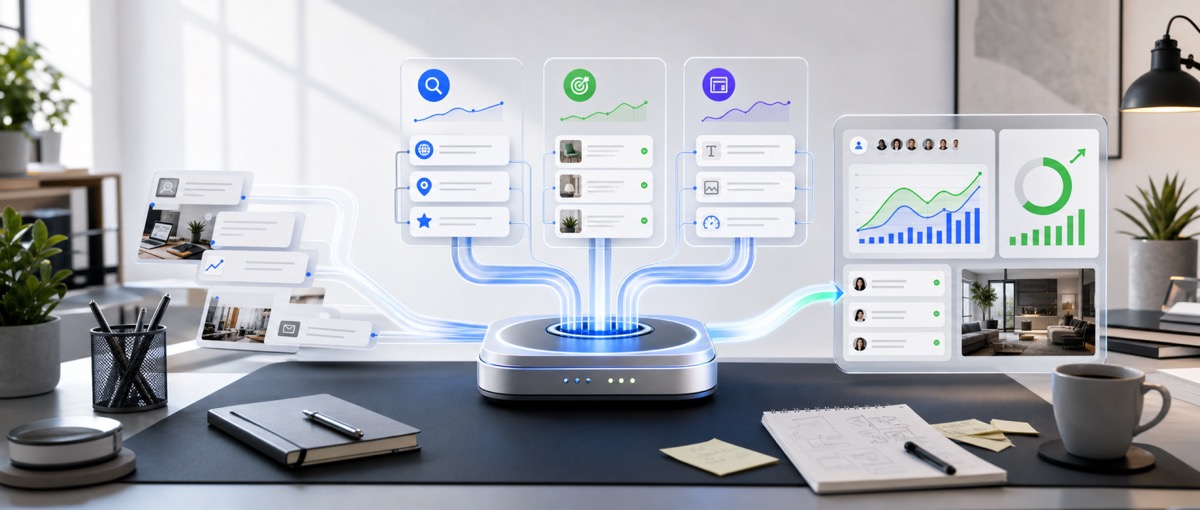
Traditional SaaS usually asks the user to open a backend and configure keywords, write content, tune ads, and read reports. Mega reverses the flow. It takes the familiar act of hiring a marketing company and breaks it into three purchasable AI agents. Its website presents core agents for SEO and GEO, paid ads, and website work. The customer sees tasks, metrics, leads, and progress rather than a blank chat box.
That difference matters. Most SMBs are not short on tools. They are short on continuous execution. The hard part of marketing is not writing one blog post. It is finding keywords every week, publishing content, fixing pages, testing ads, reading conversion data, and adjusting the next round of work. Mega packages those repeated actions as a system that appears to be working on the customer’s behalf.
It is not selling AI copy. It is selling execution certainty.
Old Budgets Are Easier to Monetize Than New Demand
Mega’s pricing also reveals the real competitive comparison. It is not pricing against Canva, Notion, or ChatGPT-style low-cost software. It is pricing against agencies and outsourced growth teams.
Mega’s official blog says the SEO Agent starts at $699 per month, the Ads Agent at $1,399 per month, and the combined package at $2,099 per month. The same FAQ compares traditional agency cost with $3,000 to $15,000 per month. Forbes reported typical customer spend of about $800 to $3,000 per month, while customers still pay normal Google, Meta, and other ad-platform budgets.
The key is not the absolute price. It is the anchor.
If Mega is understood as an AI writing tool, hundreds or thousands of dollars per month looks expensive. If it is understood as a small growth team or agency alternative, that price sits inside a budget the customer already understands.
This is a point AI founders often miss. The more a product tries to create completely new demand, the more education it must do. The more it can enter a budget the customer already spends every month, the easier the sale becomes. Mega is not asking an SMB to invent an AI budget. It is trying to capture the money already spent on SEO, ads, websites, and agencies.
The Product Mechanism Is a Marketing Task Queue
AdExchanger reported that Mega’s agents roughly map to SEO, ads, and website work. The SEO agent handles blogs, keyword research, and content optimization. The ads agent creates creative briefs and assets. The website agent improves page experience and navigation.
None of those categories sounds new. The product mechanism is orchestration.
A point AI tool usually owns one output: an article, an ad image, or landing-page copy. Mega tries to connect outputs into a loop. SEO keyword data can affect ads and landing pages. Ad leads can inform website changes. Website conversion data can feed back into content and budget decisions.
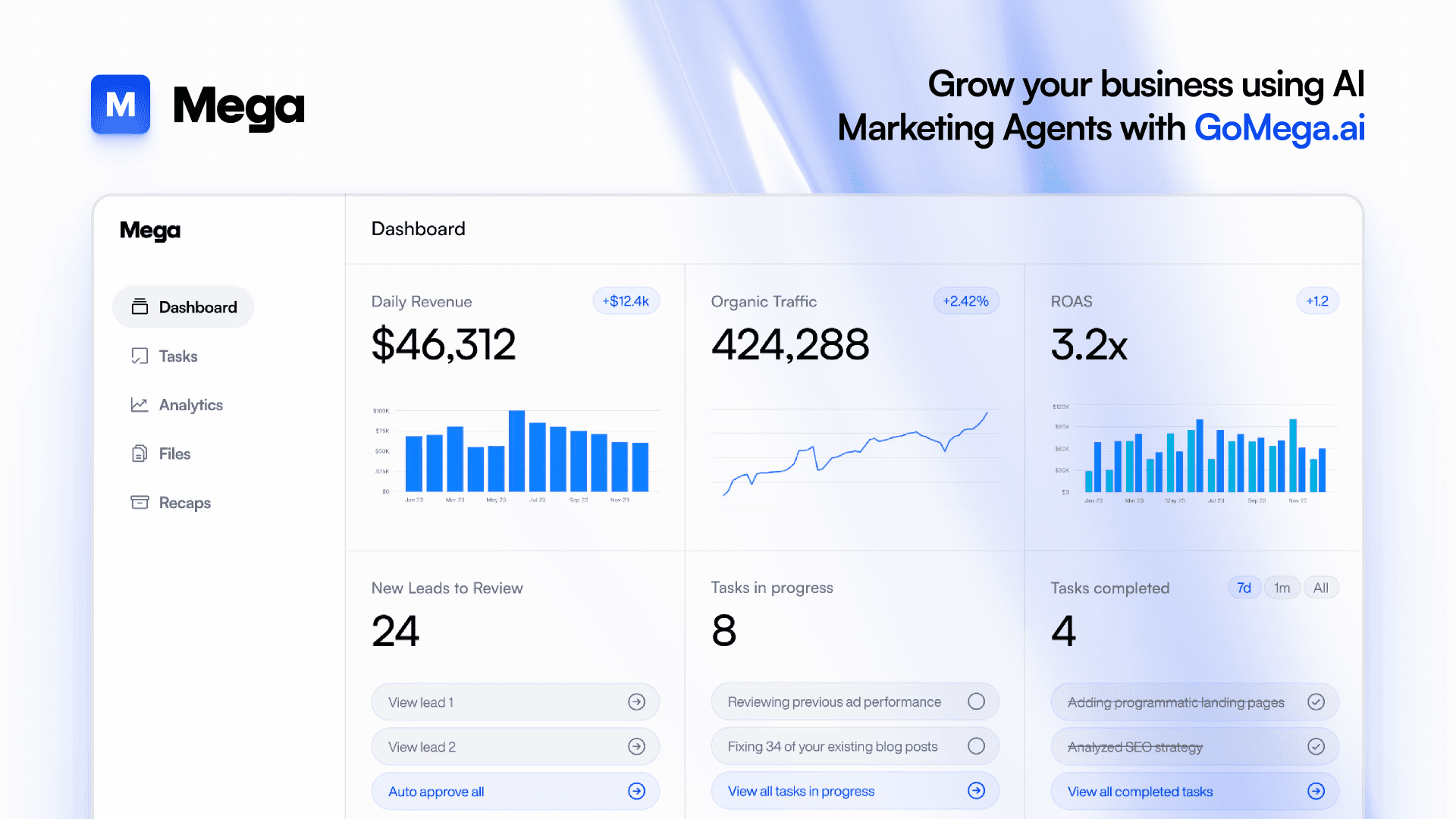
From the customer side, those actions are collapsed into a dashboard: revenue, organic traffic, ROAS, new leads, in-progress tasks, and completed tasks. The promise behind that interface is simple: the customer does not need to know how every action happens. They need to see the system continuously moving work forward.
That is why Mega looks more like “service through software” than traditional SaaS. SaaS gives the customer a tool. A service company gives the customer people. Mega is trying to give the customer an execution organization composed of AI plus a small amount of human review.
It Does Not Pretend to Be Fully Autonomous
Many AI agent products overstate the fully autonomous story. Mega is more interesting because it publicly describes automation as layered.
In the AdExchanger report, Pellan said more than half of the work is fully automated, about 35% is mostly automated with human participation, and around 10% remains human end to end. Forbes described a similar split: about 55% of marketing tasks automated end to end, 35% with human review, and 10% manual.
That is not a weakness. It is commercialization reality.
SMBs will pay for results, but they do not want unlimited brand risk. Auto-publishing content, changing ad budgets, and modifying a website can create quality, compliance, and reputation issues. A sellable AI product does not need to be 100% autonomous on day one. It needs users to believe the system will not run out of control.
Mega’s dashboard and human fallback are therefore trust design. Users can see work progressing while also understanding that complex or high-risk actions have review. That is closer to the psychology of buying than a slogan that says the system will automatically handle everything.
The Growth Flywheel Is Cross-Customer Learning
Mega’s most imaginative element is cross-customer learning.
SignalFire’s investment note said Mega moved from an internal growth tool to an independent platform and reached $10 million ARR in 10 months. It also disclosed customer results around search traffic, search visibility, and website revenue. Those metrics come from an investor article and are not independently audited.
Still, they point to a plausible explanation. Mega is not building a custom marketing agency from scratch for every SMB. It is trying to accumulate tasks, industry data, content feedback, ad performance, and conversion patterns into one execution system.
If that works, Mega’s marginal delivery cost can be lower than a traditional agency’s. An agency expands by hiring more people. An AI execution system can reuse task templates, industry keyword patterns, ad creative learnings, and conversion data. Humans remain in the loop, but they are no longer the only capacity constraint.
That is the practical leverage in AI commercialization: not eliminating service completely, but software-izing the parts of service that are repetitive, measurable, and feedback-rich.
The Risks Are in the Same Place
Mega’s risks are also clear.
First, marketing results are hard to attribute. The website, blog, ad budget, seasonality, market competition, and the customer’s own responsiveness all affect lead volume. If customers expect automatic growth after purchase, renewal pressure can appear quickly. Mega’s own terms of use state that it does not guarantee specific rankings, traffic, leads, conversions, sales, ROAS, or similar outcomes.
Second, SEO and automated content face platform risk. AI-generated content can create short-term efficiency, but search quality rules and user trust keep changing. The AdExchanger report notes that Mega can generate and publish content frequently. That is an efficiency advantage, but also a quality-control challenge.
Third, pricing remains worth watching. Public pages show a “from $299/mo” meta description, blog FAQ references $699, $1,399, and $2,099 per month packages, and Forbes cites typical monthly spend of $800 to $3,000. For founders, that suggests Mega may still be tuning the package: low-cost automation tool or higher-ACV agency replacement.
What AI Founders Should Learn
Mega’s lesson is not simply “go build AI marketing.”
The more reusable pattern is this: find a service market where customers already pay continuously, delivery still depends heavily on humans, and results are measurable. Break the work into a few named agents. Make the execution process visible through tasks and metrics. Use human fallback for high-risk steps. Price against the budget that used to go to people and agencies.
The first principle is not “what can the model do?” It is “who did the customer hire before?”
If the customer previously bought a tool, the product can get trapped in feature competition. If the customer previously bought a service, AI can restructure delivery and capture more value. Mega’s answer is that the real money in AI agents may not come from asking users to operate one more piece of software. It may come from letting users manage one fewer vendor.
For many vertical AI products, that is much closer to the commercialization endgame than a smarter chat box.