
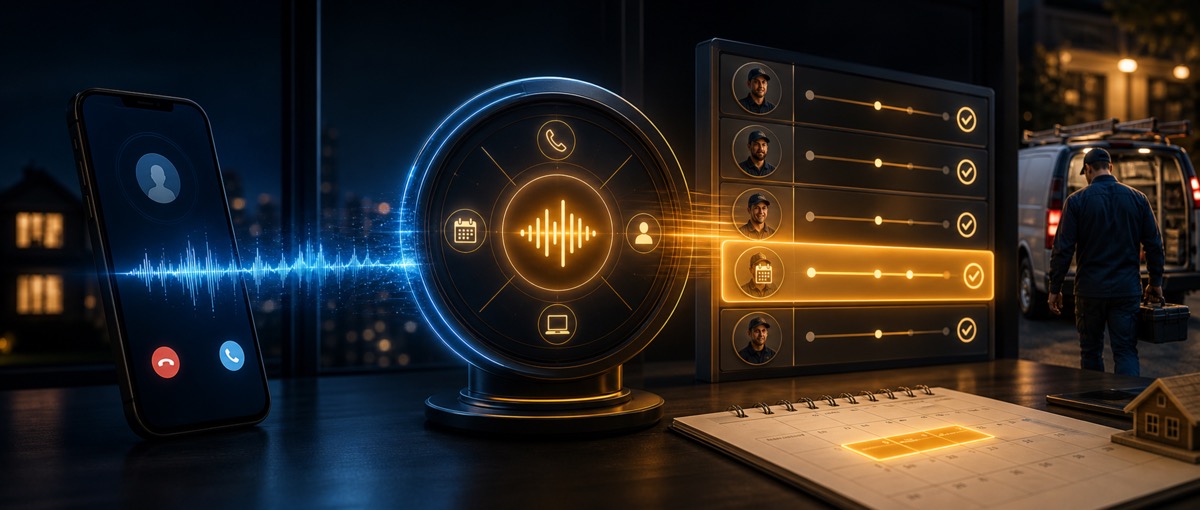
If an AI company says it can answer the phone, that is no longer surprising. The more important question is what happens after the call is answered. Can the system move a real order into booking, dispatch, CRM records, and follow-up quality control?
Avoca starts from that question. It describes itself as an AI Front Office for service businesses. Phone calls, text messages, web chat, appointment booking, CRM sync, outbound follow-up, quality scoring, and operating analytics all sit around the same local-service revenue funnel.
Several signals make the case worth studying:
- Avoca says on its website that it is trusted by 1,000+ service leaders across HVAC, plumbing, electrical, pest control, garage doors, roofing, and related service categories.
- In April 2026, the company announced a Series B and said it had raised more than $125 million at a $1 billion valuation. The announcement says the news was first reported by Fortune. The financing and valuation should be treated as company-disclosed figures.
- In its Granite Comfort customer story, Avoca says the pilot brand Yost & Campbell achieved 20 percent year-over-year revenue growth, 50 percent-plus of bookable calls handled end to end by AI, and consolidation from nine contact centers to one. These are official customer-case claims, not third-party-audited results.
This is not only another AI customer-support story. Avoca is trying to prove that the first profitable home for AI agents may be the place where traditional businesses lose money before work even reaches the field.
A Missed Call Is Missed Revenue
Phone calls in local services are not ordinary support requests.
When an air conditioner fails, a pipe leaks, a heater stops working, or a pest problem appears, the caller usually has urgent intent. They are not exploring a category for fun. They are trying to get someone scheduled. If nobody answers, or if the customer waits too long, the next call may go to a competitor.
Avoca’s founder announcement frames this pain in concrete terms. A thirty-person HVAC company gets flooded with Saturday calls in the summer. The support team cannot keep up. Google Local Services ads keep spending money, while high-intent leads fall into voicemail. The company may serve the customers it reaches well, but the customers it misses become someone else’s jobs.
That is Avoca’s productization starting point. The question is not whether AI can sound human. The question is whether AI can capture orders that would otherwise disappear.
It Sells a Front-Office Pipeline
Avoca does not appear to package itself as a single voice bot. Its product structure breaks the front office into work units a service company already understands:
- Inbound AI CSR for 24/7 calls, texts, chat, intent recognition, and booking.
- Simple Scheduler for self-service appointment selection.
- Speed-to-Lead for fast response to new leads from advertising, websites, and other channels.
- Outbound Campaigns for customer follow-up by text and phone.
- Google LSA support for leads from Google Local Services Ads.
- Coach and Analytics for call quality, missed opportunities, and team performance.
- ServiceTitan integration for moving booked jobs, customer details, addresses, service types, and conversation notes into the CRM and dispatch board.
The ServiceTitan integration page explains the workflow clearly. Avoca answers calls, chats, and web leads, then sends booked jobs into ServiceTitan so dispatchers and technicians can keep working in the system they already use. The page also says customer name, address, service type, booking source, and conversation notes flow into the system. The feature description is credible as product copy. Claims such as “5 minute setup” and sub-10-second booking-to-board timing are official marketing claims and should be read that way.
This is what separates Avoca from a generic support agent. It does not ask service businesses to change the way work is dispatched. It inserts AI into the existing booking, scheduling, and CRM flow.
Why This Scenario Is Easier to Monetize
Many AI products struggle commercially because their value is hard to measure. Faster writing, cleaner summaries, and more natural answers can be useful, but the buyer still has to translate those benefits into a budget.
Avoca chose a more direct setting:
- Was the phone answered?
- Was the customer booked?
- Did a job appear on the dispatch board?
- Did paid advertising convert into service demand?
- Did quality review cover more calls?
- Could the team handle peak season with less incremental hiring?
Those metrics sit close to the owner’s cash flow. For a service-business operator, “we missed ten fewer urgent calls” is easier to buy than “the AI sounded more natural.”
The Granite Comfort story reflects the same logic. Avoca says Granite rebuilt front-office operations across nine brands around its system: Responder answered calls for each brand, Coach let one seat manage quality, and Human-in-the-Loop replaced nine after-hours vendors. The stated outcome was nine contact centers consolidated into one, more than 50 percent of bookable calls handled end to end by AI, and 20 percent year-over-year revenue growth at Yost & Campbell. Again, these are official customer-case figures, not audited facts.
Even if the numbers are treated cautiously, they show the product argument. An AI front office is not a cost-center tool. It is a revenue-capture system.
The Moat May Live in Industry Details
Service calls look simple from the outside. They are messy in practice.
The same phrase, such as “my AC stopped working,” can mean different things depending on brand, city, weather, membership tier, equipment history, technician availability, emergency rules, and CRM fields. A useful AI front office needs to know when to send an emergency job, when to schedule a standard visit, when a customer has a previous equipment record, when an address may be a duplicate, and which conversation patterns increase booking rate.
That explains why Avoca emphasizes vertical service categories rather than a universal receptionist. Its website lists HVAC, plumbing, electrical, pest control, garage doors, contractors, and more. The product also extends from inbound calls into speed-to-lead, outbound campaigns, Google LSA, coaching, and analytics.
If the system sits every day inside calls, leads, bookings, and outcomes, the data it learns is not simply “how to speak.” It learns which conversations turn into dispatched revenue. That operating data is hard to obtain from public training sets and hard for a horizontal model company to replicate instantly.
This remains a hypothesis, not a proven moat. The real test will be customer retention, multi-brand deployment speed, competition from CRM platforms, model costs, and the boundaries of responsibility when the AI handles urgent customer situations.
Four Lessons for AI Builders
First, look for high-intent entry points, not just high-frequency ones.
Phone calls are old, but local-service calls often carry immediate buying intent. The customer usually has a problem, a budget, and a time constraint. When AI captures that moment, it is not merely improving experience. It is catching revenue.
Second, package the agent as an outcome chain.
Avoca is not selling “AI can answer calls.” It is selling a chain: answer the call, understand the issue, book an appointment, sync the CRM, escalate when needed, score quality, and follow up. A single intelligent action is easier to replace. A repeatable operating chain is easier for the buyer to value.
Third, use effect data carefully.
Avoca’s customer cases are informative, but the figures come from the company’s own website and customer stories. Commercialization writing can cite them, but the source boundary should be explicit. Founders should learn the same lesson for their own sales material: the stronger the numbers, the more important it is to explain sample, time window, and calculation method.
Fourth, application-layer AI opportunities are strongest where public data is scarce.
Code, writing, and images are crowded partly because the data is abundant. Service-business front offices contain knowledge scattered across calls, schedules, CRM records, owner judgment, local rules, technician availability, and customer habits. There may be no clean public dataset, but there is real pain and a clear reason to pay.
The Takeaway
Avoca’s lesson is not simply that AI can answer customer-service calls.
The sharper lesson is this: when AI enters a high-intent, time-sensitive, measurable operating entry point and moves the action all the way to a revenue outcome, the buyer is no longer paying for “intelligence.” The buyer is paying to stop losing money before the work even starts.