

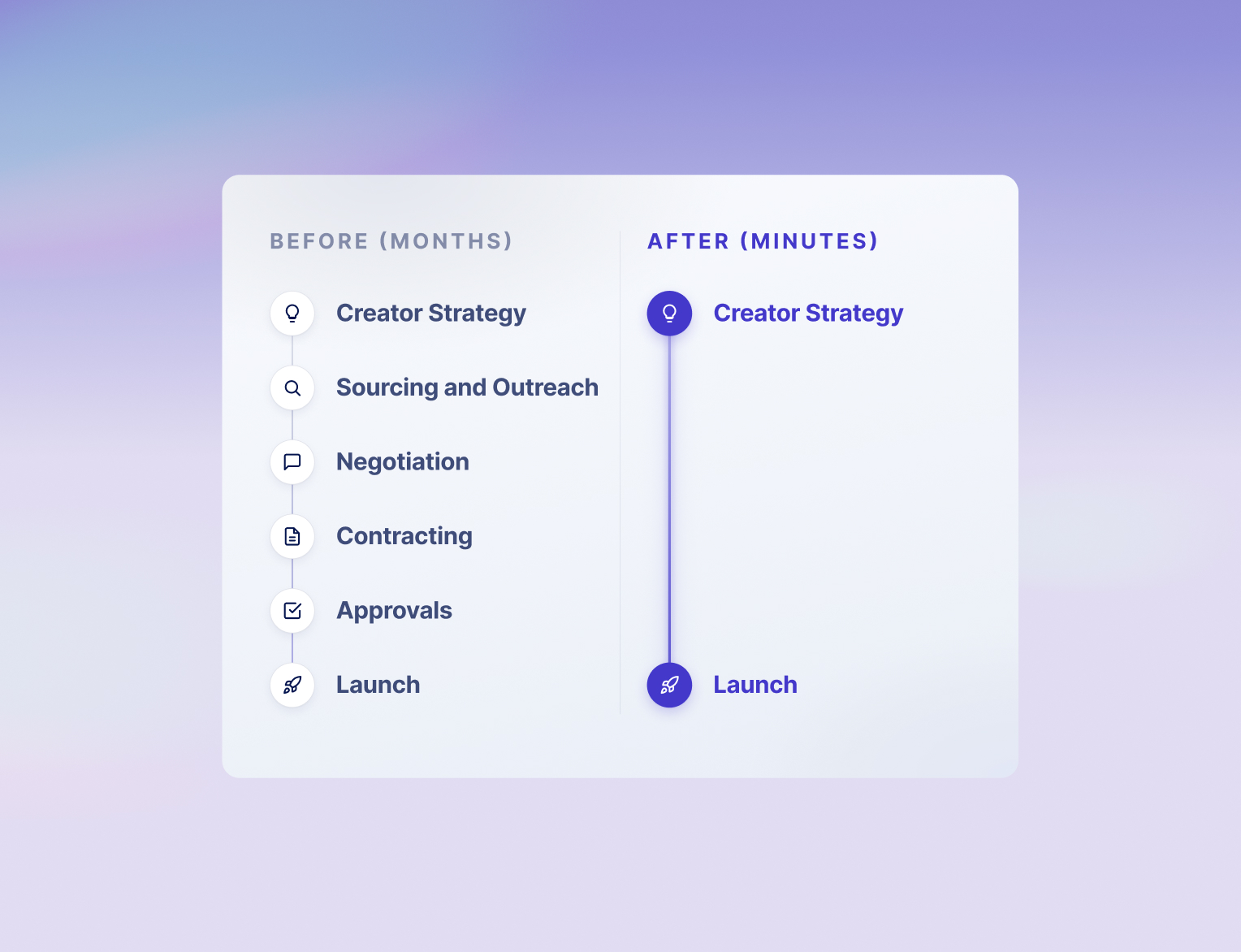
Source: Agentio official public product image. It explains workflow compression from creator strategy, sourcing, outreach, negotiation, contracting, approvals, and launch. It is official promotional material, not third-party performance evidence.
Creator advertising has an awkward truth. Users trust creators, and brands know creator content can convert, but most performance budget still flows to search, feeds, and conventional digital advertising.
The problem is not whether creators have value. The problem is whether creator advertising can be bought like media.
Agentio is interesting because it starts from that gap. It is not another AI ad generator. It is trying to turn a relationship-heavy, non-standard, human-driven market into AI-native media infrastructure.
Several signals explain why this case is worth studying:
- Axios reported in November 2025 that Agentio raised a $40 million Series B, bringing total funding to $56 million and valuation to $340 million.
- The same report described Agentio as a two-sided marketplace connecting brands and creators while automating matching, management, and performance tracking.
- CEO Arthur Leopold said the company had served more than 100 brands, had a network of “many thousands” of creators, was profitable, and had grown revenue fivefold year over year.
- Agentio’s website describes the product as AI infrastructure for YouTube, Meta, and more creator media channels.
Those are not the signals of a simple creative tool. They look more like early signals of a new buying layer for creator media.
The Hard Part Is Not Content, It Is Operations
Many AI advertising products start with content generation: scripts, videos, avatars, ad variants, landing-page copy, and creative testing. That is useful, but crowded.
Agentio works one layer deeper. It targets the transaction itself.
In the company’s own product language, traditional creator advertising breaks across a long chain of inefficient work: finding relevant creators, doing outreach, negotiating price, signing contracts, sending briefs, shipping samples, checking brand safety, approving content, launching, tracking performance, and deciding whether to repeat the buy.
This workflow does have tools, but each step remains fragmented. Once a brand wants to move from a dozen creators to hundreds, the team is buried in email, spreadsheets, contracts, tracking links, and approval loops.
Agentio’s website claims it can compress 15 manual transaction steps into two main actions: define strategy and define outcome, while the system handles matching, briefing, measurement, and optimization. That is company positioning, but it clearly states what Agentio is selling. It is not “AI writes your ad.” It is “AI makes creator advertising executable as a media-buying workflow.”
It Turns Creators Into Purchasable Media Inventory
The most important capability of an ad platform is not merely having ad space. It is making that inventory purchasable, predictable, and measurable.
Search advertising turned keywords into inventory. Meta turned audiences and feeds into inventory. Agentio wants to turn creator trust relationships into inventory.
Agentio says it uses first-party creator audience and performance data to predict which creators are likely to perform, and that creators in the network are verified, brand-safe, transparently priced, and backed by real performance data.
The key detail is not the phrase “recommendation algorithm.” The key detail is that creator advertising historically lacked a unified data structure.
If a brand sells premium dog food, a human buyer might naturally start with “pet creators.” Agentio’s Maev case gives a more precise example. Maev needed not just pet accounts, but creators who owned dogs, could tell a lifestyle story, and could influence high-intent households.
Agentio says its semantic analysis can identify dog-owning creators across cooking, fitness, family, travel, and adjacent categories. In the same case, Agentio says it helped Maev manage more than 200 YouTube partnerships with one person and generate more than 30 million views. Those results come from an official customer story and should not be treated as independently audited facts. The mechanism is still useful: AI is not finding only similar accounts. It is restructuring content, audience, product context, and campaign goals into a buying system.
That is the product boundary. When AI can turn non-standard creator relationships into searchable, comparable, approvable, and attributable objects, brands can move creator marketing from experiment budget into recurring media budget.
The Business Is About Catching Existing Budget
Agentio’s brand intake form includes a small but important signal. It asks about monthly Meta spend, with options running from below $250,000 to above $5 million.
That suggests Agentio is not selling a $29-per-month creator tool. It is qualifying brands that already have mature paid acquisition budgets. In other words, it is not starting from the creator side by asking creators to pay. It starts from the brand side, where budget already exists but scalable execution is missing.
That is a useful commercialization sequence for AI products:
Find a large existing budget first, then use AI to lower the operating cost of moving that budget into a new channel.
If a brand already spends hundreds of thousands or millions of dollars a month on Meta, YouTube, or other digital channels, Agentio does not need to convince the buyer that marketing matters. It needs to convince the buyer that part of that budget can move into creator media while remaining controlled, measurable, and repeatable.
Axios reported that Agentio had served more than 100 brands by 2025, including Uber, Tecovas, DoorDash, Cash App, and Olipop. Agentio’s own announcement also lists Bombas, Mint Mobile, Vuori, David Protein, The Farmer’s Dog, and others. The evidence layers matter: customer names and financing are supported by media or company announcements; specific performance results mostly come from company-published case studies.
For example, the Bombas case says an Agentio campaign delivered 5.3 times higher efficiency than standard YouTube ads, 90 percent net-new customers, and 10 percent higher lifetime revenue. The Maev case says YouTube creator-attributed customers increased threefold and EMV was two to three times higher than Instagram and TikTok. These are official case-study claims, not third-party-audited facts.
Even if those numbers are treated cautiously, they reveal Agentio’s sales language. It is not selling “cooler AI.” It is selling better CAC, more new customers, and a more manageable creator advertising channel.
Why AI Is Necessary Here
Creator advertising is not simple database matching.
Whether a creator fits a brand depends on content semantics, audience structure, historical performance, brand safety, price, availability, creative format, platform rules, and campaign goals. Traditional SaaS can manage a process, but it struggles to answer why a specific creator is appropriate for a specific brand.
Agentio appears to place AI in three areas.
First, supply and demand matching. The system uses creator content and audience signals to understand who fits whom, instead of filtering only by category tags.
Second, workflow automation. Briefs, contracts, approvals, launch, and tracking become repeatable workflows, reducing the loss from project management work.
Third, repeat-buy learning. Agentio says every campaign feeds first-party signals back into matching and prediction models so the next buy gets smarter.
Together, those pieces become infrastructure. A standalone AI recommender is easy to copy. A recommender connected to creator supply, brand demand, execution workflows, attribution data, and repeat-buy decisions is harder to displace, because the advantage comes from the market structure around the model.
Lessons for AI Builders
The first lesson is to look at budget flows, not only content generation.
AI lowers the cost of producing content, but budget does not automatically flow to generation tools. Budget flows to systems that reduce transaction cost, improve control, and make attribution easier. Agentio targets the infrastructure gap that appears when creator advertising moves from experiment to scale.
The second lesson is that non-standard markets are not bad markets if the product can structure the non-standard part.
Creator advertising has been hard to scale because it depends on relationships, negotiation, review, delivery, and performance interpretation. Agentio’s value is not to remove creator individuality. It is to turn the messy transaction side into objects a system can process.
The third lesson is that strong AI products often sit close to workflows where someone already pays.
Agentio does not start by educating the market that creators matter. That belief already exists. It enters the place where brands already want to spend and already know the channel can work, but execution is too slow and fragmented. AI is not creating the demand. It is releasing budget blocked by process.
What To Watch
Agentio’s story also has uncertainty.
Attribution in creator advertising is naturally complex. The official customer-case numbers are attractive, but they remain company-published claims. The long-term question is whether Agentio can prove reliable attribution across broader brands, categories, formats, and platforms.
Scale may also damage the very thing that makes creator advertising valuable: authenticity. The more the platform looks like a media-buying system, the more carefully it must prevent creator content from becoming generic insertion.
Finally, Agentio depends on large platform ecosystems such as YouTube and Meta. If those platforms build stronger creator-ad infrastructure themselves, Agentio will need to prove independent value through cross-platform data, creator network depth, and campaign intelligence.
The Core Insight
Agentio is not merely an “AI in advertising” story. That label is too broad.
The more precise lesson is this: when a channel already works but cannot absorb large budgets because it is non-standard, manual, and hard to measure, an AI product can repackage that channel as infrastructure.
Creator advertising used to look like a craft: find the right person, negotiate the price, manage delivery, and interpret results.
Agentio wants it to look like a system: define the goal, match supply, control the workflow, measure outcomes, and reuse data.
For AI founders, that is more useful than building another smarter generator. Durable buyers usually do not pay for AI itself. They pay for the certainty AI brings to an expensive workflow.