

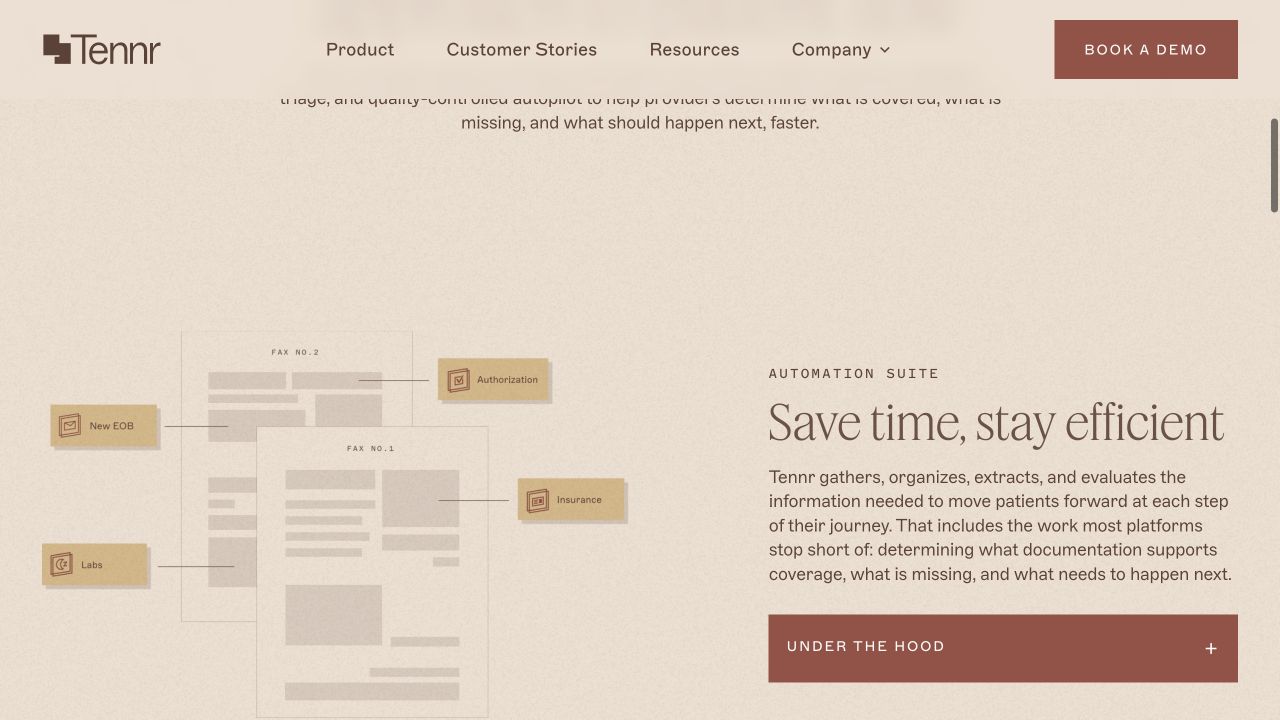
Image source: Tennr official product page, showing EOB, lab, insurance, and authorization information from faxes entering Automation Suite.
Tennr turns healthcare referrals, faxes, missing documents, and payer rules into a patient queue that can keep moving. The company says revenue has already reached eight figures.
Eight-Figure Revenue From an Invisible Workflow
When a patient leaves a primary-care office, that does not mean they will successfully reach a specialist. A referral may arrive by fax, email, or portal. Insurance information and medical records are often incomplete. Staff still have to check payer rules one by one. Any missing piece can leave the patient stuck before scheduling.
Tennr chose to own this workflow, which patients rarely see. Several operating signals show that the company has moved beyond a document-recognition demo:
- Tennr’s CEO told Fortune that company revenue had reached eight figures and had roughly tripled since the October 2024 Series B.
- Tennr told Fierce Healthcare that it processes about 10 million documents per month and serves hundreds of healthcare organizations.
- Tennr’s official NMA customer story says referral volume processed per day rose 157 percent and days-sales-outstanding fell 30 percent after using the product. These results are not third-party audited.
The first two figures are also company and founder disclosures to media, not independent audits. But revenue, document volume, and customer workflow outcomes all point to one idea: healthcare organizations will pay when AI helps patients enter the service workflow faster.
Why Referrals Become Lost Revenue
The pain in US healthcare referrals is not only that fax machines still exist. The harder issue is that one packet has to satisfy the provider, payer, and patient at the same time.
A referral may lack a physician signature. A medical record may not prove medical necessity. An insurance plan may have changed. Once staff find the issue, they still have to reach the right clinic, patient, or payer to collect the missing information. If the material never enters the correct queue, the patient disappears into waiting, and the provider loses service revenue that could have been completed.
Fierce Healthcare described this as a referral black hole: information arrives through many channels, but the organization lacks one chain that shows where the patient is stuck and who should act next. Tennr keeps legacy inputs such as fax, then productizes the judgment and action layer behind them.
Turning a Fax Into a Patient Queue
Tennr’s product page breaks referral work into four continuous actions.
Read. The system extracts patient, clinical, insurance, and service information from faxes, portals, and internal orders, then writes it into the relevant workflow.
Check. The product matches the materials against payer requirements, identifying which proofs are complete, what information is missing, and whether the patient has the required coverage.
Advance. The system follows up with patients, referring providers, or payers, submits and tracks prior authorization, and prioritizes queues based on urgency.
Keep control. High-confidence tasks can be automated. Exceptions, missing conditions, and high-risk decisions move into human review and escalation.
These four steps move AI output from “I can read this document” to “this patient can move to the next step today.” That also makes the purchased result measurable: backlog reduction, referrals handled per person, fewer denials, and whether the patient actually receives service.
Why Healthcare Organizations Pay
Tennr does not publish pricing, contract size, or exact billing model. What can be confirmed is that it sells software to healthcare organizations and that the CEO has disclosed eight-figure revenue. The website uses demo-based sales rather than self-serve purchase, and implementation appears to serve both independent practices and national healthcare networks.
The buyer’s ROI logic is straightforward. The slower referral handling is, the fewer patients can be scheduled. The more incomplete the insurance material is, the more denials and payment delays accumulate. Adding headcount to clear backlogs raises administrative cost.
Tennr’s NMA case gives a concrete company-published example: staff went from handling 15 to 20 referrals per person per day to more than 60; backlog dropped from 65 to zero; and the document team shrank to one-third of its prior size. NMA also said the business tripled over three years without adding administrative headcount. These claims need independent validation, but they clearly show how a customer might calculate return on investment.
The product also has a natural expansion path. Tennr began with material intake, then added eligibility and benefits checks, prior authorization, communication coordination, and patient-status network capabilities. Each adjacent workflow increases the amount of work handled and moves the product closer to the provider’s revenue cycle.
The Data Moat Lives in Payer Conditions
Large volumes of healthcare documents do not automatically create a moat. The valuable data is which proof a service requires, which payer accepts what material, which missing item causes denial, and how the exception is ultimately resolved.
Tennr told Fierce Healthcare that its models use 100 million anonymized medical documents, 2.3 billion data fields, and 8,000 condition groups. Those are company-reported figures. The more important point is the data structure: Tennr connects medical materials to payer conditions, so the model can judge whether a service requirement is satisfied instead of merely extracting fields.
As Tennr processes more referrals, it can accumulate missing-material patterns, human corrections, authorization results, and patient outcomes. A general model can read a fax, but it cannot instantly obtain that operational feedback or the integrations into healthcare systems.
Three Actions Builders Can Copy
First, support the old entry point, then transform the backend.
Tennr accepts faxes, emails, portals, and internal orders. It does not require every referring provider to change systems first. In traditional industries, preserving existing inputs is often faster than forcing the whole ecosystem to migrate.
Second, turn industry rules into next actions.
Reading an insurance card is a capability. Checking payer requirements, spotting missing proof, and triggering follow-up is a product. Founders need to find the rule set that determines whether the real workflow can continue.
Third, define product value with customer operating metrics.
Tennr’s customer story uses referrals per person per day, backlog, DSO, and business growth without additional administrative staff. Those metrics map directly to budget. They are better procurement evidence than model accuracy alone.
Three Pressures Remain
The first pressure is verification. Eight-figure revenue, tripled growth, and 10 million monthly documents are all company disclosures. Public information does not fully show revenue structure, customer concentration, or renewal rates.
The second pressure is error cost. Misclassified materials, missed insurance requirements, or patients routed to the wrong queue can affect care and payment. As the product expands deeper into workflows, quality control, human escalation, and responsibility records become more important.
The third pressure is implementation complexity. Specialties, payers, and healthcare organizations use different rules and systems. Tennr’s ability to preserve deployment speed while adding customers and product lines will determine how far eight-figure revenue can grow.
Tennr’s value is no longer just digitizing fax. It connects scattered documents, insurance conditions, and communication actions into a patient queue, allowing providers to see both service progress and revenue impact. That ability to place industry rules directly inside operations is what moves vertical AI from a feature into a business.