
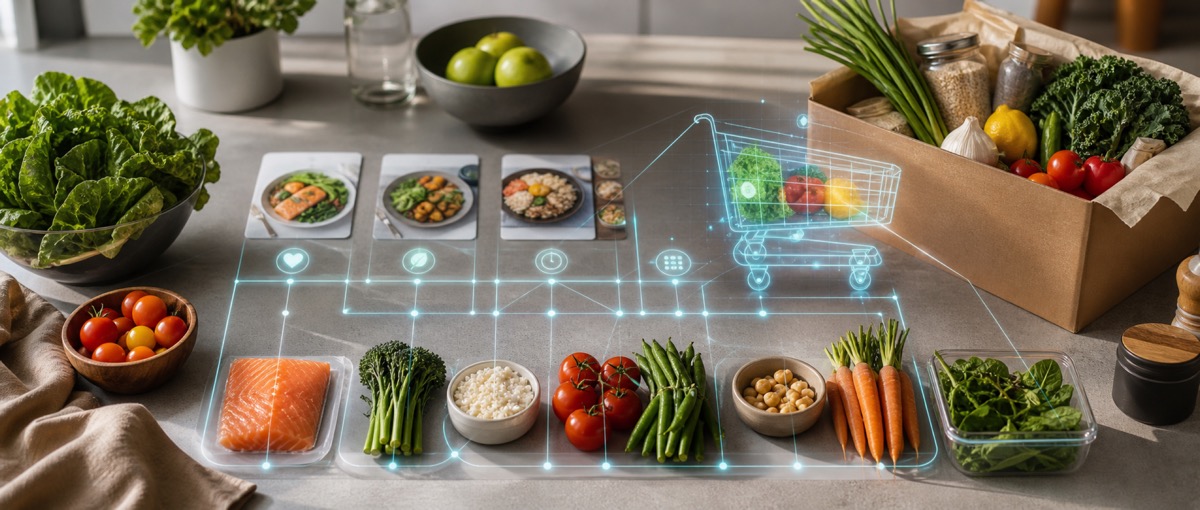
At first glance, Hungryroot looks like a healthy meal-subscription company: answer a few questions, receive a box of food, and cook from the recipes.
The more useful lesson for AI product builders is not the meal. It is the shopping cart.
Hungryroot’s website is direct about the positioning. It combines meal-kit convenience, grocery-store variety, and personalization. Users tell it their dietary preferences, health goals, and budget, and Hungryroot automatically fills a weekly cart. This is not a chat assistant that asks for more prompts. It is a system that makes a weekly purchase-composition decision on the user’s behalf.
Several signals make the case more than a nice concept:
- Hungryroot’s website says it has more than 50,000 recipes, more than 14 million deliveries, a 4.8 average rating, and thousands of Trustpilot reviews.
- WIRED’s review notes that Hungryroot had been developing proprietary AI models for highly personalized menus.
- Bon Appetit says Hungryroot has strengthened its AI and algorithmic capabilities to recommend products and autofill carts.
- Public reporting cites roughly 700 million dollars in 2025 net revenue and 55 percent year-over-year growth. This operating figure comes from company disclosure or public retellings, not an independent audit, so it should be treated as a commercial signal rather than verified financial evidence.
The lesson is simple: consumer AI does not have to look like ChatGPT. A more monetizable position may be to turn a recurring decision that users cannot avoid into a default order they are willing to accept.
Users Do Not Need Another Recipe. They Need a Default
Many consumer AI products interpret the problem as “users want more answers.” Hungryroot makes the opposite bet. The user does not primarily lack dinner ideas. The user does not want to plan dinner from scratch every week.
Grocery planning contains many small constraints:
- How many people are eating.
- What each person refuses or cannot eat.
- Whether the week prioritizes saving money or saving time.
- How breakfast, lunch, dinner, snacks, and drinks fit together.
- Which ingredients must be fresh and which can be prepared.
- Whether the budget stays under control.
- Whether the food can actually be cooked after it arrives.
A typical AI recipe tool can produce a suggestion. Hungryroot turns the suggestion into a purchasable, deliverable, editable cart. Its How It Works page says users explain how they eat, then Hungryroot sends a personalized cart every week that users can edit, approve, skip, or cancel.
That distinction is crucial.
Generating a menu is a content product. Generating a cart that can be purchased, fulfilled, and repeated is a transaction product.
AI Is the Orchestrator, Not the Main Character
Hungryroot’s experience does not foreground “talking to AI.” It behaves more like a default grocery buyer that learns.
Food & Wine’s review says new users complete a comprehensive quiz so the platform can understand household food preferences. As users keep using the service, it learns the meals they like and filters recommendations better. The same review notes that many meals can usually be prepared in 10 to 20 minutes.
That means Hungryroot compresses a full household food workflow, not one isolated action.
| Traditional flow | Hungryroot’s productized version |
|---|---|
| Decide what to eat this week | Generate a default plan from preferences, goals, and budget |
| Browse a grocery app or store | Autofill a cart |
| Match recipes with nutrition preferences | Bind recipes to ingredients |
| Worry about buying too much or too little | Organize products around a weekly plan and delivery box |
| Repeat the same decision every week | Use subscription, skipping, editing, and repeat behavior |
The AI value is not that the answer sounds more human. It reduces the choice space until the user is likely to accept the result.
That is especially important in consumer AI. People often say they like choice, but they pay to reduce choice. Spotify recommendations, the Netflix home screen, and TikTok’s feed all sell reduced decision cost. Hungryroot applies the same logic to a heavier and more real commerce category: food.
Why the Business Works: The Cart Is Closer to Money Than Advice
If Hungryroot were only an AI nutritionist, it might be limited to subscription fees while competing with free content and general AI tools.
Instead, it owns the cart and fulfillment layer, so the revenue interface is different.
Hungryroot’s website shows price clues such as breakfast from 3.99 dollars per serving, lunch from 5.99 dollars, and dinner from 8.99 dollars, with delivery-fee rules around order size. Bon Appetit’s testing found a rough range of 9 to 11 dollars per serving and described Hungryroot as more like a virtual grocery store with quick-prep suggestions than a traditional meal kit.
That means revenue comes from real weekly consumption, not just software access:
- The user opens a default cart every week.
- The system places recipes, ingredients, snacks, drinks, and supplements into one basket.
- The user removes or swaps disliked items.
- The platform fulfills delivery.
- The system learns from the next week.
AI improves cart acceptance, basket size, order frequency, and retention. It is not optimizing session length for its own sake.
That is why Hungryroot is more useful to study than many consumer AI apps. Chat products first have to prove that users will pay for conversation. Hungryroot starts in a category where users already spend money continuously, then turns AI into conversion infrastructure.
But This Model Is Not Light
Hungryroot is not “a model plus a front end.”
It has to manage food SKUs, inventory, cold-chain delivery, taste preferences, price sensitivity, household size, nutrition goals, and the user’s changing weekly mood. These constraints make the company harder to copy, but also harder to operate.
Third-party reviews show clear friction. WIRED notes that users may need to enter a credit card and commit to a plan before seeing the specific options generated for the first order, which creates a psychological hurdle. Bon Appetit mentions that Hungryroot’s points or credit system can take time to understand.
So the story is not simply that better AI recommendations win. Recommendation is only the visible layer. The hard part is that the recommendation has to land on real supply, real prices, and real dinners.
If AI recommends products a user wants but inventory is unstable, the experience breaks. If it recommends food that is healthy but unpleasant, repeat behavior drops. If it saves money by weakening freshness, trust drops. If it offers too much choice and makes the user rebuild the cart every week, the convenience value disappears.
That is the reality of consumer AI inside transactions: the model must obey fulfillment.
Lessons for AI Founders
First, do not rush to create an “AI destination.” Find a decision where the user already pays repeatedly.
Hungryroot does not educate users to pay for AI. It enters food purchasing, where the spend already exists. AI lowers decision cost. The transaction captures value.
Second, a good default can be more valuable than infinite generation.
Many AI products treat “can generate many options” as the selling point. In household shopping, the user usually wants one plan that is likely to be acceptable. Productizing fewer choices can be the real value.
Third, a consumer AI moat may live in the operating system.
Hungryroot’s hard problem is not writing one recipe. It is connecting preferences, budget, SKUs, inventory, delivery, and repeat behavior. For founders, that means the moat may not come from model parameters. It may come from a system continuously calibrated by real transactions.
Fourth, treat company-reported data carefully.
Hungryroot’s public claims about health improvement, savings, and time saved often come from customer surveys or company reporting rather than independent audits. They help explain the brand story, but builders should focus on durable metrics: first-order conversion, cart acceptance, order frequency, gross margin, retention, and refunds.
The Takeaway
Hungryroot’s lesson is not that AI can cook.
It is that AI products do not always need to stand at center stage. Often, the best position is one second before a transaction, where the product turns complex choices into a default answer.
The user sees a box of food that can cover the week.
The founder should see AI compressing recommendations, subscriptions, retail margin, and fulfillment into one shopping cart.