

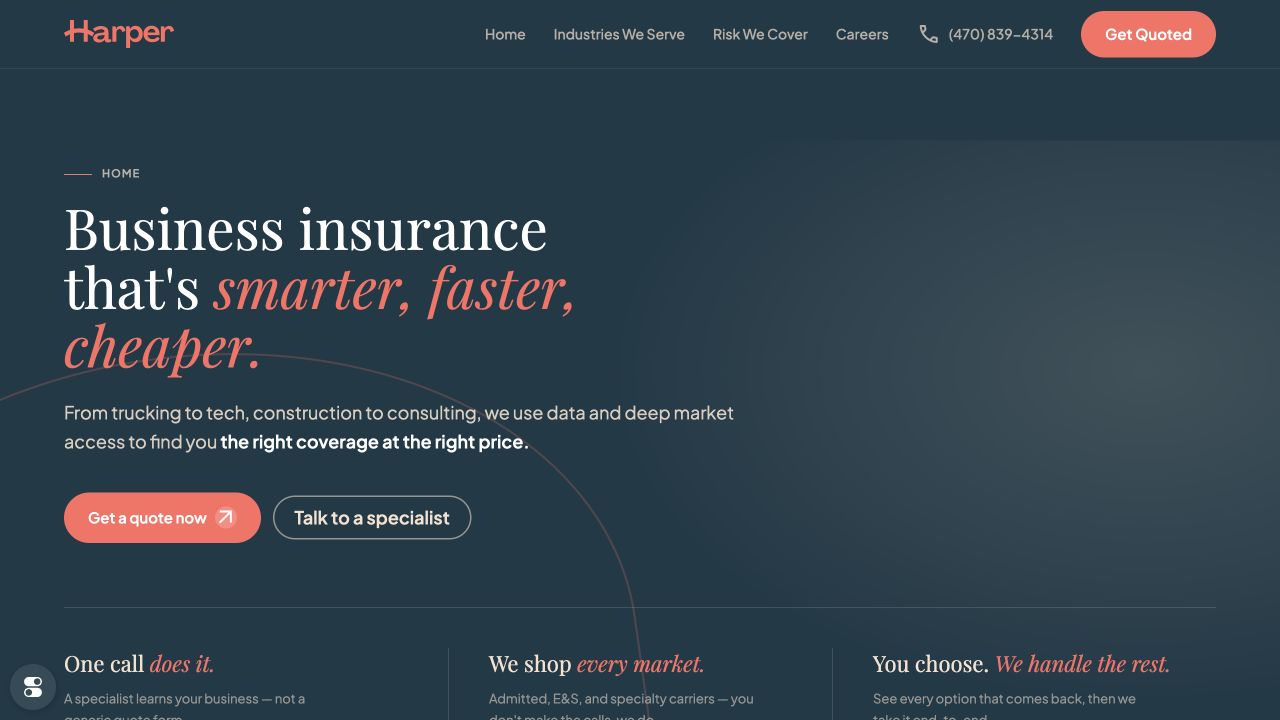
Image source: Harper official website, showing a three-step flow: one conversation, carrier-market comparison, and Harper handling the rest after the customer chooses.
Many AI companies sell efficiency to professional-service firms. Harper chooses to become one of those firms.
It does not sell an assistant to insurance brokers. It uses AI to operate a commercial insurance brokerage.
The Operating Signal
Commercial insurance is not an easy market for an AI demo. Customer materials are fragmented. Carrier appetite changes. Licensing and compliance vary by state. The final output is not an answer. It is a policy that can actually take effect.
Harper has produced several signals worth studying:
- TechCrunch reported that Harper announced 46.8 million dollars in total seed and Series A funding in February 2026.
- The same report said a traditional brokerage process often takes five to seven days, while Harper compresses some workflows to one to two days. It also said a traditional sales team may complete 20 to 30 deals per month, while Harper was adding more than 1,000 customers per month at the time.
- TechCrunch reported that Harper had served more than 5,000 customers. Harper’s website currently says it serves more than 6,000 companies and has a 98.78 percent customer retention rate. These are company-reported figures, not third-party-audited evidence.
The point is not only that AI makes buying insurance faster. The more important signal is that Harper is testing a different commercial structure: using software-like operations to capture revenue that used to belong to a labor-intensive brokerage.
From Selling Tools to Delivering the Result
The usual AI startup path is to sell software to existing institutions. In insurance, that could mean helping brokers organize materials, draft emails, search policies, and prepare submissions, then charging by seat or account.
Harper moves one step further. The customer describes the business and risk. Harper contacts carrier markets, compares options, advances the paperwork, and continues service after the customer chooses a policy. The promise is not “we give you a smarter workbench.” The promise is “we get the insurance done.”
That changes how AI value is priced. Each day removed from the process and each additional customer served by the same team is not merely more software usage. It is more transaction capacity for the brokerage itself. Harper has not disclosed revenue or commission structure, so its monetization efficiency should not be treated as a public fact. But as a licensed brokerage, it has the chance to retain more of the automation upside inside service revenue rather than collecting only a fixed tool fee.
AI Takes Over Operational Weight
Harper’s automation is not built around one all-purpose agent. It looks more like an insurance process decomposed into trackable operating tasks, with AI taking on the heaviest repeated work.
| Workflow step | AI and systems can handle | Humans still own |
|---|---|---|
| Customer intake | Extract business, risk, and coverage information from conversations and documents | Confirm key details and needs |
| Market matching | Match customer characteristics with carrier appetite | Handle exceptions and complex risks |
| Applications | Organize materials, route submissions, and track missing items | Review submission quality |
| Follow-up service | Draft messages, prioritize next actions, and advance workflow | Manage critical communication with customers and carriers |
| Final decision | Provide internal context and operating support | Licensed humans and carriers make final eligibility and binding decisions |
Harper’s privacy policy says AI is used for document classification and extraction, message drafting, follow-up prioritization, and internal prompts during calls. It also says final eligibility and binding-policy decisions remain with humans and insurance companies.
That boundary matters. The hard part of commercial insurance is not removing every person from the workflow. It is letting a smaller group of professionals handle more business without losing the responsible party. AI absorbs operational weight. Humans keep judgment, relationships, and accountability.
Why Brokerage Can Amplify the AI Dividend
Professional services often have a structural problem: customers buy outcomes, while providers scale by headcount. More demand means more salespeople, assistants, operations staff, and professionals. As the firm grows, coordination costs grow too.
Harper is trying to flatten that cost curve. Its customer intake, material structure, market matching, and follow-up work live in the same operating system. Growth does not have to require proportional increases in manual coordination. If automation accuracy and compliance controls hold up, each licensed professional can support more customers.
That is why AI-native professional services can be commercially more interesting than ordinary productivity tools. They do not require customers to buy a new software category or agree that they are buying AI. Customers are still buying commercial insurance. The delivery company simply has a different cost structure.
The Moat Grows Inside Real Operations
Harper’s public technical description points toward an asset that matters more than the model itself. Its models can use customer communications, applications, policy documents, quotes, endorsements, carrier appetite guides, and internal labeled data. The company also mentions golden datasets, automatic evaluation, monitoring, and human override.
These are not generic industry facts scraped from the open web. They are process records created while completing real insurance work: which risk should be sent to which carrier, which materials are rejected, which follow-up moves a quote forward, and which exceptions require escalation to a person.
The more business Harper handles, the more it can learn about carrier appetite and workflow feedback. Better matching and faster response can then support more business. That loop requires real transactions, licensed operations, and carrier-market relationships. A model or chat interface alone cannot reproduce it.
What Builders Can Copy
Harper’s approach is not limited to insurance.
First, look for services where the result is clear, the process is tedious, and responsibility cannot disappear. AI can first take over material handling, routing, follow-up, and quality checks while professionals retain final judgment.
Second, translate product metrics into operating metrics. Model accuracy may show technical feasibility. Days removed from a workflow, customers served per employee, renewal behavior, and service reliability show whether the business system works.
Third, design human fallback early. In regulated industries, human review is not an admission that automation failed. It is part of the product boundary. Who can overrule AI, when escalation is mandatory, and how decisions are logged should be formal workflow features.
Fourth, decide whether to sell a tool or deliver the result. Selling tools is lighter and easier to start. Delivering the result requires licensing, operations, and channels, but it may capture more value. The right path depends on whether the team can actually carry industry responsibility.
The Hardest Part Is Not the Model
Harper launched in 2024, so its market history is still short. But its advantage is not only early use of large language models. The harder pieces are carrier relationships, state-level regulatory experience, licensed teams, and operational data from thousands of customer workflows.
There are also limits to romanticizing the case. Raising 46.8 million dollars gives Harper room to build technology, brokerage operations, and compliance infrastructure at the same time. Insurance talent and channel relationships are not assets a pure software team can instantly buy. Founders can learn from Harper’s process design and value-capture logic, but they should not assume the required industry infrastructure will appear automatically.
Three Open Questions
The first question is growth quality. The 98.78 percent retention figure on Harper’s website is striking, but it is not third-party audited and the calculation basis is not public. It will take a longer cycle to know whether customer growth turns into stable renewals and sustainable commissions.
The second question is profit structure. A faster workflow does not automatically create higher profit. Customer acquisition cost, complex cases that require human labor, and commission differences across insurance products can all affect whether an AI-native brokerage can approach software-like economics.
The third question is regulation and responsibility. Harper keeps final decisions with humans, but expanding into more states, industries, and special risks will add compliance cost. Whether automation scale and responsibility controls can grow together is the real stress test for this category.
Harper is worth watching because it places AI inside a profit and loss statement, not merely inside a software feature. The next wave of AI products may not always look like tools. Some will become companies that deliver the result directly, and customers will experience AI through faster, cheaper, and more reliable service.