

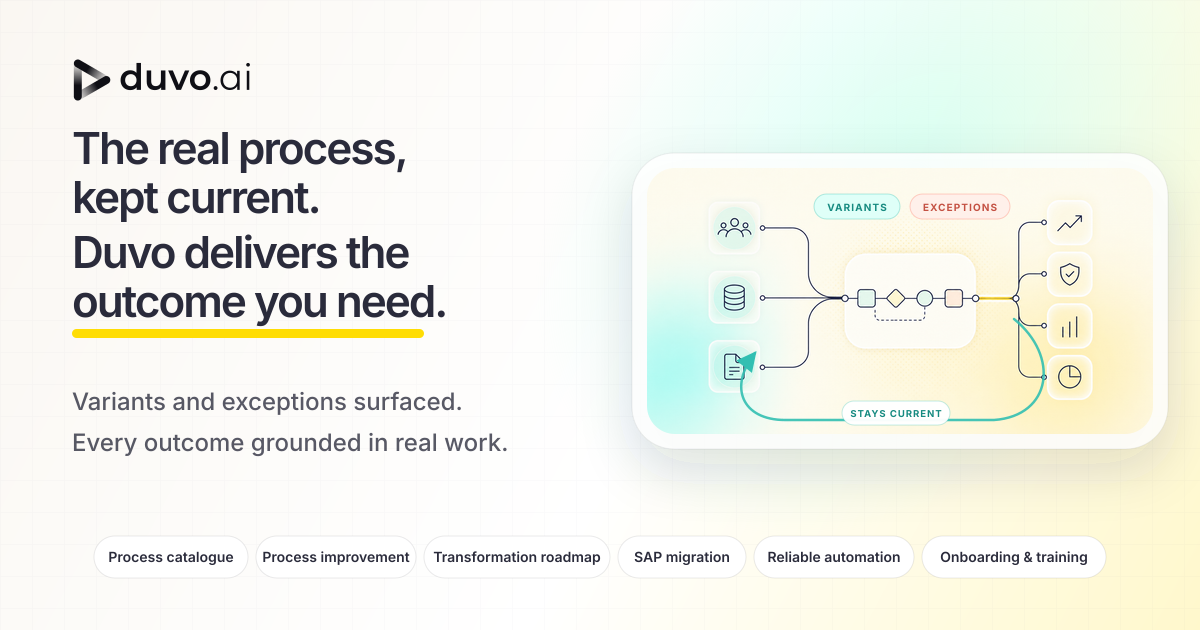
Image source: Duvo official public product preview. This is official promotional material, not independent commercial-performance evidence.
The first profitable home for AI agents may not be a clean new system. It may be the operational gaps between old systems that nobody wants to touch.
Duvo is that kind of case. It does not start with the story of a general-purpose AI employee. It narrows the job to retail, FMCG, and CPG teams that move data and handle exceptions across SAP, supplier portals, email, Excel, files, web tools, and internal systems. Duvo describes itself as an agentic operations platform for those teams. The goal is not to replace ERP. The goal is to map how work actually happens, design a better workflow, and let agents run approved work on top of existing systems.
That makes Duvo useful to study. It explains one of the hardest parts of AI commercialization: customers do not pay for intelligence in the abstract. They pay for an auditable, reusable work result that changes a business metric.
It Sells the Real Workflow, Not Automation
Many AI automation products begin by asking users what they want to automate. In complex enterprises, that is often the wrong starting point, because users may not be able to describe the real process.
Retail operations are especially messy. A simple purchase order can involve supplier confirmation, inventory availability, price lists, promotion planning, arrival discrepancies, invoice matching, and store or warehouse exceptions. Part of the work lives in ERP. Part of it lives in a supplier portal. Another part lives in spreadsheets, email, and Slack.
Duvo’s product wedge is to turn that real work into an asset first. Its machine-readable product description says it forms process evidence from walkthroughs, interviews, and existing documentation, preserving tasks, systems, roles, decisions, handoffs, exceptions, and workarounds. In other words, it first sells “the process can be seen,” then sells “the process can be executed.”
That is different from many horizontal agent tools. The horizontal assumption is that users know what they want and only need an AI helper. Duvo’s assumption is that in dirty operational environments, the missing asset is a process map that can explain reality.
Why Retail Operations Are a Strong Entry Point
Retail is not a glamorous market, but it is a hard commercial entry point.
First, margins are thin, so improvements are visible to management. Duvo’s website case material says Pilulka improved product availability by 15 percent in two weeks, and that Rohlik Group protected 2.1 million euros in revenue and 1.4 million euros in gross margin by fixing inbound invoice discrepancies. These are Duvo-published customer claims, not third-party-audited results, but they show the category logic: the AI is not writing reports. It is affecting inventory, margin, and cash leakage.
Second, systems are fragmented, which makes the pain harder for generic software to absorb. Duvo says it runs on top of the systems retail teams already use, including ERP, supplier portals, email, spreadsheets, files, web tools, and internal systems. For the customer, that means value does not depend on finishing a two-year core-system transformation first.
Third, exceptions create room for agents. Traditional RPA works best when the process is stable, repetitive, and rule-clear. The valuable part of retail operations is often outside the happy path: mismatched prices, wrong arrival quantities, insufficient promotional stock, missing supplier confirmations, and invoice discrepancies. Duvo’s product visuals place variants and exceptions in prominent positions. That is a category judgment, not decoration.
The Productization Is in the Control Plane
If Duvo were only letting a large language model click across systems, customers would not trust it. What is more interesting is how it turns the control plane into part of the product.
Its materials repeatedly mention RBAC, SSO, audit trails, policy gates, and human-in-the-loop review. Duvo is not promising that AI can fully replace people. It is placing permissions, approvals, logs, and exception handling into the default workflow. Sensitive write actions can require approval. Execution history can be reviewed. Role permissions inherit organizational boundaries.
This matters for AI founders. Many teams treat human review as a compromise caused by weak automation. In high-value B2B workflows, it is often the ticket into production systems. Without approval and auditability, an agent remains in the recommendation layer. With approval and auditability, it can touch orders, invoices, inventory, and prices.
Duvo also exposes OpenAPI, MCP, webhooks, a CLI, and developer resources, while saying that evaluation workspaces, API credentials, MCP access, and production pilots require a technical demo or an approved pilot. That is a typical enterprise rhythm: show technical buyers that integration is possible, but do not expose high-risk capabilities as a toy sandbox.
Pricing Matters More Than Model Mechanics
Duvo’s most useful lesson is that it does not tie the business model to tokens.
Its pricing material lists three commercial modes: fixed-scope process discovery, transformation and SAP project pricing, and production automation billed by completed work units. The last unit is especially important. A processed invoice, a completed price change, or a resolved case can become the billing unit. Duvo also says token usage is a managed internal cost, not a customer-bill line, and it does not charge by seat.
That is a practical reminder for AI product builders. Customers do not want to understand your model-cost structure. They want to know what outcome they are buying.
Token pricing creates uncertainty. Seat pricing invites comparison with ordinary SaaS. Completed-work pricing lets buyers compare the product with the people, time, and error costs attached to that work today. For vertical agent products, that is often the stronger commercialization language.
Index Ventures wrote that Duvo customers sign six-figure annual contracts and grow with deployment expansion. That is investor-published framing, not an independent audit, but it fits Duvo’s pricing logic: prove value in one process, then expand into more countries, teams, and task volume.
Why Duvo Is Worth Studying Now
This research round also looked at Mercor and Parloa, both strong AI companies.
Mercor is a high-growth case in AI training data and expert networks. The Verge reported that it started with highly automated recruiting, reached 1 million dollars in annualized revenue within months, and later shifted toward expert training data, rubrics, and evaluation environments for model labs. Mercor’s enterprise page also shares company claims about a 100,000-plus contractor network, automated recruiting, valuation, and revenue run rate. The signal is strong, but the case is really about AI data supply chains, with labor, privacy, customer concentration, and supply-risk questions attached.
Parloa is a mature player in voice customer-service agents. The Financial Times reported a 350 million dollar financing, a 3 billion dollar valuation, and ARR above 50 million dollars in 2025. Its website lists customers such as BER Airport, Decathlon, TUI, and Swiss Life. The evidence is stronger, but the voice-agent narrative is already crowded.
Duvo is valuable because it represents a different path. It does not chase the hottest entry points such as AI customer support, AI sales, or AI coding. It enters an older, more fragmented operational site that is harder to describe.
Three Lessons for Builders
First, vertical agents should not start by selling “all-purpose capability.” They should sell that one dirty workflow can finally run end to end.
Duvo’s entry point is not “we can do everything for retailers.” It is supplier work, procurement, invoices, inventory, promotions, master data, and other concrete jobs. The more specific the job, the easier it is to define success. The easier it is to define success, the easier it is to charge.
Second, process evidence itself is a product.
Many enterprise AI projects fail not because the model is weak, but because nobody knows what a good result should look like. Duvo first structures workflows, exceptions, roles, approvals, handoffs, and system boundaries. That is effectively a business operating system for the agent.
Third, move the pricing unit from AI capability to business output.
Charging for completed work units contains a strong claim: customers will pay to reduce an exception, a wrong invoice, or an inventory loss, not to experience smarter conversation. The place to commercialize AI is not necessarily where the model looks most magical. It is where the customer is already paying cash for inefficiency.
Duvo’s lesson can be summarized simply: before an AI agent tries to become a new system, it should learn to catch the dirty work between old systems. If it can catch that work, it has a chance to turn intelligence into revenue.