

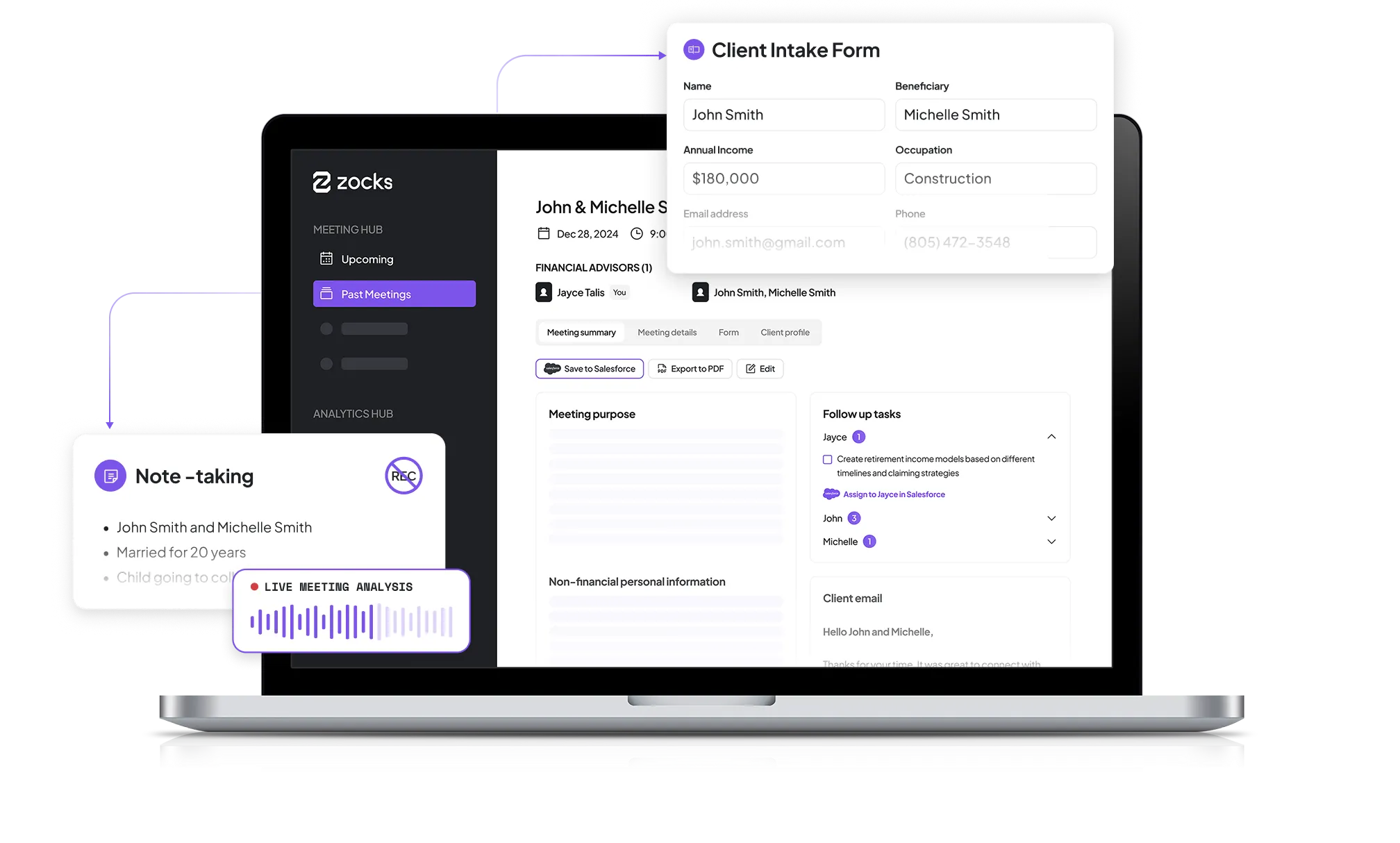
Image source: Zocks official product image showing how client conversations become forms, Salesforce tasks, and follow-up emails. This is official promotional media, not independent performance proof.
Zocks turns client conversations into CRM fields, forms, and next actions.
Three Signals First
The first signal is funding. Zocks announced a $45 million Series B in January 2026 and said total funding reached $65 million.
The second signal is pricing. Its website lists seat-based subscriptions starting at $67 per user per month when billed annually, with the highest self-serve tier at $184 per user per month and custom Enterprise pricing.
The third signal is customer traction. Zocks says more than 5,000 financial-services firms use the product. ROI and engagement numbers in the Carson Group case study are company-published claims and should not be treated as independently audited benchmarks.
For a financial advisor, a client meeting does not end when the call ends.
The client may have discussed retirement planning, family changes, outside assets, tax planning, beneficiaries, or future goals. The advisor still has to put that information into CRM, client forms, financial-planning software, emails, tasks, and the next follow-up. The expensive work is not simply remembering the conversation. It is moving the conversation through multiple systems.
Zocks targets exactly that post-meeting workflow. It starts with notes, but its product endpoint is client data and business execution.
After the Meeting, Information Has Four Destinations
An advisor meeting usually produces four categories of output: facts that must be saved, systems that must be updated, tasks that must be assigned, and client opportunities that can be cultivated later.
| Meeting result | Traditional handling | Zocks product action |
|---|---|---|
| Client facts | Manual note cleanup | Structured client profiles and forms |
| System updates | Manual entry into CRM and planning tools | Field and meeting sync |
| Follow-up execution | Separate emails and tasks | Email drafts and assigned next steps |
| Client development | Advisor memory and periodic reviews | Queryable client lists and service opportunities |
Zocks’ website shows a workflow that covers meeting preparation, live note capture, client forms, email, document intelligence, CRM integration, and client querying. Investopedia’s third-party review also describes a workflow that combines prep, forms, CRM updates, and automated emails for advisors.
That changes the value unit. The customer is not buying a summary. The customer is buying how much business work a meeting can trigger.
Move the Endpoint From “Read” to “Write Back”
Generic meeting tools usually hand the user a summary. Zocks goes further by recognizing financial-advisor context and sending results into systems such as Salesforce, Wealthbox, eMoney, Holistiplan, and Orion.
That extra step determines whether the product becomes part of daily work.
A natural-language summary is easy to replace. Data that has entered CRM, compliance records, client forms, and team tasks keeps participating in the business. Every meeting makes the client profile more complete and helps the advisor organization answer a more operational question: who should we contact next?
Zocks’ website also shows more strategic questions: which households do not have a 529 education savings plan, which clients hold outside 401(k) assets, and which clients are nearing required minimum distribution age. The product is turning meeting data into a queryable client portfolio, not just a searchable memory.
A $67 Entry Point Can Lead to Enterprise Budget
Zocks’ pricing page makes the expansion path visible.
| Tier | Annual price | Main value |
|---|---|---|
| Essentials | $67 per user per month | Meeting prep, AI notes, core integrations |
| Professional | $117 per user per month | Forms, analytics, client profiles, team collaboration |
| Ultimate | $184 per user per month | Email replies, document extraction, custom automation |
| Enterprise | Custom | Enterprise controls, security, compliance, and deployment |
An individual advisor can use a 14-day trial to prove time savings. A team can upgrade for integrations, permissions, shared workflows, and client intelligence. The packaging serves two buying motions at once: the individual sees immediate productivity, while management evaluates team capacity and client-service leverage.
The Carson Group customer story says 400 advisors launched in 30 days, first-half-year ROI exceeded $2 million, and weekly advisor activity reached 97 percent. These are company-published claims, not independent benchmarks, but they show the enterprise sales language: deployment speed, active usage, and measurable return.
The Hardest Part to Copy Is Not Transcription
1. Industry Fields
Financial advisors care about beneficiaries, retirement accounts, required minimum distributions, 529 plans, outside assets, estate facts, and client discovery details. The product must know what information is worth extracting, where it should go, and who needs to confirm it.
2. Trust Design
Advisor conversations include assets, taxes, family dynamics, and inheritance details. Zocks emphasizes privacy-first handling, no recording, encryption, SOC 2 Type II, and customer-controlled retention policies. For financial institutions, those choices affect purchasing before they become back-office details.
3. Workflow Connections
Single-meeting summary quality can be copied. Cross-system workflow is harder to dislodge. When CRM, planning software, forms, email, and team tasks are connected, the replacement cost comes from process continuity, not just stored data.
Four Builder Lessons
1. Use a Frequent Entry Point to Earn System Position
Meeting notes are frequent, easy to try, and easy to measure for time savings. But the product route should point toward a deeper position from the beginning: fields, approvals, tasks, revenue actions, or compliance records.
2. Send AI Output Into the Next Step
Users keep paying when the product saves a copy-paste, a system switch, a manual form, or a follow-up task. Writing the output into business systems is more commercially valuable than polishing the summary one more time.
3. Put Industry Constraints in the Sales Story
In finance, healthcare, law, and insurance, data handling, review, retention, and responsibility boundaries are part of the product experience. The more sensitive the customer, the more these constraints can become purchase reasons.
4. Design for Both Individual Trial and Organizational Expansion
A low-friction trial helps frontline users verify value quickly. Team management, integrations, compliance, and controls move the product into larger budgets. The two motions should share the same data and workflow from the beginning.
What This Business Still Has to Prove
The first question is whether more independent customer cases will validate the company’s ROI and long-term engagement claims.
The second question is whether Zocks can keep its cross-system work layer as CRM, custodial platforms, and financial-planning software add more AI features themselves.
The third question is how regulators and firms will treat AI-generated client records, emails, and next-step suggestions, and how responsibility will be assigned inside the advisor organization.
Zocks is worth studying because of its chosen endpoint.
It does not treat a client meeting as audio that needs a summary. It treats the meeting as a batch of data that should enter CRM, forms, email, tasks, and client intelligence. For vertical AI builders, that choice matters more than model size: the entry point can be small, but every use should move the product into a more important business position.