

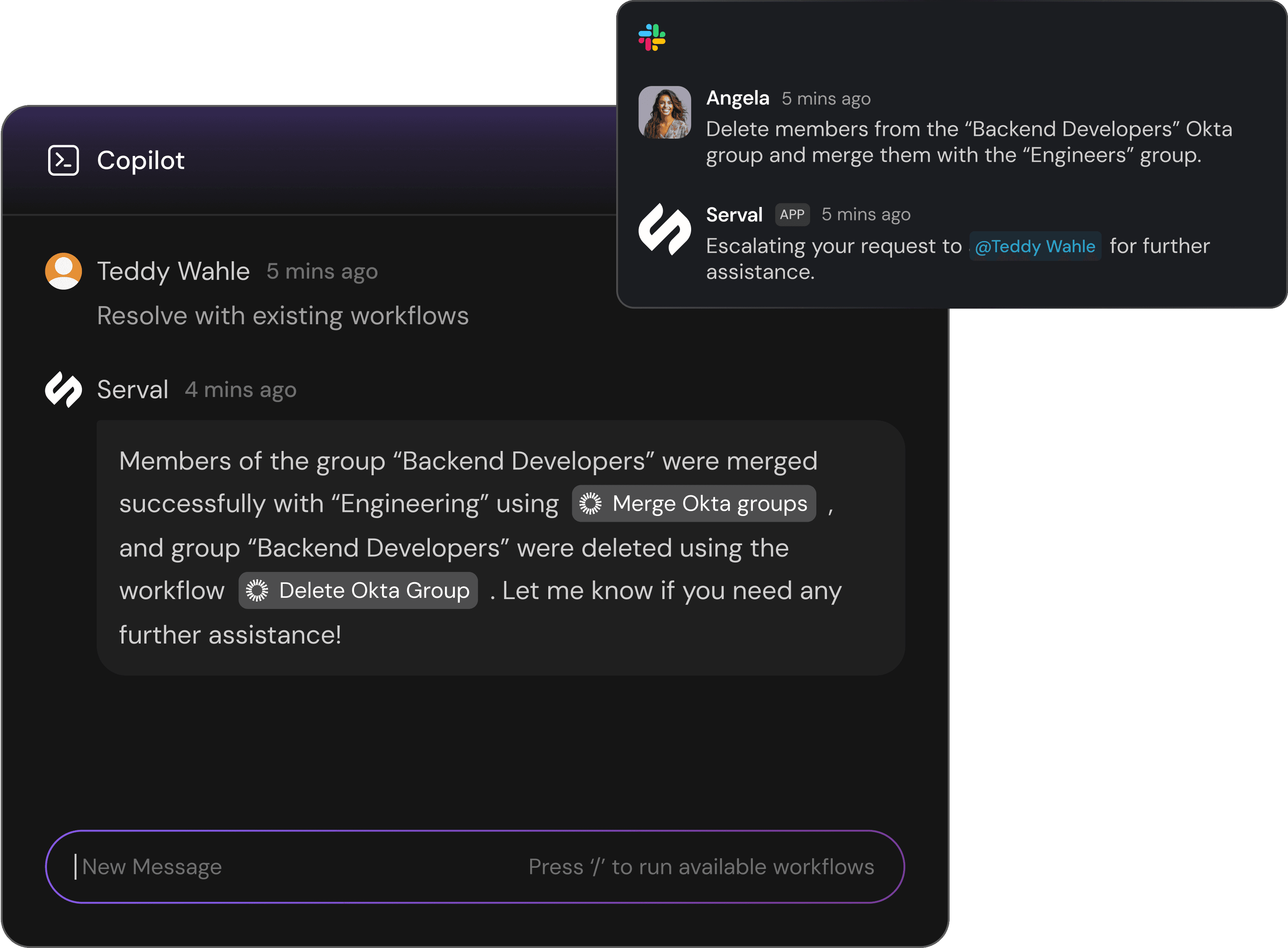
Image source: Serval official product screenshot showing Copilot escalating an Okta group-change request into an existing workflow. This is official promotional media, not third-party performance proof.
An IT agent does not really sell conversation. It sells completion.
Many enterprise AI products still stop at the answer layer. An employee asks a question, the system replies, and the workflow continues somewhere else: permissions, approvals, system changes, ticket sync, audit records, and escalation.
Serval is interesting because it puts AI agents into the old IT service management workflow. It is not selling a friendlier help-desk chatbot. It is selling an operating layer that can get internal requests done.
Three Signals First
The first signal is funding. Business Insider reported that Serval completed a $75 million Series B in December 2025 at a $1 billion valuation.
The second signal is positioning. Serval describes itself as ITSM for the AI era, covering help desk, onboarding and offboarding, just-in-time access, and long-tail IT work.
The third signal is customer-case framing. Serval’s public customer story says Perplexity automated more than 50 percent of IT requests with Serval. That is a company-published customer-case claim, not independently audited evidence, but it shows how the product wants to be measured.
What Problem Does Serval Solve?
Enterprise IT teams face a large volume of requests that are not individually complex but are operationally expensive.
Someone needs access to Figma, Ramp, Okta, or another tool. A new employee needs accounts, devices, groups, and permissions. A departing employee needs access removed. Someone asks about VPN, email, devices, reimbursement tools, or a workflow they rarely use. Security and IT leaders need every action to be traceable.
Traditional ITSM systems are good at recording work: tickets, assignment, routing, status, closure. But the expensive part is often not the record. It is the execution.
Serval tries to productize that execution chain. Employees can submit requests through Slack, Teams, email, or a web portal. Serval maps the request to a knowledge base, permission policy, approval rule, and system integration, then acts or escalates.
That is a major difference. A chatbot answers. IT service management has to manage responsibility.
What Serval Turns the Agent Into
Serval’s product structure has several important layers.
1. The Request Entrance Becomes a Workflow Entrance
Employees do not want to know which system owns a request, which form to fill, or who must approve it. They want the work done.
Serval lets the employee express a request in natural language, then maps that request to the right workflow. In a permission example, an employee may ask for access to an application. Traditionally, that may involve a ticket, manager approval, IT review, security review, and a change in an identity system. Serval’s product surface shows a different path: the chat entry point becomes a controlled workflow.
For AI products, this is an important interface lesson. Users do not want to learn your process. They want the result. The product has to connect natural language to deterministic operations behind the scenes.
2. The Permission Layer Lets Agents Act With Boundaries
Enterprise IT does not fear slow software as much as uncontrolled software. If an AI can open permissions, delete groups, or change configuration without constraints, nobody will trust it.
That is why Serval emphasizes access policies, approvals, time limits, justification requirements, and access governance. Its public materials mention SCIM groups, API configuration, custom AI-generated workflows, and automatic deprovisioning.
In other words, the product puts “AI can act” after “AI can act only under rules.”
This is core to enterprise AI agent commercialization. The closer a product gets to real business actions, the more it needs permissioning, approval, audit, and escalation.
3. Workflows Can Be Generated, But They Must Be Managed
Serval says users can describe a workflow in natural language and Serval does the rest. The more interesting detail is that it uses code-based workflows that can also be expressed in a no-code UI. Technical teams can inspect the workflow code and manage it with Git.
That sounds less flashy than “AI builds automation,” but it is more enterprise-ready.
Enterprises do not need a one-time automation demo. They need workflow assets that can be maintained, reviewed, rolled back, and handed off when organizations, permissions, or audit requirements change.
Serval’s lesson is that AI generation is the entry point. Durable workflow management is the business.
Why the Commercialization Works
Serval does not publicly show standard self-serve pricing. Its pricing page describes one platform fee and a pilot built around real results with deployment engineering support. That sounds like an enterprise sales motion, not a low-price self-serve tool.
Why can this work?
First, IT help desk is a universal operating cost. As companies grow, requests grow, but IT headcount rarely grows at the same rate.
Second, automation can be measured. Serval’s public cases say Perplexity automated more than 50 percent of IT requests and saved each admin one to two hours per day, while Mercor automated more than 60 percent of tickets and created 24/7 global support coverage. Again, these are official customer-case claims, not audited numbers.
Third, the product is not a point solution. Help desk, access, onboarding, offboarding, tickets, assets, knowledge, approvals, and security governance become more valuable when connected. Once those workflows and policies live in a system, switching costs can rise.
Many AI tools have a retention problem after the trial. Serval moves the other way: start from a high-frequency request entrance, then let every request become part of the permission policy, workflow library, knowledge base, and audit history.
How It Cuts Into an Existing Market
Serval is not entering an empty market. ServiceNow, Freshservice, Jira Service Management, Moveworks, and other service-management products already exist.
So Serval does not only tell customers to replace old systems. Its site says it can sync bidirectionally with third-party ticketing solutions and offers a public API.
That is pragmatic. In enterprise software, the hardest part is not proving your product is better. It is getting a customer to accept migration risk.
Serval can first become an AI-native execution layer above the old system: catch employee requests, automate common work, and sync records back to the ticketing tool. As more workflows and policies move into Serval, it has a path to become the system center.
For AI builders entering mature software categories, that is a useful pattern: do not demand that the customer throw away the old system on day one. Become the better execution layer first.
How to Read the External Signals
Serval’s market signal has two sides.
Business Insider reported in March 2026 that Serval was hiring sales talent from ServiceNow and Moveworks, and referenced the company’s 2025 Series B and unicorn valuation. That suggests investors and operators are paying attention to AI-native ITSM.
At the same time, visible public summaries of a Wall Street Journal article discussed valuation structures across AI startups, including Serval. That does not invalidate the product case, but it is a reminder that financing heat is not the same thing as durable commercial success.
The research value is not “another AI unicorn.” It is how Serval reframes an old market: the service desk is no longer just ticketing software. It can become one of the first reliable operating environments for enterprise AI agents.
Five Lessons for AI Builders
First, do not only sell intelligence. Sell completion. Buyers pay when permissions are granted, onboarding is done, tickets close, and records exist.
Second, treat permissioning and audit as product features, not enterprise burdens. The more an AI can do, the more the buyer needs to know why it acted, who approved it, what changed, and who takes over when it fails.
Third, tell customer stories in operating metrics. “Our model is stronger” is weaker than “more than half of requests were automated” or “each admin saved one to two hours per day.” The claims still need source clarity, but the metric shape is right.
Fourth, sync with old systems before trying to replace them. In mature categories, coexistence can shorten the sales path.
Fifth, turn workflows into assets. One AI automation is easy to demo. A reusable, auditable, maintainable workflow is what an enterprise can manage.
The Core Takeaway
Serval is not worth studying because it built an IT chatbot.
It is worth studying because it reframed employee requests as internal action flows. ITSM is not just ticketing; it is a system of permissions, approvals, execution, records, and governance.
The first AI agents to make stable money may not be the broadest general assistants. They may be agents inside boring, repetitive, bounded, verifiable internal workflows.
The lesson is direct: do not rush to prove how smart the AI is. Prove it can get one real organizational task done.