

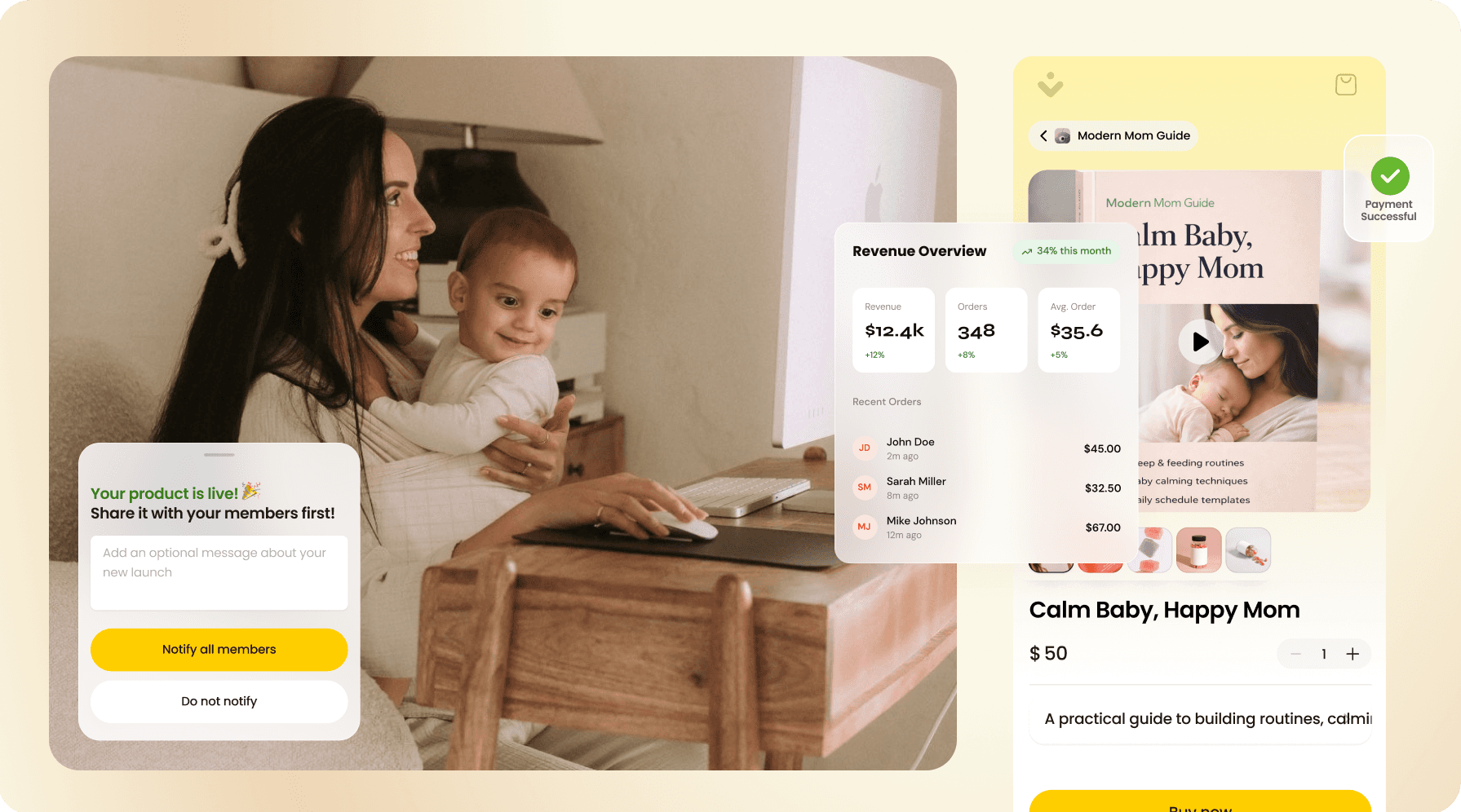
Image source: Nas.com public product image showing a creator workspace, storefront, revenue dashboard, and payment success flow.
AI pushes small businesses from “I can make this” toward “I can sell this.”
Many AI builders still ask whether users will pay for AI-generated copy, images, or landing pages. Nas.com gives a different answer. It is not only helping users generate more material. It turns “I have something to sell” into “I have a storefront, content, ads, checkout, payments, and a way to reach customers.”
That is why the case is useful. AI website generation is only the entry point. The real product is a commerce operating loop for an individual seller.
Three Signals First
The first signal is funding. Business Insider reported that Nas.com raised a $27 million Series A in April 2026.
The second signal is company-published growth. The company said it had more than 350,000 businesses, 3.5 million buyers, and annual recurring revenue that grew from $1 million to $8 million in 2025. Those are company claims, not independently audited metrics.
The third signal is positioning. The homepage message is simple: start selling from a single photo. From there, the product creates a storefront, content, ads, and payments.
Start With a Photo, Not a Store Setup
Nas.com’s main product promise is “Start selling from a single photo.” A user can take a photo of a product, skill, or service, or write a short description. The platform then helps generate the offer, page, and checkout.
That is a strong product choice.
Most individual sellers are not unaware of Shopify, Etsy, Meta Ads, email tools, payment processors, and community platforms. The problem is knowing how to assemble those tools into a working system. The more choices the seller faces, the easier it is to stop.
Nas.com compresses the starting action into something with low cognitive load: give us one image.
That is more powerful than saying “create your online business.” A photo is an action the user can take today. “Build your business” is a stack of unknown tasks.
This Is Not Just AI Website Generation
If Nas.com were only generating a storefront page, the product would be less interesting. AI landing pages, product descriptions, ads, and posters are already common.
Nas.com’s product bundle looks more like a small-business assembly line.
The storefront is only the first step. The site says it can turn product photos or descriptions into product pages, sales pages, and checkout. It also supports different products: courses, challenges, one-on-one services, templates, jewelry, apparel, home goods, events, and more.
That means it is not only serving physical ecommerce. It puts creators, teachers, makers, local service providers, and digital-product sellers into the same selling framework.
Content and ads form the acquisition layer. Nas.com’s Magic Content and Magic Ads address the harder question after a page exists: where do customers come from? Business Insider described users generating marketing content with simple prompts and running ads on Facebook.
For individual sellers, this layer matters more than page polish. Without traffic, the store is only a URL.
Payments, memberships, email, affiliates, community feeds, and dashboards form the operating loop. Once the seller’s products, customers, revenue, and outreach live in the same system, switching costs come less from the template and more from the seller’s daily operating habit.
Commercialization: Subscription Is the Ticket, Transactions Are the Depth
Business Insider reported that Nas.com raised a $27 million Series A led by Khosla Ventures and cited the company’s claims of 350,000 businesses, 3.5 million buyers, and ARR growth from $1 million to $8 million in 2025.
Those numbers remain company-published signals. Still, they suggest the product is not only a novelty AI tool. It is trying to sit near real sellers and real buyer transactions.
Pricing reinforces that direction. Business Insider said the lowest subscription was $6 per month and that Nas.com charged a 5 percent fee on marketing spend. On July 11, 2026, the public pricing page showed Pro and Platinum plans, annualized at roughly $20.75 and $66.58 per month, with Magic Ads transaction fees of 10 percent on Pro and 5 percent on Platinum. Different product types also carry different Nas fees and payment-processing fees.
The packaging may continue to evolve, but the direction is clear. Low-friction subscription brings users in. Transaction fees, ad fees, payment fees, and higher-tier operations expand revenue as the user sells more.
That is steadier than selling AI generation credits alone. The user is not paying because a page was generated. The user is paying because a sale can happen.
Why This Is an Old Tree With New Growth
Nas.com is not a company that appeared from nowhere.
Nas Daily had years of creator content, education, community building, and creator commercialization behind it. Public materials show Nas Academy emerging around 2020 and Nas.io being used in 2023 to help creators make money outside a single social platform.
Nas.com looks like a new AI packaging of those older assets. The underlying need existed for years: creators and small sellers wanted to turn attention, skill, or product inventory into revenue. AI now compresses the steps between asset and commerce.
That matters for builders. Many AI opportunities do not start by inventing a new need. They start by compressing a workflow that already exists but is too complex for ordinary users.
Three Moves Builders Can Copy
First, use one low-friction input to start a complex workflow. Uploading a product photo avoids the blank page. Many AI products ask the user to define industry, audience, style, pricing, benefits, channels, and tone before anything happens. That may produce better output in theory, but it increases drop-off in practice.
Second, connect AI output to business results. Pages, copy, and images are intermediate artifacts. Nas.com connects them to ads, checkout, payments, memberships, and orders. Builders should ask: after the user gets the AI output, where do they go next? If the next step is another tool, that may be the expansion opportunity.
Third, make pricing follow the success path. Subscription revenue creates predictability. Transaction and advertising fees connect revenue to customer success. Higher plans can justify themselves through lower fees, more members, more AI credits, and priority support.
That structure is closer to a commerce product than a generator. Users do not care how many times they generated something. They care whether they sold.
The Risks Are Clear
Nas.com has not publicly disclosed enough detail on active sellers, GMV, advertising ROI, retention, refunds, or seller quality to fully judge the business.
There is also a platform-quality risk. Lowering the barrier to opening a store can attract a large number of experimental, low-quality, or inconsistent sellers. Once a product touches payments and advertising, the platform has to manage trust, safety, risk, consumer experience, and seller success.
That is why the hard part is not AI generation. The hard part is operating a commerce system.
The Core Takeaway
Nas.com shows that the next phase of AI products is not only “help users make content.” It is “help users finish a commercial action.”
From photo to storefront, storefront to ads, ads to payment, and payment to customer operations, none of the steps is new. The new opportunity is compressing them into a default flow that an individual seller can understand, start, and pay for.
The lesson is not that Nas.com built an AI storefront. The lesson is that it connects the hardest parts of a small business into one workflow.
AI often sells best when it helps people start working.