

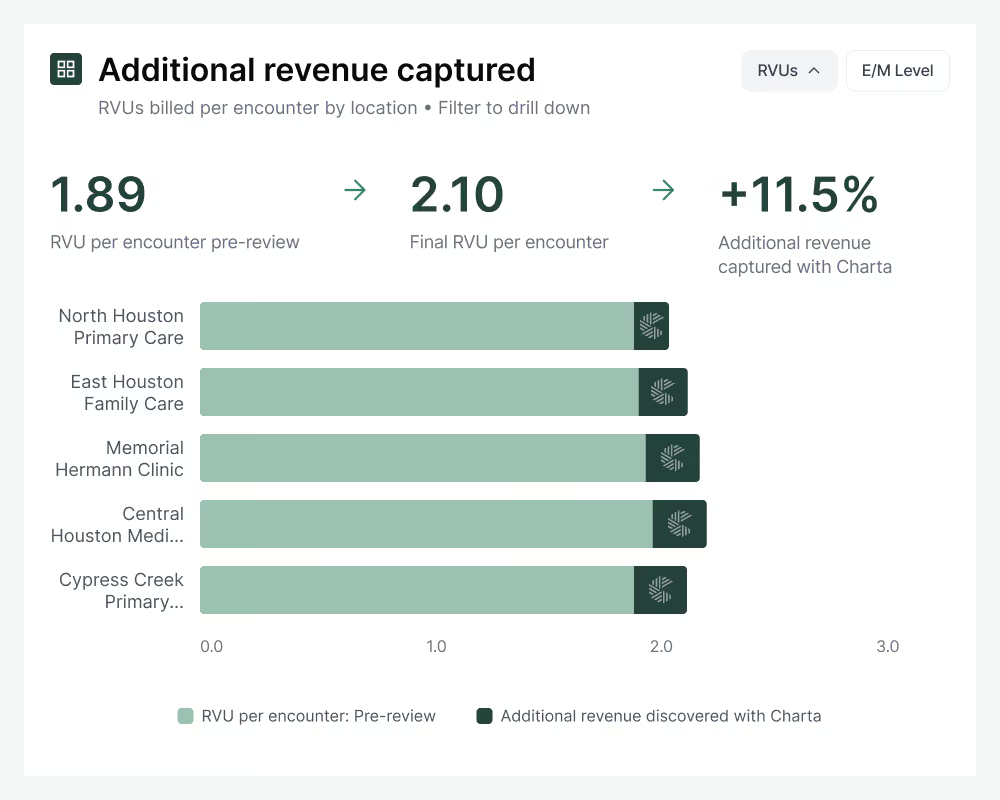
Image source: Charta Health Solutions page. The official screenshot explains the Revenue Discovery workflow and is not third-party performance proof.
Healthcare AI can make money first by finding billing evidence.
When people hear “healthcare AI,” they often think of AI doctors, diagnosis, patient chat, or clinical scribes. Charta Health chooses a less glamorous but more budget-adjacent entry point: chart review.
The core question is not whether AI can understand medicine like a doctor. The question is whether a healthcare organization can convert services it already delivered into accurate, compliant, timely revenue.
That may sound like back-office work. It is also the kind of vertical workflow where AI commercializes well: there is a clear owner, an existing budget, measurable leakage, compliance pressure, and an overburdened manual process.
Three Signals First
The first signal is funding. Business Insider reported that Charta Health raised an $8.1 million seed round in 2025 led by Bain Capital Ventures.
The second signal is early revenue. The same report said Charta reached $500,000 in revenue within 60 days through cold email outreach before coming out of stealth, and reached early profitability.
The third signal is value positioning. Charta’s website says its AI chart review platform can create an 11 percent revenue uplift. That is a company-published claim, not an independently audited result, but it tells us how the product wants to be evaluated.
What Charta Health Does
Charta positions itself as an AI chart review platform. Its Solutions page packages the product as a set of modules rather than a single coding feature:
| Module | Problem it addresses |
|---|---|
| Autonomous coding | Generates coding from provider documentation |
| Revenue discovery | Finds missed revenue and undercoding before billing |
| Payer compliance | Detects documentation gaps and payer-specific risk |
| Clinical quality | Expands quality measurement beyond manual sampling |
| Risk adjustment | Finds documented HCC and risk-adjustment opportunities |
| Provider feedback | Gives clinicians feedback on coding, documentation, and quality |
That packaging is important. If the company only said “we use LLMs to read charts,” a buyer would immediately ask about accuracy, liability, EHR integration, review processes, and failure handling.
But if the company says “we review 100 percent of patient encounters before billing to find missed revenue, reduce denials, and lower compliance risk,” the buyer hears revenue cycle, compliance, and operating leverage.
The same AI capability enters the budget through a different door.
This Is Revenue Integrity AI, Not Diagnosis AI
Charta’s most interesting decision is avoiding the most dramatic clinical claim.
Diagnostic AI has huge potential, but it also faces heavier clinical responsibility, more regulatory friction, and a longer trust-building path. Chart review is different. Healthcare organizations already perform it every day, often through manual sampling, retrospective review, and expert judgment.
Business Insider described Charta as automating chart review to find missed codes, detect potential denial issues before billing, and check whether documentation satisfies complex payer requirements.
Those actions all point to one job: convert a clinical record into business evidence that is billable, explainable, and auditable.
That is why the product is easier to sell than a general medical assistant. Revenue cycle leaders do not need to be convinced that AI is magical. They need to believe that money is currently leaking and that the system can review more charts without adding equivalent headcount.
Why This Entry Point Has Commercial Tension
The third-party story is useful. Business Insider reported that Charta’s founders, after leaving Rockset, spent roughly a year earning medical coding certification and interviewing more than 100 healthcare professionals before choosing patient chart review.
That path matters. They did not start with “we have model talent.” They started by looking for a workflow that was painful enough to productize.
The company’s public site also speaks to multiple buyer roles: revenue cycle, clinical leadership, compliance, operations, executive, and quality. Each role hears a different KPI. Revenue cycle teams hear revenue per encounter and fewer denials. Compliance hears documentation gaps. Operations hears more patient volume without more back-office headcount.
That is basic but important B2B AI productization. The company does not make every stakeholder understand the same model. It translates the model into each stakeholder’s work language.
How to Read the Website Claims
Charta’s site says the platform can expand pre-billing chart review to 100 percent of patient encounters and create an 11 percent revenue uplift. Its Solutions page also shows official customer-style metrics, such as reduced clinical management workflow burden and higher pre-billing chart review coverage.
Those numbers should be read in layers.
The fact layer is that the company publicly presents these claims and that Business Insider reported its funding, early revenue, profitability, and product use case.
The interpretation layer is that Charta anchors value in revenue uplift, broader coverage, reduced manual burden, and lower compliance risk rather than a smarter chatbot.
The uncertainty layer is that public sources do not disclose enough about contract sizes, retention, deployment cycles, customer mix, or ROI by specialty to treat the website claims as audited outcomes.
For builders, the copyable lesson is not the exact 11 percent number. It is the value framing: put AI output into a buyer metric that already matters.
Productization Means Closing the Loop
Many AI tools stop at “we generated a result.” Charta is more interesting because it puts results into a loop.
The input is not a prompt. It is existing provider documentation, charts, billing workflows, and payer requirements. The product does not need to create a new user habit from scratch; it inserts itself into an old, painful process.
The output is not a generic answer. Charta talks about missed revenue opportunities, E/M levels, documentation gaps, risk-adjustment opportunities, and provider feedback. These are work items a revenue, compliance, or clinical operations team can act on.
The value is not only saving minutes. Manual chart review is limited by coverage. You can sample, prioritize, or audit after the fact, but it is hard to review every encounter at high quality. Charta’s story is to move the workflow toward pre-billing, full-coverage, continuous review.
That changes AI from an efficiency tool into an operating control layer.
What AI Builders Can Copy
First, find where the money is leaking before talking about AI capability. Charta’s entry point is not “we understand medical text.” It is “insufficient chart review causes missed revenue, denials, and audit risk.”
Second, translate model output into organizational language. The same underlying capability can be revenue discovery for one team, payer compliance for another, quality measurement for another, and operating leverage for another.
Third, in high-risk industries, evidence is safer to sell than automation. Healthcare, finance, legal, tax, and insurance products all need to answer the same questions: what is the basis, where is the citation, who reviewed it, how is error detected, and how is the system audited?
The Core Takeaway
Charta Health shows that the first money in vertical healthcare AI may not come from the grandest AI vision.
It may come from a concrete old workflow: every chart needs review, every code affects revenue, every documentation gap can create denial or audit risk.
When AI moves that process from manual sampling to pre-billing full-coverage review, the product is not selling intelligence alone. It is selling revenue, compliance, and operating certainty.
That is the builder lesson: do not only look for tasks AI can replace. Look for workflows AI can repackage into a budget item.